Thursday, October 19, 2006

New York Philharmonic – David Robertson, conductor; Gil Shaham, violin. October 14, 2006.

Avery Fisher Hall at Lincoln Center, First Tier Center, Seat AA16 ($59).

Program

Overture to Candide (1956) by Bernstein (1918-90).
Concerto in E-flat, “Dumbarton Oaks” (1937-38) by Stravinsky (1882-1971).
Violin Concerto No. 2 in D major, K. 211 (1775) by Mozart (1756-91).
Violin Concerto in D (1931) by Stranvinsky.
Symphony No. 36 in C major, “Linz,” K. 425 (1783) by Mozart.

This was the second concert of the day. And there were two Mozart pieces on the program. This, after sitting through a three-hour (plus intermission) Mozart opera earlier in the day. I was worried that it may be a bit much. Turns out it was.

On the anniversary of Leonard Bernstein’s death, the orchestra played the composer piece without a conductor. Sheryl Maples did start the orchestra off with a few swings of her arm. The familiar piece was brilliantly played, and the audience was appreciative.

Robertson appeared to conduct Stravinsky Concerto. It was performed by an ensemble of about 16 players. This is a rather complex piece, but one can’t help but wonder – especially after the Candide performance – why a conductor was necessary. Stravinsky compares this composition to Bach’s Brandenburg Concertos. The similarity, alas, eludes me. The first movement (Tempo giusto) was delightful but monotonous sounding at times. The Allegretto movement had more give and take among the various instruments. There were some nice flute passages. The last movement (Con moto) was march-like. Dumbarton Oaks refers to an impressive 19th-century mansion in Washington, D.C.

One would think Mozart’s violin concertos would be part of an orchestra’s standard repertoire. I was surprised to find out tonight’s performance was a New York Philharmonic premiere. Gil Shaham performed the piece on the 1699 “Countess Polignac” Stradivarius. When I heard him in June, 2005, I mentioned the violin didn’t sound as brilliant as I expected, but the Mozart piece carried beautifully above the orchestra tonight. He had some intonation problems with the first movement (Allegro moderato) but played the cadenza beautifully. He still moves about the stage quite a bit – obviously hasn’t read my review yet. After the second movement (Andante) I found the Rondeau-Allegro particularly delightful.

Shaham came back after the intermission to play Stravinsky’s Violin Concerto. The concerto consists of four movements: Toccata, Aria I, Aria II and Capriccio. Stravinsky actually specifies the tempo also, I guess he had a specific way he wanted the music played. Against the much larger orchestra, Shaham sounded much weaker. He actually needed the music which surprised me a bit. The first movement showcased good interplay between the soloist and the orchestra. Aria I contained a 3-note theme, nice harmonics, and detached notes. Aria II started with a strong statement from the violin which had a prominent role. The last movement was energetic, required much virtuosity from the violinist, and had many abrupt change of moods. I sense one’s appreciation of this concerto will greatly increase with additional listenings. An interesting note: Stravinsky was not a fan of the violin concerto genre.

Mozart’s Symphony began slowing (Adagio; Allegro spiritoso), and I was sure at a couple of occasions some jumped the gun. While it was a nice composition, I was feeling a bit sated with Mozart by this time. The second movement (Andante) was pastoral sounding and painted a picture of a countryside. The third movement (Menuetto; Trio) continued without pause to the Presto movement. Overall this is a nice Symphony that sounds very similar to Beethoven’s Pastoral Symphony.

With the addition of the Bernstein piece, we were not done until about 10:10 pm. It made for a long day – we left the house at 11 am and didn’t get back until after 11 pm, but I’m glad we went.

Metropolitan Opera – Mozart’s Idomeneo. October 14, 2006.

Metropolitan Opera at Lincoln Center – Dress Circle, Seat B118 ($125).

Conductor – James Levine; Ilia – Nicole Heaston, Idamante – Kristine Jepson, Elettra – Olga Makarina, Idomeneo – Ben Heppner.

Story: The Cretan king Idomeneo captures Ilia of Troy and sends her to Crete. She is rescued from a storm by the king’s son Idamante and falls in love with him. Princess Elettra flees Argos to take refuge in Crete, and also falls in love with Idamante. On his way home, Idomeneo runs into a storm, and promises Neptune he will sacrifice the first man he meets if he survives. Idomeneo comes ashore to find Idamante seeking solitude, having been misinformed of his father’s death. Idomeneo hopes to avoid carrying out his vow by banishing Idamante without telling him the reason, which causes great sorrow in his son. Eventually Idamante finds out, and demands to be sacrificed. As he is about to be killed, Neptune speaks and proclaims that the alternative is for Idomeneo to yield the throne to Idamante and Ilia. Elettra is horrified and dies.

The story, as I summarized it, sounds a bit disjoint, but it reflected my understanding of the plot after seeing the opera and reading the program synopsis a couple of times. I have seen several of Mozart’s operas (Don Giovanni, Cosi Fan Tutte, and this one), they all seem to have plots that are not particularly captivating. Some of the "monologues", especially the ones by Idomeneo and Elettra, were a bit long.

The Met usually has relatively impressive sets, while the columns are quite tall, the same set (with slight backstage variations) was used for all three acts of the opera. For Act 2, which is supposed to be a seashore setting, all they did was to add a few white sheets to represent sails. The stage designers must have been great fans of symmetry. The two halves seem to be mirror images of one another. Even where people stand is balanced. I don't particularly care for it.

And the costumes. The story is set during the Trojan War. I am not a historian, but what Elettra wore looks like a formal gown during Victorian times, and the soldiers’ costumes look more Roman than Greek. The chorus members looked like French peasants. All in all, it seemed anachronistic and hodge-podge.

Prince Idamante’s part was sung by a mezzo-soprano. During intermission some music student Anne ran into (waiting in line to buy coffee) explains the range is beyond most tenors and is thus often played by a mezzo-soprano. I just find it awkward, unbelievable, and confusing. The singing in and of itself was good, and one is supposed to suspend reality, but they weren’t enough to get me past thinking it as being ridiculous. Surely Mozart could have written equally great music for a “regular” tenor. The Elettra death scene, while funny, was a bit incongruous also.

The music is good. The orchestra played well, the singing was excellent. However, the music is not enough to overcome the disjoint story, simplistic staging, weird costumes, and confusing roles. This is an opera you can just listen to on the radio and not miss much.

The opera is being staged in Germany (Berlin, I think), and is causing a great stir because of the staging. There were threats directed against the opera house. I simply can’t understand how the production design people can turn this into a controversial affair, or why people would be so offended.

See also the New York Times review of the performance.

Thursday, September 28, 2006

Westfield Symphony Orchestra – Puccini’s Turandot. September 28, 2006

PNC Arts Center, Holmdel, NJ, Right Rear section (Free).

Conductor – David Wroe; New York City Opera, Monmouth Civic Chorus, and Nai-Ni Chen Dance Company; Turandot – Othalie Graham, Calaf – Carlo Scibelli, Liu – Julianne Borg, Timur – Kevin Maynor.

Story: Prince Calaf, who just reunited with his father Timor and the slave girl Liu, is smitten with Turandot’s beauty and is determined to win her as his bride. To do so, Calaf has to solve three puzzles given by Turandot; failure to do so would mean death. After successfully solving the three puzzles (hope, blood, and Turandot being the answers), Calaf gives the princess a chance to get out of the marriage: she can kill him if she can guess his name by daybreak. Turandot tries to find out the Prince’s name by torturing Liu and Timor. Liu, who has been in love with Calaf since he showed her kindness a long time ago, commits suicide after claiming only she knows the name. The Prince further puts his fate in Turandot’s hands by telling her his name. Moved, Turandot announces the Prince’s name as “Love”.

We have lived in New Jersey since 1979, except for a couple of years in Hong Kong and a year in California, yet this was the first time we went to the Arts Center. I know it as a venue for rock concerts; evidently every now and then one can catch a classical music performance. The Center must seat up to 5,000 people, and it was about half-filled for tonight’s event.

My impression of the performance was amateurish, although the result was generally satisfactory. The orchestra and chorus each consisted of about 60 members, the soloists mostly sang the music, and some of the scenes were acted out by the dance troupe.

Sometimes I feel “Turandot” should be re-titled “Liu”. The slave girl certainly had more memorable arias, and Borg delivered the two well-known ones (in Acts 1 and 3) with feeling and precision. Her performance was by far the best among the soloists. The other two characters mostly shouted out their lines. Scibelli (as Calaf) every now and then struggled with his intonation. I felt a great sense of relief when he successfully sang “Nessun Dorma”: it had a wobbly beginning, but he managed the last notes well. Turandot’s arias were not easily hummed, which was a pity for the role.

The orchestra and chorus were generally quite good, despite confusion every now and then, and several miscues. Saying that the “world-class” orchestra “rivals any in the New York metropolitan area” (as in the program notes) was a bit much though. Indeed, I play the same music as (name your concert violinist).

It was quite interesting to have dancers perform some of the scenes. I find the ones depicting the riddles and Liu’s death particularly enjoyable. (Anne pointed out the riddles to me.) We were seated too far back to really appreciate the dancing, though.

Perhaps some of the loudness was attributable to the sound system, which was particularly problematic. It sounded tinny and the occurrences of loud feedback were too frequent for a professional venue like the Arts Center. The lack of projected English subtitles didn't help either. It was difficult to follow the story unless one was familiar with the opera.

A good opera performance captures one’s imagination. A whisper can hold the rapt attention of the audience. Unfortunately those moments were not to be found tonight.

In any case, Turandot is an opera easily enjoyed, with several great arias, a generally good storyline, and several passages based on popular Chinese folk melodies. I am still confused whether it is a comedy or a tragedy, though. Calaf’s success and happiness follow a bit too closely Liu’s self-sacrifice.

Perhaps my real feeling about tonight is the realization that it is often worth it to pay $100 or more for an opera performance in New York City.

Tuesday, September 19, 2006

New York Philharmonic – Lorin Maazel, Conductor; Itzhak Perlman, Violin. September 16, 2006.

Avery Fisher Hall at Lincoln Center, Second Tier Center, Seat AA109 ($63).

Program

Sebastian im Traum, Salzburger Nachtmusik auf eine Dichtung von Georg Trakl (Dream of Sebastian, Salzburg Night-Music on a poem by Georg Trakl; 2003-2004) by Hans Werner Henze (b. 1926).
Violin Concerto No. 1 in G minor, Op. 26 (1864-67) by Max Bruch (1838-1920).
Rapsodie espangnole (Spanish Rhapsody, 1907) by Maurice Ravel (1875-1937).
L’Oiseau de feu (The Firebird): Suite for Orchestra (1919) by Igor Stravinsky (1882-1971).

Tonight’s concert marked the new 2006/2007 season for us. The program was quite diverse, containing both familiar pieces and a premiere performance.

This was the first time I heard of (and heard) Hanze, a German now living in Italy. The program notes call him “one of the most important opera composers of our time.” In the composers words, the work tries to follow the poem, referring “to the (Catholic) melancholy there, to the Salzburg temperatures and perfumes, to the rustic Baroque, to the biblical, to the wooden crucifix, to the nearness of death, to the moonlight, to Traklish evening sonatas.” Unfortunately I didn’t get any of that. (The actual poem was more interesting, although to be fair, I read it a few times.) The low rumble and the detached notes that began the piece did convey aimless wandering, though. As with a lot of contemporary music, the percussion section was huge, including a piano and two harps. The piece lasted about 15 minutes, and I couldn’t help thinking of Ravel’s remark “The orchestra’s too large for the number of bars.” (Quoted later in the program in reference to Ravel’s own composition.)

Bruch’s first violin concerto defines the composer, who was younger than Brahms by five years and is destined to always remain in Brahms’ shadow. Perlman’s performance of this popular piece was very enjoyable. However, I found the runs a bit “mushed” and the dynamic range a bit limited. In general the violin (naturally a Stradivarius, the “Soil” built in 1714 Perlman bought from Yehudi Mennhin in 1986) projected very well over the orchestra, which made the flaws more puzzling. The three movements (Prelude: Allegro moderato; Adagio; Finale: Allegro energico) were played through without pauses, and by my watch it took about 29 minutes, longer than the 24 minutes listed in the program, and much longer than the 20 minutes or so of the Heifetz performance on my iPod.

Bruch started to work on this concerto in 1857, did most of the work on it between 1864 and 1866, and sought advice from Joseph Joachim. According to the program notes, when Joachim was asked to characterize the four most famous German concertos in his repertoire – by Beethoven, Mendelssohn, Bruch, and Brahms – he insisted that Bruch’s was “the richest and the most seductive.”

True to the title, the Spanish Rhapsody was very Spanish, and very Ravelian. The first movement (Prelude to Night) began with a simple four-note theme repeated by various sections of the orchestra. The second movement (Malaguena) was short and contained a nice solo by the English Horn. The third movement (Habanera) was equally short and was the subject of the earlier quote about too large an orchestra. The English Horn had a few lines that were played beautifully. The Festival movement concluded the piece.

Stravinsky composed the original ballet music in 1909-1910. The chance came to the young artist rather by accident: the composer commissioned by Serge Diaghilev (of Ballets Russes) procrastinated on the request. The Suite performed tonight was created in 1919. The story involves Prince Ivan wandering through the evil monarch King Kashchei’s garden. There the Prince captures a Firebird which he agrees to free after it gives him a magic tail-feather. The Prince then happens upon 13 princesses; the most beautiful of them, acting under Kashchei’s spell, lures him to a spot where Kashchei’s demonic guards can ensnare him. Instead, the Prince uses the feather to summon the Firebird that leads the Prince to smash the egg that gives the evil monarch his power. Thus liberated, the Princess marries the Prince.

In the Suite, the story is told in five movements: The Firebird and its Dance, Variation of the Firebird; The Princesses’ Khorovod (Round-Dance); Infernal Dance of King Kaschchei; Lullaby; and Finale. I am quite familiar with a couple of the movements, and thoroughly enjoyed the performance. The piccolo had a few interesting parts.

On our way home, there was a disabled subway train at the 59th street station. We left the subway, walked about ten blocks before we managed to grab a taxi to Penn Station. The train back home was stopped at Newark for a while to wait for the police (no idea what happened). It was not a good day for train travel. Nonetheless, tonight was a good start to the season.

The New York Times reivew contains an interesting perspective on the Hanze piece.

Monday, July 03, 2006

J.S. Kids. June 30, 2006

Location: Monmouth Chinese Christian Church, Middletown, NJ

Program
Johann Sebastian Bach
Invention no. 8 in G major, BWV 781; Invention no. 9 in g minor, BWV 782; Sinfonia no. 5 in E-flat major, BWV 791. Yi-heng Yang, piano.
Georg Philip Telemann
Trio Sonata in C major - Xantippe (Presto), Corinna (Allegretto), Clelia (Vivace). Jojo Cheng, flute; Mitchell Li, oboe; Margret Arnadottir, cello.
Johann Sebastian Bach
Suite no. 2 in d minor, BWV 1008 - Prelude; Allemande. Margret Arnadottir, cello.
Joseph Haydn
Trio in D major, Hob XV:7 - Allegro assai. David Wu, violin; Margret Arnadottir, cello, Yi-heng Yang, piano.

J.S.Kids - A play with music by Yi-heng Yang and Dongmyung Ahn.
Students and Orchestra of the MCCC Choral Camp, conducted by Dongmyung Ahn
Johann Sebastian Bach
English Suite in g minor, BWV 808 - Overture. Yi-heng Yang, piano.

Three professional musicians led 38 students and 7 additional instrumentalists in practice for a week (mornings) to put out the performance. Since I helped out with the practice, and played the percussion in the Britten piece, I am not going to comment on the concert itself. Suffice it to say it was an interesting week that required resourceful teachers. (What to do if someone needs to go to the bathroom, and it is an "emergency"?)

The play "J.S. Kids" began with Bach having his students sing a rather straightforward SATB chorale from St. Matthew's Passion. To look for music for Noah's ark, Bach was transported into 20th century England and met up with Benjamin Britten. The JS Kids sang the last song in Britten's "Noah's Flood". The piece is relatively easy if one studied it a bit. Nonetheless, it has an 8-part canon (fancy word for a round) that involves quite a bit of discipline. Glad to report we pulled it off, in a manner of speaking.

The concert was quite well attended, and I certainly enjoyed being part of the preparation and the performance.

Saturday, June 03, 2006

Newton Community Chorus - Richard Travers, Music Director. June 3, 2006.

Our Lady Help of Christians Church, Newton, MA

Lesley Chen, Concertmaster; Megan Workman, Soprano; Shannon Wicks, Countertenor; John William Gomez, Tenor; Michael D. Andrako, Baritone.

Program
Mass in Time of War (Paukenmesse) in C major (1796) by Joseph Haydn (1732-1809).

We came up to Boston to listen to the chorus of which Ellie is a member. Tonight we were seated in the front, on the right hand side of the church.

The Mass is known for its extensive use of the timpani (2 drums, C and G, I assume) which many felt Haydn used to denote cannons being fired. The mass was written during a time of war between Austria and France, in which Austria was ultimately defeated.

My last review of the chorus, when they sang Handel's Messiah in December 2005, largely took note of their amateur status. Perhaps I should look at tonight's performance in the same spirit. My overall impression is that the level of performance was generally higher this time around.

In general, the soloists were not as good as those in the last concert - and they were not great then. They are all voice students at the Boston Conservatory of Music, with three of them being students of one Victor Jannett. None of the voices sounded particular mature, hopefully they will improve with experience. The soprano rushed at the beginning and sang the high notes in Kyrie eleison as if she was out of breath, or couldn't wait to move off them. She did improve as the Mass progressed and was much better at the end. The countertenor's voice was a bit weak. Many in the audience were taken aback by a man singing a traditional alto role using a falsetto voice. The tenor and bass/bartione put in adequate but not spectacular performances. The bass was a bit weak in the low registers.

I actually thought the chorus did quite a bit better than December. The balance between the voices was much better, and I think this piece is musically more challenging than Messiah. There were inevitable miscues and imprecisions, and periods of chaos would creep in, but they didn't detract from the overall performance. Ellie thought they messed up in only one place.

The conductor did a good job, and most of his cues seemed timely, albeit not inspiring. The orchestra members played gallantly, but the orchestra was drowned out often due to its small size. There was a nice cello solo passage, though. The two trumpets were solid. The timpani player was quite good, but could play with more conviction during some of the more prominent passages. She didn't bring out the gloom and doom that should run in the background.

Frankly I had never encountered this piece until Ellie told me about it. I have since listened to a recording of it several times and find it enjoyable. Tonight's performance, played and sung by a group of (mostly) amateur musicians, was also quite satisfying.

This is probably Ellie's last performance with the chorus as she plans to leave the Boston area sometime during the summer. Let's hope she finds an appropriate group to join after she moves! (Not that I am being mysterious, she isn't sure where she'll end up yet.)

New York Philharmonic – Lorin Maazel, Conductor; Cynthia Phelps, Viola. May 27, 2006

Avery Fisher Hall at Lincoln Center, First Tier Center, Seat BB10.

Program
Harold in Italy, Symphony in Four Parts for Orchestra with Solo Viola, after Byron, Op. 16 (1834) by Hector Berlioz (1803-69).
Symphony No. 1 in D major (1888; rev. 1890-1906) by Gustav Mahler (1860-1911).

The “Paganini of the Viola” turns out to be Paganini himself. He asked Berlioz to write a work to be played on the famous virtuoso’s newly acquired Stradivarious viola. Although Berlioz reworked the piece per Paganini’s suggestion, Paganini opted out of the premiere. It is easy to see why.

The first movement (I. Harold in the mountains. Scenes of melancholy, happiness, and joy. Adagio – Allegro ma non tanto) began with an introduction by the low strings. The viola came in mainly as a duet with the harp, with the orchestra in the background. The viola had a nice sound, but was easily, and often, overwhelmed by the orchestra. The movement did convey the stated emotions, although the coda seemed more ominous than melancholic. The second movement (II. Procession of pilgrims chanting the evening prayer. Allegretto) saw the viola go into a different theme after a short orchestral introduction. The flying arpeggios with the theme in the background conveyed a prayer-like atmosphere. The third movement (III. Serenade of an Abruzzi highlander to his mistress. Allegro assai- Allegretto) first sounded like Scottish highland music. It also contained nice melodies by the bassoon and the clarinet. The last movement (IV. Brigands’ orgy. Recollections of preceding scenes. Allegro frenetico) was the most interesting of all, although I didn’t catch the repeated themes.

The solo viola was supposed to be a narrator. The nature of the instrument is that its sound tends not to carry well. The red dress Phelps wore drew attention to her, but her playing didn’t have the flair of a soloist in a give-and-take situation with the orchestra, so I couldn’t help thinking “incongruent.” Now if she wore a regular black dress and stood to the side … I’m not sure that would have worked either. Perhaps Paganini was right in rejecting the piece, although when he heard it four years after the premiere he was very impressed with it. To me the music wandered quite a bit, even though that’s the theme of the symphony.

I was surprised to find Mahler first symphony in tonight’s program. The orchestra played it earlier in the season (September 2005), and I had written a review of it. I enjoyed hearing it for the second time though. This symphony contained many folksy tunes, including the famous “Frere Jacques” in the third movement. The repeated motifs juxtaposed with constant changing sceneries made for very interesting listening. Brass instruments play important roles in Mahler’s symphonies, this one was no exception. At the beginning several trumpets were playing off-stage; at the end all the French horns stood up. My reaction to this performance is by and large the same as for the last one. One major difference: this time around the orchestra always seemed to be in control.

To sum up, I was lost in Harold’s wanderings, and was a bit disappointed that part of the program was a rerun. The Orchestra’s repertoire can’t be that limited.

Friday, May 26, 2006

New York Philharmonic - David Zinman, Conductor; Yo-Yo Ma, Cello, Colin Jacobsen, Violin. May 13, 2006.

Avery Fisher Hall at Lincoln Center. First Tier Box. Seat 20F4.

Program
Rhapsody No. 1 (Folk Dances) for Cello and Orchestra (1928-29) by Bartok (1881-1945).
Concerto in A minor for Violin, Cello, and Orchestra, "Double," Op. 102 (1887) by Brahms (1833-97).
Naive and Sentimental Music (1998-99) by John Adams (b. 1947).

Tonight’s concert was one of those rare sold-out events for the New York Philharmonic. I am sure Yo-Yo Ma’s appearance had a lot to do with it: proof that big names do draw big crowds.

I had not heard any of the pieces performed tonight, and was looking especially at Adams with some trepidation. Bartok’s and Brahms’ pieces turned out to be quite enjoyable. But I have to say the Adams’ piece was beyond my grasp, if there was anything to grasp.

Ma, a Paris-born Chinese American, is considered one of the most popular classical musicians. Lately he has branched off to establish the “Silk Road Project” to study traditions along the trade route from the Mediterranean Sea to the Pacific Ocean. One of his colleagues in the project is Jacobsen, the violinist tonight. Zinman is about 70 years old, and is the music director of the Tonhalle Orchestra in Zurich.

The Bartok piece consists of two parts: Prima parte (lassu): Moderato and Second parte (friss): Allegretto moderato. The program also mentions Laurence Kaptain on the Cimbalom, a strung percussion instrument that looks oriental to me (see photo). The first part was introduced by a nice melody by the cello, followed by the orchestra. It contains several oft-repeated motifs. The cello sang beautifully at the higher registers. The program notes say Ma has two cellos, a Stradivarious (1712 Davidoff) and a 1733 Montagnana. I wonder which one Ma used today. The second part had a light beginning but got quite heavy and chaotic in the middle. The ending appeared to be tagged on as an after thought. The melodies were written in the tradition of Magyar folk dances. Bartok had written violin/piano, violin/orchestra, and cello/piano arrangements; the orchestra used the violin/orchestra part. Fair enough, I say.

The Concerto was classical Brahms. The first movement (Allegro) started with a short orchestral introduction followed by a cello solo, another orchestra passage was then followed by a violin solo and then a duet. The violin, a 1696 Guarnerius, complemented the cello very well. Although this work was composed for the violin, the cello and the orchestra, I sensed Ma was the center of attention. Was that the work, or the artist? The second movement (Andante) contained several nice melodies, but was played a bit too loudly in my opinion. The third movement (Vivace non troppo) began in a scherzo-like manner with a light staccato. Here the violin was more prominent. The second theme sounded quite serious, but the violin seemed to be mechanically pounding out its part at times. All in all it was a good performance of a lovely piece.

There is an interesting story behind the concerto. Brahms had been good friends with Joseph Joachim, the latter having helped open Schumann’s door to a young Brahms. Their friendship of 30 odd years was strained by Joachim’s belief that Brahms worked against him in Joachim’s divorce from his wife. Brahms wrote this concerto as a means to rebuild their friendship, which did happen to a certain extent. The cellist Brahms had in mind was Robert Hausman, who was also a devoted Brahmsian. Perhaps Brahms was trying to accomplish two objectives simultaneously, and also to make the possible rejection of Joachim less intimidating?

Quite a few people left during the intermission. I guess they did come to see Yo-yo Ma. In any case, Zinman talked to the audience and compared the Adams piece as the sights and sounds one might encounter on a long voyage on the QE2. The music goes everywhere and stops every now and then to, say, take in a meal. The first movement (Naïve and Sentimental Music) is sinewy and whining, with multiple climaxes building up to a final, tremendous one. The second movement (Mother of the Man) reminds of Copland’s prairies, and makes use of five Japanese temple bowls (which Anne described as golden George Foreman grills). The last movement (Chained to the Rhythm) is self-explanatory.

For good measure, the music also calls for a guitar (amplified) and many many percussion instruments, including a vibraphone played with a bow. Sure enough the music followed Zinman’s description, and was at times rigid or fluid. The first movement was 19 minutes long (I am sure Zinman said it was 25 minutes long), after which quite a few people walked out. The second movement did sound prairie-like, but not Copland. The third movement didn’t quite go the way I expected. It wasn’t chained to the rhythm in the “marching band” sense, but rather there was always a steady beat somewhere.

In any case, I find the music forgettable. Many in the audience agreed: some even chose to walk out during the music, which is incredibly rude in my judgment. Perhaps Adams succeeded in proving that music can be constructed on a theoretical basis, but my question is “why?” Adams dedicated this piece to Esa-Pekka Salonen. Perhaps the reception in Los Angeles would be better? I used to subscribe to the LA Philharmonic (when I lived in that area), and let me say I doubt it.

See the New York Times review on a different program featuring Ma and Zinman. The audience there didn’t like the Adams piece either.

Thursday, May 11, 2006

New York Philharmonic – Sir Colin Davis, Conductor; Soile Isokoski, Soprano; Mitsuko Uchida, Piano. May 6, 2006.

Avery Fisher Hall at Lincoln Center, Second Tier, Seat AA109.

Program
Overture to La clemenza di Tito, K. 621 (1791) by Mozart (1756-91).
“Ch’io mi scordi di te? … Non temer, amato bene,” Scene and Rondo, K. 505 (1786) by Mozart.
Piano Concerto in D major, “Coronation,” K.537 (1788) by Mozart.
Luonnotar, Op. 70 (1913) by Sibelius (1865-1957).
Symphony No. 3 in C major, Op. 52 (1904-07) by Sibelius.

Tonight’s concert certainly had a few big names. Colin Davis is a well-known British conductor who has been around forever. Mitsuko Uchida is always a dependable concert pianist. This is the first time I encounter the Finnish soprano Soile Isokoski.

Mozart’s opera La clemenza di Tito tells of the story of the first century Roman Emperor Tito and was written to commemorate the coronation of Leopold II as King of Bohemia. It was written in September, 1791, during that time Mozart was also working on his Requiem and The Magic Flute. Mozart’s fortunes seemed to be turning around, but tragically he died in December, 1791. The overture was very Mozartian and enjoyable, with good dynamics, although the piece was played a bit too softly.

“You ask me to forget you? … Fear nothing, my beloved.” is about 10 minutes in duration. The ensemble consists of a reduced size orchestra, a soprano, and a pianist. It is interesting and shows good balance. Isokoski has good volume, projects well, but didn’t show a lot of dynamic range.

Uchida put on a different top for the piano concerto (maybe she dressed in layers and just shed one of them). It should be noted this Concerto was written for a different coronation of Leopold II (this time as Holy Roman Emperor). After a rather lengthy introduction (Allegro), the piano played the first theme which in typical Mozartian fashion contained many repeated notes. Uchida uses minimal pedaling to produce a crisp sound that is most enjoyable. The dynamic range was a bit too narrow, though. After the first movement, Davis held the orchestra so the coughing could subside. The clapping started by some in the audience was cut off by Uchida’s raised hand. The second movement (Larghetto) began with a rather familiar motif which was answered by the orchestra. The third movement (Allegretto) also contained some familiar tunes. This was a satisfying performance of a Mozart concerto with a degree of clarity and crispness that is refreshing.

The dark mood of the second half of the program is a strong contrast to that of the first half. A frequent listener of Sibelius might guess that the conductor eventually committed suicide during one of these dark Finnish winter days. In actuality, he stopped writing music when he was 62 and lived for another 30 or so years.

Luonnotar is adapted from the Finnish mythology Kalevala, and is about 8 minutes long. Thus it was a bit surprising that the Finnish singer would need her music for this piece (she didn’t need it earlier). The story is a bit complicated but tells of the creation of the cosmos. The harps (2 of them) and timpani (2 sets) evoke the images of the ocean and the waves. The broken phrases sung by the soprano underscore the feeling of despair. It is also interesting that the singer is the narrator rather than the subject. Isokoski’s voice was impressive, even against the full orchestra. I actually thought she was a bit too loud at times.

Both the orchestration and form of Sibelius’s third symphony are quite traditional. The only percussion instrument is the timpani. The first movement (Allegro moderato) started with the low strings and contained some nice melodies. The second movement (Andantino con moto, quasi allegretto) had a pleasant beginning contrasting nicely with the dark first movement. An interlude by woodwind and low strings seems to be on a different tempo and produced an unsettling effect. The motif was repeated multiple times in different sections of the orchestra. Even though the orchestra launched into the third movement (Moderato – Allegro man non tanto) with enthusiasm, it was doomed by the coughing in the audience. Nonetheless, the dramatic movement left no doubt that this is 20th century music.

This is the first time I saw Colin Davis; Anne had seen her in Hong Kong decades ago. He conducts with energy, and seemed to manage the rather long concert with ease. Unfortunately, the nature of tonight’s piece was such that I couldn’t form an opinion of how well a job he did.

The Lincoln Center Plaza had a huge crowd lining up to see the magician David Blaine inside a fish bowl, attempting to break some kind of world record. He eventually failed after holding his breath for about seven minutes at the end of his seven-day soak in the bowl.


See also the New York Times review of the concert.

Sunday, April 23, 2006

New York State Opera – Handel’s Acis and Galatea. 4/22/2006.

New York State Theater at Lincoln Center – First Ring, Seat C18.

Conductor – Ransom Wilson ; Galatea – Sarah Jane McMahon, Acis – Philippe Castagner, Damon – Nicholas Phan, Polyphemus – Jason Hardy

Story: Galatea and Acis are blissfully in love, but Galatea is killed by the jealous Polythemus. Galatea transforms Acis into a stream that flows for eternity.

Anne couldn’t make the concert, but Ellie was in town, so Ellie and I went to see this rather short opera (at about 2 hours with intermission.)

The opera was disappointing on many levels. First, there was not much of a plot (the two line description above did the story justice), so the entire first act was spent describing the bliss experienced by the two young lovers. Second, the music reflected the lack of drama in the story, even though the program notes gallantly described it as “remarkably theatrical, given the essential simplicity of the dramatic parameters.” (Speaking of big words for little thoughts.) Third, NYC Opera in its wisdom decided to dress the singers up in “contemporary” clothes (although the women’s clothes can be passed off as togas), which seemed extraordinarily incongruent with the music and the story. I kept thinking of “The Pirates of Penzance.” The miner’s outfit of Polyphemus was funny, though. Fourth, English probably isn’t a good language for the opera; my ability to understand the language made the plot seem even more pointless, the repetitions more superfluous, and the pace more glacial. Fifth, the set was way too simple. I thought they could at least put out a real stream. Sixth, this was the first opera Ellie got to see in a theater (she had seen Turandot at the New Haven Green), and I am not sure this was a good introduction to the rich world of the genre.

If one digs deep, one can find some good things to say about the opera. The singing actually was quite good, although there were not too many stand-alone hummable melodies. The music was pleasant enough, the recorders were delightful. One other highlight was Polyphemus whose attire and acting added a degree of comedy to the show. Indeed Ellie remarked to me there was more action during the first couple of minutes of his appearance compared to the entire first act. The miniature, identical scene within a scene was quite clever, also.

New York City Opera is trying to revive the Handel Operas (there are over 50 of them) and now has about 10 in the repertoire. I would suggest there is no need to break their back to try to get to all of them. They may be interesting research projects, but I suspect there is not a lot of clamoring from the audience for them. We saw Orlando last year, it was more enjoyable.

We had bought an extra ticket for $120, not knowing Anne would have a business meeting on that day. So I sold the ticket on the plaza. This was the first time I ever did something like this, so when the lady said she couldn’t afford $40, I quickly offered it to her for $20, first tier center. She got a fair deal; that’s how much the concert was worth.

See the New York Times review here.

Thursday, April 20, 2006

Metropolitan Opera – Donizetti’s Don Pasquale. 4/15/2006.

Metropolitan Opera at Lincoln Center – Dress Circle, Seat G105.

Conductor – Maurizio Benini ; Don Pasquale – Simone Alaimo, Dr. Malatesta – Mariusz Kwiecien, Ernesto – Juan Diego Forez, Norina – Anna Netrebko, A Notary – Anthony Laciura.

Story : Don Pasquale plans to disinherit his nephew Ernesto because he is displeased with Ernesto’s plan to marry Norina. Instead Don Pasquale plans to get marry himself to produce an heir. Upon learning this, Norina teams up with Malatesta to trick Don Pasquale into marrying her, disguised as Malatesta’s sister Sofronia. Don Pasquale’s life is made so miserable after the marriage that he is glad to have Norina marry Ernesto after she reveals to Pasquale her true identity.

The Wall Street Journal had a review of an earlier performance of this opera, published on April 5, 2006, which I read before I went to the show. The review was not kind to the soprano Anna Netrebko, and it colored my view of the performance.

I have never heard Donizetti before. I thought he was one of the earlier Italian opera masters, and was therefore surprised to find out this opera premiered in 1843. In any case, the opera is very classical in the sense that the harmony is traditional and the arias are generally melodic.

The settings are simple: Don Pasquale’s house, his garden, and Norina’s terrace. But the stage designs were elegant and bright. The audience gave an appreciative applause when the curtain first went up. There seemed to be some problem with the column inside the house, and it had to propped up with a 2x4 stud. The New York Times review attributes this to the state of decline in Don Pasquale’s fortune.

The orchestra played with precision, which was probably not a great challenge for this work. The singers’ voices all carried well, better than most other concerts. Norina’s voice at first sounded a bit unrefined, but it eventually developed into a smooth enjoyable sound. Her acting skills actually were quite good, especially compared to other opera sopranos; not being overweight also helped a lot. The other characters also put in an excellent performance. Perhaps she toned it down after the WSJ review, perhaps the WSJ was overly critical, or perhaps I just have a different standard, but I didn’t think Netrebko’s acting dominated the play at all.

There was a mad scene in Act II that was quite interesting. The love song in Act III Scene 2 was very nice. However, there were not that many songs so lovely that people would hum along.

Overall, this was a great performance of a nice opera that showcased some good singing. I am not a great fan of comedic operas, and Don Pasquale is no exception. The moral that older men shouldn’t be going around chasing young women made many in the audience chuckle, although I am sure it also made quite a few people uncomfortable. I am more bothered by Ernesto’s readiness to call off the marriage when he found out his uncle’s plan to disinherit him, though.

The New York Times evidently went to the same performance as the WSJ reviewer (they both reported the “allergic attack” suffered by Florez). The reviewer was kind to Netrebko, and surprisingly described in some detail the plot of the play also – perhaps he also found little else to write about?

Sunday, April 02, 2006

New York Philharmonic – Lorin Maazel, Conductor. 4/1/2006.

Avery Fisher Hall at Lincoln Center: Third Tier Box 21R, Seat 7.

New York Choral Artists, Joseph Flummerfelt, Director. Fiorenza Cedolins, Soprano; Luciana D’Intino, Mezzo-soprano; Franco Farina, Tenor; Orlin Anastassov, Bass.

Program
Requiem Mass (1873-1875) by Verdi (1813-1901).

Tonight’s concert was well attended. We bought our tickets late and could only get these seats on the top tier. These side seats have only a partial view of the stage: we had to lean forward if we wanted to see the two woman soloists. Surprisingly, the acoustics was excellent at this corner of the concert hall. Anne remembers it being much better than at the center of the third tier where we had to cup our hands to our ears if we wanted to hear well.

I had performed the Faure Requiem with the Cornell Symphony Orchestra a while back, and remember being told requiems follow a standard script. So I did some research on the web and indeed found this to be true.

Verdi composed this requiem for performance on the anniversary of the poet and novelist Alessandro Manzoni’s death. That Verdi was an atheist didn’t stop him from composing a great piece of religious music, and one could also enjoy the piece as a choral work.

The soloists all have impeccable credentials, and they all sang well. Farina was a last minute stand-in for Ramon Vargas, whom we have heard in a couple of Metropolitan Opera roles. The bass sang without the music, which made him look a bit incongruent with the others. At times the tenor was a bit unsteady and the bass was drowned out by the orchestra, though.

We have heard the New York Choral Artists quite a few times before. I thought they could work a bit on their precision. Perhaps due to their location on stage, they sounded a bit muffled at times also. But the sound was generally good.

Maazel also managed the 85 or so minute piece without music. There were a few miscues at the beginning soft string passages, but after a while the orchestra settled down. There were a few interesting passages: the four trumpets in the second tier during “Tuba mirum” of “Dies irae”; a very pleasant flute and clarinet accompaniment for “Lux aeterna” which sounded very much like one of Verdi’s opera pieces, complete with a recitative-like beginning. The requiem ended with “Libera me” which was sung by the Soprano and the chorus – the other three soloists just sat there looking at their hands. Perhaps that is what the mass calls for, but you wish everyone could join in the action.

It was overall an excellent concert. At $26 a ticket it was a (relative) bargain.

Monday, March 06, 2006

New York Philharmonic – Ludovic Morlot, conductor; Frank Peter Zimmerman, violin. 3/4/2006.

Avery Fisher Hall at Lincoln Center; Second Tier, Seat DD107.

Program
Allegro scorrevole (1996) by Elliott Carter (b. 1908).
Symphony No. 4 in D minor, Op. 120 (1841/1851) by Schumann (1810-56).
Violin Concerto in D major, Op. 77 (1878-79) by Brahms (1833-97).

We were in New York City early, so we attended the pre-concert lecture. The lecturer for today was David Wallace, who teaches at Julliard and the New York Philharmonic. He talked about rhythmic vitality and the different techniques Schumann and Brahms used to achieve it, illustrating his point with some excerpts from the Symphony and the Violin Concerto. And he talked about Carter in rather glowing terms, saying how he brings out the best in the various instruments, and how interesting the piece would be to listen to. Both Wallace and the program notes mention the wispy end to Carter’s piece. It was quite an interesting lecture. Perhaps the New York Philharmonic should make these lectures free and thus available to more people. As it is, 60 or so attendees at $5 per head doesn’t amount to much.

Tonight’s conductor was a stand-in for Christoph von Dohnanyi, who had to withdraw because of illness. I had never heard of Morlot before, the program notes say he is French, and is currently an assistant conductor at Boston Symphony Orchestra. The Carter piece, meaning a “flowing allegro”, was commissioned by Dohnanyi. Perhaps the piece would have sounded better with Dohnanyi conducting, but tonight it sounded simple, monotonous, and the melody (or what passes as such in these contemporary pieces) didn’t go “on and on” as Wallace put it during the lecture. The bursts of energy every now and then couldn’t salvage the otherwise muted piece. The ending, a short ascending phrase by the piccolo, to me didn’t sound wispy or interesting at all.

We actually heard another of Carter’s piece, the Holiday Overture, in October, 2005. I don’t remember the piece well, but I did write rather glowingly about it, calling it surprisingly tonal and folksy. The Holiday Overture (1944) was written about 50 years before tonight’s piece was, all this mathematical construction, rhythmic modulation, and other techniques Carter brought to his "newer" composition just made it more out of reach for me.

I am not a great fan of Schumann, no doubt in part due to my not having listened to him much. My expectations for tonight’s piece were somewhat shaped by the lecture: listen for the rhythmic techniques, and contrast his work with that of Carter’s. Schumann died at age 46, suffering from mental illness. He didn’t start composing symphonies until 1841, and the D minor symphony was started during that year. After an unsuccessful premiere, it was withdrawn and the revised work wasn’t performed until 1852, and he continued to work on it for two more years. Thus this symphony “covers Schumann’s career as a symphonist nearly from its beginning to its end – which, unfortunately, was a span that scarcely exceeded a decade.” (Quoting from the Program Notes.)

The piece turned out to be quite interesting. It was in four movements played without pause: Fairly slow- lively; Romance: Fairly slow; Scherzo: Lively; Slow – Lively – Faster – Presto. The movements were clearly demarcated, and contained several nice solos by various instruments. It was interesting to contrast how motifs are developed in Schuamann’s piece with Carter’s attempt to mold a long continuous melody.

Morlot’s conducting seemed much improved for the Schumann symphony. Perhaps it is unfair to judge him by the Carter piece as it is technically difficult and probably required a more experienced conductor. Morlot seemed much less mechanical in how he approached the symphony. The orchestra generally played with precision, although there were a couple of instances that some in the orchestra came in early (this also happened with the Brahms piece). The dynamic range could be broader for my taste.

I like the Brahms Violin concerto, even though it is a bit long at 40 minutes. The piece was dedicated to the great violinist Joseph Joachim whom Brahms consulted extensively.

Zimmerman plays a 1711 Stradivarius which once belonged to Fritz Kreisler. I have heard quite a few Strads before (every well-known violinist, except Midori, seems to play one), but this has to be the best sounding one I have heard so far. While the volume wasn’t loud, it projected very well against the orchestra; at no point was the violin drowned out by the orchestra.

Zimmerman had a good technical approach to the concerto, and made a beautiful sound with his violin. The Joachim cadenza was unfortunately interrupted by much coughing in the audience. The Brahms violin concerto is a virtuoso piece with a great orchestra part. The relative long introduction in the first movement (Allegro non troppo) can stand on its own as an orchestral piece. It was a bit disappointing that towards the end of the first movement things sounded a bit stretched.

According to the Program Notes, Sarasate once said he would never play the Brahms concerto because of his view that during the second movement (Adagio) the violinist “would stand there … while the oboe plays the only melody in the entire work.” Indeed the oboe had a nice melodic introduction, but this has to be one of the most beautiful movements in the violin repertoire, with well-balanced violin and orchestra parts. And it was quite well done tonight.

The third movement (Allegro giocoso, ma non troppo vivace – Poco piu presto) began with a strong statement from the violin. Wallace talked about the use of “triple stops” first popularized by Bruch about 10 years before, and one could indeed hear the similarities. As with many last movements in concertos, this movement was the most exciting of all, but the orchestra playing was a bit muddled.

For the encore, Zimmerman played a slow Bach partita (not completely sure). It showcased the beautiful sound of the Strad, but was a relatively easy piece (technically and musically).

A concert that by-and-large lived up to its potential.

Monday, February 20, 2006

Metropolitan Opera – Saint-Saen’s Samson et Dalila. 2/17/2006.

Metropolitan Opera at Lincoln Center – Dress Circle, Seat D19.

Conductor – Emmanuel Villaume; Samson – Clifton Forbis, Dalila – Marina Domashenko, Abimelech – James Courtney; The High Priest – Jean-Philippe Lafont; An Old Hebrew – Kwangchul Youn.

Story: Samson leads the Hebrews in a successful rebellion against the Philistines. Dalila, spurned by Samson, conspires with the Philistines to find out about Samson’s secret and subsequently renders him powerless. When Samson is brought out to the temple of Dagon, he asks God for strength and topples the temple by bringing down a pillar.

This is a familiar story with a major twist. In the opera Dalila (Delilah) was motivated more by unrequited love than by her allegiance to her people. This should make for a more treacherous plot, but somehow it didn’t come through in tonight’s performance. Whether that was due to the opera, the performers, or my lack of perception, I cannot tell.

The overture to Act I led to a long choral number. The singing was a bit unsteady at first, perhaps understandable given the large number of singers involved. The program notes compares this to the oratorios of Handel and Mendelssohn, indeed the choral music sounded complete and had climaxes of its own. The stage set for Act 1 was very simple, although the corn field at the end of Act 1 was cleverly designed. We don’t understand why Abimelech’s clothes had all these hand prints on them; nor do we understand why his nails were so long – but they made for an interesting spectacle. Dalila appeared about 30 minutes into the opera. The trio sung by her, Samson, and the old Hebrew on temptation and resistance was at times a bit confusing. At the conclusion of the Act, I found myself agreeing with one of Saint-Saen’s critics (as quoted in the program notes): “Never has any drama so completely lacked melody as this one, ….” Nonetheless I found the Act quite fascinating. Forbis had a good voice; Domashenko’s was a bit weak in the lower registers.

The setting for Act 2 was strange. The main props were three tepees or cones of unknown significance. In sharp contrast to Act 1 where the chorus had a major role, Act 2 was mostly taken up by Dalila, Samson, and the High Priest; the only exception was the Philistines approaching Samson stealthily at the end. The supposed scheming, hatred, and vengefulness were not quite there. Dalila didn’t appear tormented enough; actually the famous aria “Mon Coeur s’ouvre a ta voix” was wistful and pleasant, and sounded more out of love than treachery.

There was a long intermission (more than 30 minutes) between Acts 2 and 3. Scene 1 was very simple, with Samson turning the mill by himself. Act 2 took place inside the temple of Dagon. It began with a dance by a large troupe accompanied by the Bacchanale which is quite well-known. The choreography is modern, and was pleasant enough to watch – but there was a bit too much falling backwards though. The program notes contrasts the lack of dignity in “Dagon se revele” with Samson’s prayer for strength. To me the former sounded like Ravel’s bolero. When Dalila mocked Samson, she recalled many of the motifs in the love song in Act 2. Eventually the music turned quite ominous as Samson was led to the column and brought it down. I thought the collapse could have been more spectacular, especially since this was a Met production.

Perhaps that is a fitting description of tonight’s performance: everything was good, but you just thought they could have done a little better.

Thursday, February 16, 2006

New York Philharmonic. The Magic of Mozart Festival. Lorin Maazel, Conductor. 2/11/2006.

Avery Fisher Hall at Lincoln Center. Prime Orchestra, Seat W4.

Program
Symphony No. 39 in E-flat major, K. 543 (1788) by Mozart (1756-1791).
Symphony No. 40 in G minor, K. 550 (1788).
Symphony No. 41 in C major, K. 551 (1788).

2006 marks the 250th birthday of Mozart (born January 27, 1756), and the New York Philharmonic put out a three-week celebration of the event. Tonight’s performance comprised of his last three symphonies. They were all composed within a span of three months, averaging one movement every five days or so.

The first movement (Adagio – Allegro) of No. 39 began with a stately adagio opening, which seems a popular way for Mozart to start his compositions. I thought the orchestra sounded a bit too heavy for the light-hearted theme. New York Philharmonic usually doesn’t have the precision of, say, a Boston Symphony Orchestra, but I thought tonight it was sloppier than usual. The second movement (Andante con moto) had the Andante but not the “con moto”, it seemed a bit slow. The third movement (Menuetto – Trio) was delightful but still sounded a bit on the heavy side. Perhaps the impending snowstorm weighed on the orchestra? (Turns out over the next day or so NYC had record snowfall.) I am embarrassed to say that I didn’t catch the “alpine melody” described in the program notes. The last movement (Allegro) sounded unsteady at first but ended up being quite pleasant.

By this time we noticed that the lady behind us had fallen asleep. Her sleep was briefly interrupted by the applause after the conclusion of this symphony. Don’t despair, she promptly went back to her light snoring at the start of the next symphony. Is there a proper etiquette in situations like this? Is it okay to drop something so the noise would wake her up?

The orchestra did much better with No. 40. The movements are: Molto allegro, Andante, Menuetto, and Allegro assai. Maazel can go through a Mahler symphony without breaking a sweat, but tonight’s gestures seemed a bit too animated for the music. Anne also pointed out this viola player that was so into it (his face was red) that we thought he might collapse from the excitement. The second movement had many nice phrases of Mozart’s trademark repeated notes, but dragged on a bit. The program notes mentions this 12-note (minus the key note of G) short passage in the last movement. I am glad I caught it; but it was a bit like listening to the entire opera Turandot to catch the 3-minute aria Nessun Dorma.

Of the three symphonies, the Jupiter must be the most popular of all. The first movement (Allegro vivace) contained a lot of descending scales in addition to the repeated notes. The strings were muted for the second movement (Andante cantabile) which contains several pleasant melodies. The last two movements (Menuetto and Molto allegro) brought the performance to a good (but not great) ending. Even at their most complex, Mozart’s symphonies still sound simple because of limited use of woodwind and brass instruments; and there is one percussion instrument – the timpani. I say that despite the presence of a “breathtaking display of quintuple counterpoint that renders the listener slack-jawed” (paraphrasing the program notes). Although it is quite seldom that double basses get to get in the act as they did in this instance.

Due to the popularity of his music, it’s difficult to write about a Mozart performance unless it is a botched one. There certainly was not any major botching tonight, but I did find quite a few problems with the performance. I am of the opinion that Mozart should be played lightly and crisply: think a piano sonata played without any use of the pedals. Tonight’s performance did not quite live up to that standard.

And there is this thing about too much of a (good) thing. Each of the three symphonies would be a delightful piece to listen to; but all three in a row …

Oh, one other thing. I have concluded there is not one perfect seat in the entire Avery Fisher Hall. Tonight we were in the Prime Orchestra section, so we have a good view of the players, but the woodwind, brass, and percussion sections were invisible. In the tiers (First and Second) one gets a good bird’s eye view, but is seated too far back so binoculars are needed.

Sunday, February 05, 2006

Opera Australia - Puccini's Madama Butterfly. 2/1/2006.

Sydney Opera House Opera Theater. Seat Stall B30.

Conductor – Andrea Licata; Madama Butterfly – Elena Prokina; B. F. Pinkerton – Rosario La Spina; Suzuki – Sally-Anne Russell; Sharpless – John Pringle; Goro – Graeme Macfarlane.

Story: Cio-Cio San (Butterfly) marries B. F. Pinkerton, a U.S. naval officer. Butterfly takes her vows seriously and patiently awaits Pinkerton’s return with her son and her servant Suzuki. When he returns 3 years later, he brings with him his new wife from America. Butterfly commits suicide so her child can be brought to the U.S. to be cared for by Pinkerton.

This is the second time I saw Madama Butterfly in Sydney. While the sets remain by-and-large the same, the stage acting was quite different. Most productions have Butterfly committing suicide off stage, but this one had her doing the sad deed front and center. They didn’t bother to use artificial blood though.

Athough the story is admittedly over-the-top melodramatic, I have to say I really enjoyed the opera. In anticipation, I brought along the score to study on the plane ride over, and listened to the entire opera once again on my iPod walking around Sydney. I went with several other people, and they all enjoyed it.

This time we were seated in the second row, so we had a good view of the stage and the orchestra (the Australia Opera and Ballet Orchestra). Conducting by Andrea Licata was precise and intense, accompanied by heavy breathing on the up beat. I wished he would calm down for some of the passages though. As it was, the orchestra often drowned out the softer arias. I was quite disappointed at the way the humming chorus was rushed through, though. A downside for being close is we nearly all got whiplash tilting our heads up and down to see the subtitles (Australians call them surtitles).

It should have been a real stretch for Elena Prokina, who appeared to be in her late 30s (let’s be charitable), to play a 15-year old Japanese Geisha, somehow I overlook that as the opera progressed. Her voice was pleasant, and I really enjoyed the soft passages, but she seemed to have trouble reaching some of the high notes (B-flat or C, I am not sure). Nonetheless, she managed to put in a performance strong enough to make this a memorable production. Rosario La Spina, who played the role of Pinkerton, had a strong voice. Unfortunately, he seemed more intent in showing off his own singing talents and didn’t mind drowning out other people.

The Opera Australia Chorus was a bit shaky and off-key when they first appeared with Cio-Cio San. Otherwise they were quite solid.

Both Suzuki and Sharpless (played by Sally-Anne Russell and John Pringle respectively) put in strong performances. The duets Suzuki sang with Butterfly were well done. Sharpless added one of the few light moments in the evening by feigning how difficult it was for him to sit on a mat.

The staging, while cleverly designed, was a bit too simple. In some other productions I have seen of this opera, they at least bothered to haul Yamadori around in a rickshaw! More elaborate staging definitely would have added to the production.

In contrast to Sydney concert audiences (see my earlier blog on the Nigel Kennedy concert), tonight’s audience was extremely reserved. They applauded sparingly during the show (one noted exception: after Butterfly sang “un bel di vedremo”, an aria I wish she had taken more slowly and more wistfully). Given how enthusiastic they were after each act, they were undoubtedly very appreciative. The actors and musicians put everything they had into the opera. One of the dancers slipped on the rose petals but recovered quickly. I am sure he had bruises on him from the fall.

Madama Butterfly is a sympathetic figure and Puccini’s music is as usual extremely nice to listen to, although at times I wish he had put in a few more of the great melodies he was capable of. Even though tonight’s performance had some considerable flaws, it was nonetheless very enjoyable.

See also the Sydney Morning Herald review of the opera.

Monday, January 30, 2006

Nigel Kennedy Plays Vivaldi; Sydney Symphony Chamber Orchestra “All Stars”. 1/28/2006.


Sydney Opera House Concert Hall. Seat Box B40.

Program
Concerto in A minor for violin, strings and harpsichord RV356 by Antonio Vivaldi (1678-1742).
Concerto in D major for violin, strings and harpsichord RV230.
Concerto in B flat major for violin, oboe, strings and harpsichord RV548.
Concerto in D major for 2 violins, strings and harpsichord RV507.
Concerto in C major for 2 violins, strings and harpsichord RV511.
Concerto in G minor (Summer from the Four Seaons) for violin, strings and harpsichord RV315.

With the many extra pieces added to the published program, this ended up being a 3 hour concert (including a 25 minute intermission). Nigel Kennedy is a well-known violinist, his Four Seasons CD opened my eyes to new dimensions to Vivaldi’s music, thus I went to the concert with great expectations. Unfortunately, the concert was mostly a series of mediocre performances broken up by moments of brilliance. It was too bad as Kennedy could have chosen to take the concert more seriously rather than indulge in crowd-pleasing antics that detracted from the music.

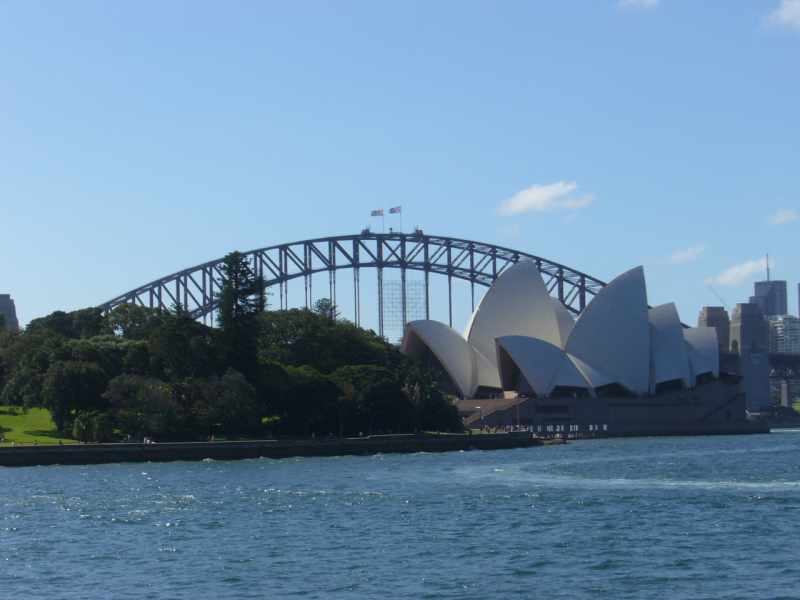
I arrived in Sydney on Saturday January 28 to celebrate Chinese New Year with my mother and a couple of my siblings. I usually try to catch a couple of concerts while I am in town, and have tickets for tonight’s concert and a performance of Madama Butterfly later in the week. Sydney Opera House is well known for its “sails” design, and the concert hall is well laid out with most of the audience sitting close to the stage. I had a good view of the stage. For tonight’s concert, the chamber orchestra consisted of about 20 persons, with a harpsichord, a baroque guitar, and a lute.

There is no charitable way to describe Kennedy clothes other than bizarre. One of the coat sleeve is cut short, I guess it at least serve the purpose of not impeding the movement of his right arm. There is also this sash around his neck of unknown significance. I refuse out of principle to purchase a program (for $7.50) that contains mostly advertisements, so if there is an explanation for what he is wearing, it will continue to elude me. To me it’s just an aging artist making a feeble and failed attempt at retaining his youthful looks and outlook. The rest of the orchestra members were dressed more traditionally though. Kennedy also chose to talk to the audience a bit about each piece of music. What he said contained some useful information, but his attempts at humor didn’t work, in my judgment.

Kennedy began by acknowledging tonight was Chinese New Year Eve and played a “new year song” which was actually a communist liberation song. Some Chinese in the audience were appreciative, I found it condescending. It also started my negative view of the concert which was further reinforced by the first Vivaldi piece. The violin concerto in A minor is relatively simple; most violin students take it up during their third year of lessons. It can be enjoyable when brilliantly played. But any flaw will be noticed and greatly magnified. Kennedy’s antics made me wonder whether he chose to put more emphasis on moving around the stage and stomping his boots rather than on playing serious music.

Australian audiences seem to have no problems with applauding in the middle of a work, they demonstrated that after the first movement of the D major violin concerto. I guess that’s okay if it was really exceptional, but doing that as a matter of course is a bit much. How the movements interrelate can be important too. The cadenza for this used similar techniques as that of the first concerto. Even though it was done well, one began to wonder if there are other technical flourishes (harmonics, double stops, etc) that would be displayed tonight.

After this concerto, Kennedy told the audience about the “Manchester Sonatas” that were discovered in the early 1970s. Four movements (Largo/Larghetto, Courant, Gigue, and Gavotte) were played by the violin, harpsichord (basso continuo), guitar, cello and doubling bass. Vivaldi scholars may find the music of great significance, but they didn’t sound particular to me.

Shelfali Pryor was introduced by Kennedy as one of the greatest oboist. Surely he jested. The oboe was overwhelmed by the small orchestra, coming through only during moments when a reduced set of musicians was playing. By this time I was debating whether I should give up on the concert and go home. It was a combination of my desire to stay up to fight jet lag, a stubbornness that makes people finish bad novels, and the fact the ticket cost (Australian) $97 that kept me in my seat.

As an encore piece for the oboe soloist, Kennedy’s own composition “Melody on Wind” was played. It contains a few nice motifs, but they were repeated again and again until the audience was tired of the droning. It is better to leave the audience wanting for more than to make them ask when the piece is going to be put out of its misery. (Not unlike many of my blogs, come to think of it.)

After the intermission, Kennedy added Nos. 1, 8, and 6 of Bach’s 2 part inventions. The pieces are simple, very fast, and well known respectively. These were played with the orchestra’s principal cellist (Tracy). I do respect Kennedy for his willingness to share the stage with mediocre musicians (for tonight, the oboist and cellist).

My initial reaction to the second violin (in the 2 double violin concertos) wasn’t all that positive. Michael Dauth did improve as the program progressed and was able to match Kennedy phrase for phrase; well, most of the time anyway. These 2 double concertos helped tremendously in salvaging the concert. The Largo movement of the C major one, according to Kennedy, describes the unrequited love of Vivaldi for a beautiful woman passing by his studio in a gondola. I repeat that here suspecting it is a made up story. The cadenza was impressive and brilliantly played, but again it’s the same recipe of flying staccatos and arpeggios.

The Bach allegro was then added to the program. It should be simple and clear architecturally, but the performers went back to sounding muddled.

Kennedy described an interesting fact about the Four Seasons: they were not composed at the same time but put together later, probably for commercial reasons. Nonetheless, “Summer” was generally done well, and showcased some of the techniques Kennedy is well known for: aggressive, fast, and brilliant sounds. At times he was a bit too ambitious with the speed and intonation suffered as a result.

As the evening’s encore they played another Kennedy composition “inspired by Jimmy Hendrix”. I am no Hendrix fan so I couldn’t tell how much inspiration there was. Again the piece contained interesting motifs made unbearable by endless repeats like the earlier “wind” piece. Kennedy led the orchestra off the stage Pied Piper style, and I thought it was a good time to head back to the hotel also.

Monday, January 16, 2006

New York Philharmonic. Jonathan Nott – guest conductor; Joshua Bell – violin. 1/14/2006.

Avery Fisher Hall at Lincoln Center. Preferred Orchestra. Seat DD19.

Program

Violin Concerto, “The Red Violin” (1997 – 2003) by John Corigliano (b. 1938).
An Alpine Symphony, Op. 64 (1911-15) by R. Strauss (1864-1949).

I watched the movie “The Red Violin” on TV sometime ago. It traced the 300-year history of a violin from its creation in 17th century Italy (Amati, Stradivari, and Guarneri are violin makers that come to mind) to its auction in Montreal. Morritz (played by Samuel L Jackson) was the bidder who discovered that the violin varnish had the blood of the violin maker’s wife who had just died. I don’t remember much of the story other than a mad British violinist, and that it was hidden during the Chinese cultural revolution so it wouldn’t be destroyed by the red guards as a bourgeois cultural relic. The violin music in the film was played brilliantly by Joshua Bell. The film came out in 1998

To the original Chaconne (a piece built on a series of chords) composed for the movie, John Corigliano added three additional movements (Pianissimo Scherzo, Andante Flautando, and Accelerando Finale) to create a complete virtuoso violin concerto. Even having seen the movie, I still had trouble associating the music with the story. This piece can be enjoyed as a purely virtuoso piece anyway. It asks a lot from the soloist, double stops, double stop glissandos, and double harmonics; speed and intonation are taken for granted. The orchestration for the concerto is complex, although they reduced the string section considerably. The 1713 “Gibson ex Huberman” Stradivarius sounded brilliant and carried very well. Bell did have a shaky entrance (double stops) and sometimes the orchestra simply overwhelmed the solo violin during its runs.

As someone who plays the violin, I was more fascinated by the sounds and techniques than the music itself. The cadenza in the first movement was interesting, especially at the end with the violin using the wood of the bow and pizzicato answered by different sections of the orchestra. The second movement was short and contained some difficult double harmonics passages. It sounded a bit discombobulated, though. In the third movement there was supposed to be this passage where the violin sounded like a flute in a duet with an alto flute. I frankly didn’t catch it; Anne thought she heard it for a fleeting moment. The fourth movement had a violin line that sounded very baroque and etude-like, but the steady beat in the background gave an overall strange effect. This piece needs to be listened to multiple times before it can be fully appreciated.

There was a long pause after the first movement so late comers could be seated. This is the first time I experienced this sort of disruption at a New York Philharmonic concert. This was inconsiderate to the performers and unfair to those in the audience who made it on time. I hope they at least got the performers’ consent before they did so. One time I sat out the entire first half because I missed the opening. And the coughing. The program notes mentioned Ricola cough drops quite prominently, but the advertising budget evidently did not include easy access to the actual cough drops. I looked for them and couldn’t find any.

The program notes contain an interesting paragraph on how Richard Strauss originally wanted to make the Alpine Symphony into some sort of an “Antichrist” declaration (perhaps more “God is dead?”) but ended up simply with a symphonic poem depicting one man’s day trip up the mountain and back. The continuous piece contains over 20 episodes depicting the various events during the day. The episodes include: sunrise, ascent, stream, waterfall, glacier, dangerous moments, mists, storm, and sunset. (A detailed list can be found in the notes.)

The full orchestra was employed for the symphony. To start, there was a large contingent of brass instruments depicting a hunting party off stage. Every conceivable instrument was used in the symphony, including cowbells (which Anne pointed out during the “Pastures” episode), a wind machine and an organ. The strings returned in full force, increasing the pairs of outside first violins to six from four for the earlier violin piece. We were seated in the Orchestra section; while the seats were closer to the stage, we didn’t have as good a bird’s eye view compared to what we had while in the first or second tier, so we missed a lot of the visual action in the orchestra, particularly the percussion section. There was a huge piece of metal plate hanging from the ceiling, though. We had high expectations of the thunder sound it would make, but it was much softer than I expected.

Nonetheless, this was a very enjoyable piece. One could easily imagine how the different episodes depict the different scenarios. Think Beethoven's Pastoral Symphony. For a first time listener (like us), one would probably be making the wrong associations. But that should not detract from the enjoyment: so what if the waterfalls were mistaken for a ghost? With additional hearings these associations would be clearer, It takes real desire and discipline to find the time to listen to this 56-minute piece though.

A few words about the conductor, who made his debut with the New York Philharmonic for these performances. He is British born and made his conducting debut in 1988. He conducted the Strauss piece without music, which is very impressive, considering the complexities of the piece. He used a lot of wrist movements, resulting in gestures that appeared slightly unsettling. The orchestra produced a very nice sound, though.

This was a memorable concert. I am glad we went.