Monday, March 06, 2006

New York Philharmonic – Ludovic Morlot, conductor; Frank Peter Zimmerman, violin. 3/4/2006.

Avery Fisher Hall at Lincoln Center; Second Tier, Seat DD107.

Program
Allegro scorrevole (1996) by Elliott Carter (b. 1908).
Symphony No. 4 in D minor, Op. 120 (1841/1851) by Schumann (1810-56).
Violin Concerto in D major, Op. 77 (1878-79) by Brahms (1833-97).

We were in New York City early, so we attended the pre-concert lecture. The lecturer for today was David Wallace, who teaches at Julliard and the New York Philharmonic. He talked about rhythmic vitality and the different techniques Schumann and Brahms used to achieve it, illustrating his point with some excerpts from the Symphony and the Violin Concerto. And he talked about Carter in rather glowing terms, saying how he brings out the best in the various instruments, and how interesting the piece would be to listen to. Both Wallace and the program notes mention the wispy end to Carter’s piece. It was quite an interesting lecture. Perhaps the New York Philharmonic should make these lectures free and thus available to more people. As it is, 60 or so attendees at $5 per head doesn’t amount to much.

Tonight’s conductor was a stand-in for Christoph von Dohnanyi, who had to withdraw because of illness. I had never heard of Morlot before, the program notes say he is French, and is currently an assistant conductor at Boston Symphony Orchestra. The Carter piece, meaning a “flowing allegro”, was commissioned by Dohnanyi. Perhaps the piece would have sounded better with Dohnanyi conducting, but tonight it sounded simple, monotonous, and the melody (or what passes as such in these contemporary pieces) didn’t go “on and on” as Wallace put it during the lecture. The bursts of energy every now and then couldn’t salvage the otherwise muted piece. The ending, a short ascending phrase by the piccolo, to me didn’t sound wispy or interesting at all.

We actually heard another of Carter’s piece, the Holiday Overture, in October, 2005. I don’t remember the piece well, but I did write rather glowingly about it, calling it surprisingly tonal and folksy. The Holiday Overture (1944) was written about 50 years before tonight’s piece was, all this mathematical construction, rhythmic modulation, and other techniques Carter brought to his "newer" composition just made it more out of reach for me.

I am not a great fan of Schumann, no doubt in part due to my not having listened to him much. My expectations for tonight’s piece were somewhat shaped by the lecture: listen for the rhythmic techniques, and contrast his work with that of Carter’s. Schumann died at age 46, suffering from mental illness. He didn’t start composing symphonies until 1841, and the D minor symphony was started during that year. After an unsuccessful premiere, it was withdrawn and the revised work wasn’t performed until 1852, and he continued to work on it for two more years. Thus this symphony “covers Schumann’s career as a symphonist nearly from its beginning to its end – which, unfortunately, was a span that scarcely exceeded a decade.” (Quoting from the Program Notes.)

The piece turned out to be quite interesting. It was in four movements played without pause: Fairly slow- lively; Romance: Fairly slow; Scherzo: Lively; Slow – Lively – Faster – Presto. The movements were clearly demarcated, and contained several nice solos by various instruments. It was interesting to contrast how motifs are developed in Schuamann’s piece with Carter’s attempt to mold a long continuous melody.

Morlot’s conducting seemed much improved for the Schumann symphony. Perhaps it is unfair to judge him by the Carter piece as it is technically difficult and probably required a more experienced conductor. Morlot seemed much less mechanical in how he approached the symphony. The orchestra generally played with precision, although there were a couple of instances that some in the orchestra came in early (this also happened with the Brahms piece). The dynamic range could be broader for my taste.

I like the Brahms Violin concerto, even though it is a bit long at 40 minutes. The piece was dedicated to the great violinist Joseph Joachim whom Brahms consulted extensively.

Zimmerman plays a 1711 Stradivarius which once belonged to Fritz Kreisler. I have heard quite a few Strads before (every well-known violinist, except Midori, seems to play one), but this has to be the best sounding one I have heard so far. While the volume wasn’t loud, it projected very well against the orchestra; at no point was the violin drowned out by the orchestra.

Zimmerman had a good technical approach to the concerto, and made a beautiful sound with his violin. The Joachim cadenza was unfortunately interrupted by much coughing in the audience. The Brahms violin concerto is a virtuoso piece with a great orchestra part. The relative long introduction in the first movement (Allegro non troppo) can stand on its own as an orchestral piece. It was a bit disappointing that towards the end of the first movement things sounded a bit stretched.

According to the Program Notes, Sarasate once said he would never play the Brahms concerto because of his view that during the second movement (Adagio) the violinist “would stand there … while the oboe plays the only melody in the entire work.” Indeed the oboe had a nice melodic introduction, but this has to be one of the most beautiful movements in the violin repertoire, with well-balanced violin and orchestra parts. And it was quite well done tonight.

The third movement (Allegro giocoso, ma non troppo vivace – Poco piu presto) began with a strong statement from the violin. Wallace talked about the use of “triple stops” first popularized by Bruch about 10 years before, and one could indeed hear the similarities. As with many last movements in concertos, this movement was the most exciting of all, but the orchestra playing was a bit muddled.

For the encore, Zimmerman played a slow Bach partita (not completely sure). It showcased the beautiful sound of the Strad, but was a relatively easy piece (technically and musically).

A concert that by-and-large lived up to its potential.

Monday, February 20, 2006

Metropolitan Opera – Saint-Saen’s Samson et Dalila. 2/17/2006.

Metropolitan Opera at Lincoln Center – Dress Circle, Seat D19.

Conductor – Emmanuel Villaume; Samson – Clifton Forbis, Dalila – Marina Domashenko, Abimelech – James Courtney; The High Priest – Jean-Philippe Lafont; An Old Hebrew – Kwangchul Youn.

Story: Samson leads the Hebrews in a successful rebellion against the Philistines. Dalila, spurned by Samson, conspires with the Philistines to find out about Samson’s secret and subsequently renders him powerless. When Samson is brought out to the temple of Dagon, he asks God for strength and topples the temple by bringing down a pillar.

This is a familiar story with a major twist. In the opera Dalila (Delilah) was motivated more by unrequited love than by her allegiance to her people. This should make for a more treacherous plot, but somehow it didn’t come through in tonight’s performance. Whether that was due to the opera, the performers, or my lack of perception, I cannot tell.

The overture to Act I led to a long choral number. The singing was a bit unsteady at first, perhaps understandable given the large number of singers involved. The program notes compares this to the oratorios of Handel and Mendelssohn, indeed the choral music sounded complete and had climaxes of its own. The stage set for Act 1 was very simple, although the corn field at the end of Act 1 was cleverly designed. We don’t understand why Abimelech’s clothes had all these hand prints on them; nor do we understand why his nails were so long – but they made for an interesting spectacle. Dalila appeared about 30 minutes into the opera. The trio sung by her, Samson, and the old Hebrew on temptation and resistance was at times a bit confusing. At the conclusion of the Act, I found myself agreeing with one of Saint-Saen’s critics (as quoted in the program notes): “Never has any drama so completely lacked melody as this one, ….” Nonetheless I found the Act quite fascinating. Forbis had a good voice; Domashenko’s was a bit weak in the lower registers.

The setting for Act 2 was strange. The main props were three tepees or cones of unknown significance. In sharp contrast to Act 1 where the chorus had a major role, Act 2 was mostly taken up by Dalila, Samson, and the High Priest; the only exception was the Philistines approaching Samson stealthily at the end. The supposed scheming, hatred, and vengefulness were not quite there. Dalila didn’t appear tormented enough; actually the famous aria “Mon Coeur s’ouvre a ta voix” was wistful and pleasant, and sounded more out of love than treachery.

There was a long intermission (more than 30 minutes) between Acts 2 and 3. Scene 1 was very simple, with Samson turning the mill by himself. Act 2 took place inside the temple of Dagon. It began with a dance by a large troupe accompanied by the Bacchanale which is quite well-known. The choreography is modern, and was pleasant enough to watch – but there was a bit too much falling backwards though. The program notes contrasts the lack of dignity in “Dagon se revele” with Samson’s prayer for strength. To me the former sounded like Ravel’s bolero. When Dalila mocked Samson, she recalled many of the motifs in the love song in Act 2. Eventually the music turned quite ominous as Samson was led to the column and brought it down. I thought the collapse could have been more spectacular, especially since this was a Met production.

Perhaps that is a fitting description of tonight’s performance: everything was good, but you just thought they could have done a little better.

Thursday, February 16, 2006

New York Philharmonic. The Magic of Mozart Festival. Lorin Maazel, Conductor. 2/11/2006.

Avery Fisher Hall at Lincoln Center. Prime Orchestra, Seat W4.

Program
Symphony No. 39 in E-flat major, K. 543 (1788) by Mozart (1756-1791).
Symphony No. 40 in G minor, K. 550 (1788).
Symphony No. 41 in C major, K. 551 (1788).

2006 marks the 250th birthday of Mozart (born January 27, 1756), and the New York Philharmonic put out a three-week celebration of the event. Tonight’s performance comprised of his last three symphonies. They were all composed within a span of three months, averaging one movement every five days or so.

The first movement (Adagio – Allegro) of No. 39 began with a stately adagio opening, which seems a popular way for Mozart to start his compositions. I thought the orchestra sounded a bit too heavy for the light-hearted theme. New York Philharmonic usually doesn’t have the precision of, say, a Boston Symphony Orchestra, but I thought tonight it was sloppier than usual. The second movement (Andante con moto) had the Andante but not the “con moto”, it seemed a bit slow. The third movement (Menuetto – Trio) was delightful but still sounded a bit on the heavy side. Perhaps the impending snowstorm weighed on the orchestra? (Turns out over the next day or so NYC had record snowfall.) I am embarrassed to say that I didn’t catch the “alpine melody” described in the program notes. The last movement (Allegro) sounded unsteady at first but ended up being quite pleasant.

By this time we noticed that the lady behind us had fallen asleep. Her sleep was briefly interrupted by the applause after the conclusion of this symphony. Don’t despair, she promptly went back to her light snoring at the start of the next symphony. Is there a proper etiquette in situations like this? Is it okay to drop something so the noise would wake her up?

The orchestra did much better with No. 40. The movements are: Molto allegro, Andante, Menuetto, and Allegro assai. Maazel can go through a Mahler symphony without breaking a sweat, but tonight’s gestures seemed a bit too animated for the music. Anne also pointed out this viola player that was so into it (his face was red) that we thought he might collapse from the excitement. The second movement had many nice phrases of Mozart’s trademark repeated notes, but dragged on a bit. The program notes mentions this 12-note (minus the key note of G) short passage in the last movement. I am glad I caught it; but it was a bit like listening to the entire opera Turandot to catch the 3-minute aria Nessun Dorma.

Of the three symphonies, the Jupiter must be the most popular of all. The first movement (Allegro vivace) contained a lot of descending scales in addition to the repeated notes. The strings were muted for the second movement (Andante cantabile) which contains several pleasant melodies. The last two movements (Menuetto and Molto allegro) brought the performance to a good (but not great) ending. Even at their most complex, Mozart’s symphonies still sound simple because of limited use of woodwind and brass instruments; and there is one percussion instrument – the timpani. I say that despite the presence of a “breathtaking display of quintuple counterpoint that renders the listener slack-jawed” (paraphrasing the program notes). Although it is quite seldom that double basses get to get in the act as they did in this instance.

Due to the popularity of his music, it’s difficult to write about a Mozart performance unless it is a botched one. There certainly was not any major botching tonight, but I did find quite a few problems with the performance. I am of the opinion that Mozart should be played lightly and crisply: think a piano sonata played without any use of the pedals. Tonight’s performance did not quite live up to that standard.

And there is this thing about too much of a (good) thing. Each of the three symphonies would be a delightful piece to listen to; but all three in a row …

Oh, one other thing. I have concluded there is not one perfect seat in the entire Avery Fisher Hall. Tonight we were in the Prime Orchestra section, so we have a good view of the players, but the woodwind, brass, and percussion sections were invisible. In the tiers (First and Second) one gets a good bird’s eye view, but is seated too far back so binoculars are needed.

Sunday, February 05, 2006

Opera Australia - Puccini's Madama Butterfly. 2/1/2006.

Sydney Opera House Opera Theater. Seat Stall B30.

Conductor – Andrea Licata; Madama Butterfly – Elena Prokina; B. F. Pinkerton – Rosario La Spina; Suzuki – Sally-Anne Russell; Sharpless – John Pringle; Goro – Graeme Macfarlane.

Story: Cio-Cio San (Butterfly) marries B. F. Pinkerton, a U.S. naval officer. Butterfly takes her vows seriously and patiently awaits Pinkerton’s return with her son and her servant Suzuki. When he returns 3 years later, he brings with him his new wife from America. Butterfly commits suicide so her child can be brought to the U.S. to be cared for by Pinkerton.

This is the second time I saw Madama Butterfly in Sydney. While the sets remain by-and-large the same, the stage acting was quite different. Most productions have Butterfly committing suicide off stage, but this one had her doing the sad deed front and center. They didn’t bother to use artificial blood though.

Athough the story is admittedly over-the-top melodramatic, I have to say I really enjoyed the opera. In anticipation, I brought along the score to study on the plane ride over, and listened to the entire opera once again on my iPod walking around Sydney. I went with several other people, and they all enjoyed it.

This time we were seated in the second row, so we had a good view of the stage and the orchestra (the Australia Opera and Ballet Orchestra). Conducting by Andrea Licata was precise and intense, accompanied by heavy breathing on the up beat. I wished he would calm down for some of the passages though. As it was, the orchestra often drowned out the softer arias. I was quite disappointed at the way the humming chorus was rushed through, though. A downside for being close is we nearly all got whiplash tilting our heads up and down to see the subtitles (Australians call them surtitles).

It should have been a real stretch for Elena Prokina, who appeared to be in her late 30s (let’s be charitable), to play a 15-year old Japanese Geisha, somehow I overlook that as the opera progressed. Her voice was pleasant, and I really enjoyed the soft passages, but she seemed to have trouble reaching some of the high notes (B-flat or C, I am not sure). Nonetheless, she managed to put in a performance strong enough to make this a memorable production. Rosario La Spina, who played the role of Pinkerton, had a strong voice. Unfortunately, he seemed more intent in showing off his own singing talents and didn’t mind drowning out other people.

The Opera Australia Chorus was a bit shaky and off-key when they first appeared with Cio-Cio San. Otherwise they were quite solid.

Both Suzuki and Sharpless (played by Sally-Anne Russell and John Pringle respectively) put in strong performances. The duets Suzuki sang with Butterfly were well done. Sharpless added one of the few light moments in the evening by feigning how difficult it was for him to sit on a mat.

The staging, while cleverly designed, was a bit too simple. In some other productions I have seen of this opera, they at least bothered to haul Yamadori around in a rickshaw! More elaborate staging definitely would have added to the production.

In contrast to Sydney concert audiences (see my earlier blog on the Nigel Kennedy concert), tonight’s audience was extremely reserved. They applauded sparingly during the show (one noted exception: after Butterfly sang “un bel di vedremo”, an aria I wish she had taken more slowly and more wistfully). Given how enthusiastic they were after each act, they were undoubtedly very appreciative. The actors and musicians put everything they had into the opera. One of the dancers slipped on the rose petals but recovered quickly. I am sure he had bruises on him from the fall.

Madama Butterfly is a sympathetic figure and Puccini’s music is as usual extremely nice to listen to, although at times I wish he had put in a few more of the great melodies he was capable of. Even though tonight’s performance had some considerable flaws, it was nonetheless very enjoyable.

See also the Sydney Morning Herald review of the opera.

Monday, January 30, 2006

Nigel Kennedy Plays Vivaldi; Sydney Symphony Chamber Orchestra “All Stars”. 1/28/2006.


Sydney Opera House Concert Hall. Seat Box B40.

Program
Concerto in A minor for violin, strings and harpsichord RV356 by Antonio Vivaldi (1678-1742).
Concerto in D major for violin, strings and harpsichord RV230.
Concerto in B flat major for violin, oboe, strings and harpsichord RV548.
Concerto in D major for 2 violins, strings and harpsichord RV507.
Concerto in C major for 2 violins, strings and harpsichord RV511.
Concerto in G minor (Summer from the Four Seaons) for violin, strings and harpsichord RV315.

With the many extra pieces added to the published program, this ended up being a 3 hour concert (including a 25 minute intermission). Nigel Kennedy is a well-known violinist, his Four Seasons CD opened my eyes to new dimensions to Vivaldi’s music, thus I went to the concert with great expectations. Unfortunately, the concert was mostly a series of mediocre performances broken up by moments of brilliance. It was too bad as Kennedy could have chosen to take the concert more seriously rather than indulge in crowd-pleasing antics that detracted from the music.

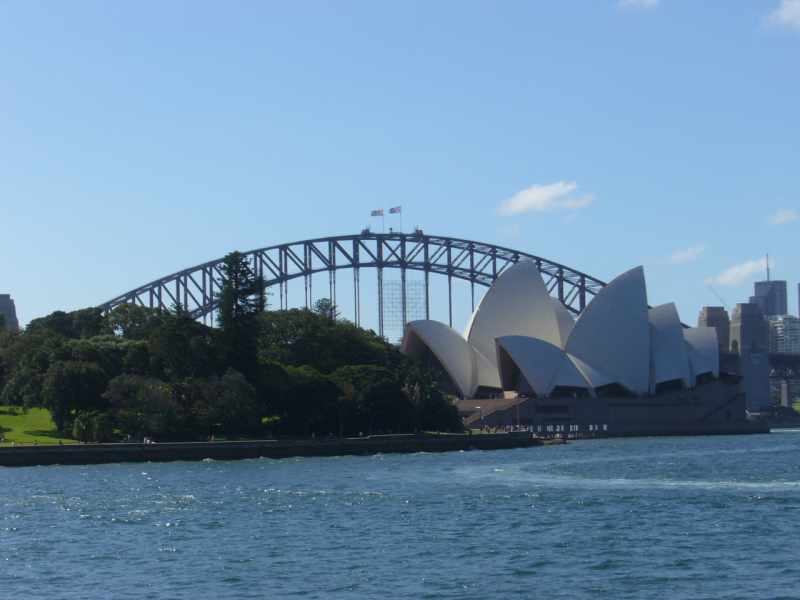
I arrived in Sydney on Saturday January 28 to celebrate Chinese New Year with my mother and a couple of my siblings. I usually try to catch a couple of concerts while I am in town, and have tickets for tonight’s concert and a performance of Madama Butterfly later in the week. Sydney Opera House is well known for its “sails” design, and the concert hall is well laid out with most of the audience sitting close to the stage. I had a good view of the stage. For tonight’s concert, the chamber orchestra consisted of about 20 persons, with a harpsichord, a baroque guitar, and a lute.

There is no charitable way to describe Kennedy clothes other than bizarre. One of the coat sleeve is cut short, I guess it at least serve the purpose of not impeding the movement of his right arm. There is also this sash around his neck of unknown significance. I refuse out of principle to purchase a program (for $7.50) that contains mostly advertisements, so if there is an explanation for what he is wearing, it will continue to elude me. To me it’s just an aging artist making a feeble and failed attempt at retaining his youthful looks and outlook. The rest of the orchestra members were dressed more traditionally though. Kennedy also chose to talk to the audience a bit about each piece of music. What he said contained some useful information, but his attempts at humor didn’t work, in my judgment.

Kennedy began by acknowledging tonight was Chinese New Year Eve and played a “new year song” which was actually a communist liberation song. Some Chinese in the audience were appreciative, I found it condescending. It also started my negative view of the concert which was further reinforced by the first Vivaldi piece. The violin concerto in A minor is relatively simple; most violin students take it up during their third year of lessons. It can be enjoyable when brilliantly played. But any flaw will be noticed and greatly magnified. Kennedy’s antics made me wonder whether he chose to put more emphasis on moving around the stage and stomping his boots rather than on playing serious music.

Australian audiences seem to have no problems with applauding in the middle of a work, they demonstrated that after the first movement of the D major violin concerto. I guess that’s okay if it was really exceptional, but doing that as a matter of course is a bit much. How the movements interrelate can be important too. The cadenza for this used similar techniques as that of the first concerto. Even though it was done well, one began to wonder if there are other technical flourishes (harmonics, double stops, etc) that would be displayed tonight.

After this concerto, Kennedy told the audience about the “Manchester Sonatas” that were discovered in the early 1970s. Four movements (Largo/Larghetto, Courant, Gigue, and Gavotte) were played by the violin, harpsichord (basso continuo), guitar, cello and doubling bass. Vivaldi scholars may find the music of great significance, but they didn’t sound particular to me.

Shelfali Pryor was introduced by Kennedy as one of the greatest oboist. Surely he jested. The oboe was overwhelmed by the small orchestra, coming through only during moments when a reduced set of musicians was playing. By this time I was debating whether I should give up on the concert and go home. It was a combination of my desire to stay up to fight jet lag, a stubbornness that makes people finish bad novels, and the fact the ticket cost (Australian) $97 that kept me in my seat.

As an encore piece for the oboe soloist, Kennedy’s own composition “Melody on Wind” was played. It contains a few nice motifs, but they were repeated again and again until the audience was tired of the droning. It is better to leave the audience wanting for more than to make them ask when the piece is going to be put out of its misery. (Not unlike many of my blogs, come to think of it.)

After the intermission, Kennedy added Nos. 1, 8, and 6 of Bach’s 2 part inventions. The pieces are simple, very fast, and well known respectively. These were played with the orchestra’s principal cellist (Tracy). I do respect Kennedy for his willingness to share the stage with mediocre musicians (for tonight, the oboist and cellist).

My initial reaction to the second violin (in the 2 double violin concertos) wasn’t all that positive. Michael Dauth did improve as the program progressed and was able to match Kennedy phrase for phrase; well, most of the time anyway. These 2 double concertos helped tremendously in salvaging the concert. The Largo movement of the C major one, according to Kennedy, describes the unrequited love of Vivaldi for a beautiful woman passing by his studio in a gondola. I repeat that here suspecting it is a made up story. The cadenza was impressive and brilliantly played, but again it’s the same recipe of flying staccatos and arpeggios.

The Bach allegro was then added to the program. It should be simple and clear architecturally, but the performers went back to sounding muddled.

Kennedy described an interesting fact about the Four Seasons: they were not composed at the same time but put together later, probably for commercial reasons. Nonetheless, “Summer” was generally done well, and showcased some of the techniques Kennedy is well known for: aggressive, fast, and brilliant sounds. At times he was a bit too ambitious with the speed and intonation suffered as a result.

As the evening’s encore they played another Kennedy composition “inspired by Jimmy Hendrix”. I am no Hendrix fan so I couldn’t tell how much inspiration there was. Again the piece contained interesting motifs made unbearable by endless repeats like the earlier “wind” piece. Kennedy led the orchestra off the stage Pied Piper style, and I thought it was a good time to head back to the hotel also.

Monday, January 16, 2006

New York Philharmonic. Jonathan Nott – guest conductor; Joshua Bell – violin. 1/14/2006.

Avery Fisher Hall at Lincoln Center. Preferred Orchestra. Seat DD19.

Program

Violin Concerto, “The Red Violin” (1997 – 2003) by John Corigliano (b. 1938).
An Alpine Symphony, Op. 64 (1911-15) by R. Strauss (1864-1949).

I watched the movie “The Red Violin” on TV sometime ago. It traced the 300-year history of a violin from its creation in 17th century Italy (Amati, Stradivari, and Guarneri are violin makers that come to mind) to its auction in Montreal. Morritz (played by Samuel L Jackson) was the bidder who discovered that the violin varnish had the blood of the violin maker’s wife who had just died. I don’t remember much of the story other than a mad British violinist, and that it was hidden during the Chinese cultural revolution so it wouldn’t be destroyed by the red guards as a bourgeois cultural relic. The violin music in the film was played brilliantly by Joshua Bell. The film came out in 1998

To the original Chaconne (a piece built on a series of chords) composed for the movie, John Corigliano added three additional movements (Pianissimo Scherzo, Andante Flautando, and Accelerando Finale) to create a complete virtuoso violin concerto. Even having seen the movie, I still had trouble associating the music with the story. This piece can be enjoyed as a purely virtuoso piece anyway. It asks a lot from the soloist, double stops, double stop glissandos, and double harmonics; speed and intonation are taken for granted. The orchestration for the concerto is complex, although they reduced the string section considerably. The 1713 “Gibson ex Huberman” Stradivarius sounded brilliant and carried very well. Bell did have a shaky entrance (double stops) and sometimes the orchestra simply overwhelmed the solo violin during its runs.

As someone who plays the violin, I was more fascinated by the sounds and techniques than the music itself. The cadenza in the first movement was interesting, especially at the end with the violin using the wood of the bow and pizzicato answered by different sections of the orchestra. The second movement was short and contained some difficult double harmonics passages. It sounded a bit discombobulated, though. In the third movement there was supposed to be this passage where the violin sounded like a flute in a duet with an alto flute. I frankly didn’t catch it; Anne thought she heard it for a fleeting moment. The fourth movement had a violin line that sounded very baroque and etude-like, but the steady beat in the background gave an overall strange effect. This piece needs to be listened to multiple times before it can be fully appreciated.

There was a long pause after the first movement so late comers could be seated. This is the first time I experienced this sort of disruption at a New York Philharmonic concert. This was inconsiderate to the performers and unfair to those in the audience who made it on time. I hope they at least got the performers’ consent before they did so. One time I sat out the entire first half because I missed the opening. And the coughing. The program notes mentioned Ricola cough drops quite prominently, but the advertising budget evidently did not include easy access to the actual cough drops. I looked for them and couldn’t find any.

The program notes contain an interesting paragraph on how Richard Strauss originally wanted to make the Alpine Symphony into some sort of an “Antichrist” declaration (perhaps more “God is dead?”) but ended up simply with a symphonic poem depicting one man’s day trip up the mountain and back. The continuous piece contains over 20 episodes depicting the various events during the day. The episodes include: sunrise, ascent, stream, waterfall, glacier, dangerous moments, mists, storm, and sunset. (A detailed list can be found in the notes.)

The full orchestra was employed for the symphony. To start, there was a large contingent of brass instruments depicting a hunting party off stage. Every conceivable instrument was used in the symphony, including cowbells (which Anne pointed out during the “Pastures” episode), a wind machine and an organ. The strings returned in full force, increasing the pairs of outside first violins to six from four for the earlier violin piece. We were seated in the Orchestra section; while the seats were closer to the stage, we didn’t have as good a bird’s eye view compared to what we had while in the first or second tier, so we missed a lot of the visual action in the orchestra, particularly the percussion section. There was a huge piece of metal plate hanging from the ceiling, though. We had high expectations of the thunder sound it would make, but it was much softer than I expected.

Nonetheless, this was a very enjoyable piece. One could easily imagine how the different episodes depict the different scenarios. Think Beethoven's Pastoral Symphony. For a first time listener (like us), one would probably be making the wrong associations. But that should not detract from the enjoyment: so what if the waterfalls were mistaken for a ghost? With additional hearings these associations would be clearer, It takes real desire and discipline to find the time to listen to this 56-minute piece though.

A few words about the conductor, who made his debut with the New York Philharmonic for these performances. He is British born and made his conducting debut in 1988. He conducted the Strauss piece without music, which is very impressive, considering the complexities of the piece. He used a lot of wrist movements, resulting in gestures that appeared slightly unsettling. The orchestra produced a very nice sound, though.

This was a memorable concert. I am glad we went.

Sunday, January 08, 2006

New York Philharmonic - Lorin Maazel, conductor; James Ehnes, Violin. 1/7/2006.

Avery Fischer Hall at Lincoln Center; Second Tier, Seat BB21.

Program

Overture to The Flying Dutchman (1840-41, rev. 1860) by Wagner (1813-83).
Violin Concerto (1936-39, rev. 1943/50) by Walton (1902-83).
Symphony No. 7 in D minor, Op. 70 (1884-85) by Dvorak (1841-1904).

I had never heard the Walton and Dvorak pieces before. I did read up on the program notes beforehand and knew Walton wrote the violin concerto for Jascha Heifetz and it is considered a virtuoso and intimate composition. Dvorak’s seventh symphony is not as popular as his ninth (New World) but is considered to be on par with works of Beethoven and Brahms. I didn’t know the violinist Ehnes either. He was born in Canada, about 29 years old, and has built up quite a resume playing with well known musicians and orchestras.

Wagner’s “The Flying Dutchman” is his fourth opera and the first to be well-known. It is a mythical story about a Dutchman condemned to sail the seas until he finds a faithful lover. The overture is quite long at about 11 minutes, contains the themes of the main characters, and is supposed to evoke images of waves and oceans. Overall, I thought the performance lacked dynamic range, and the horns were at times unsteady. I am not sure it painted a nautical theme either.

The Walton concerto is in three movements: Andante tranquillo, Presto capricciosa alla napolitana and Vivace). My overall impression is indeed it is a virtuoso piece without being overtly so. The concerto is well balanced between the soloist and the orchestra. The program notes said Walton’s music was greatly influenced by Elgar; unfortunately I couldn’t hear the similarities. Not knowing Elgar well didn’t help. Even though a Stradivarius (1715 “Ex Marsick”) was used, and despite the promising early beginning, the solo violin was oftentimes drowned out by the orchestra. Somehow I got the feeling for various reasons the soloist wasn’t into the piece.

The Dvorak symphony lived up to its billing: it indeed sounded “taut and rigorous”. The four movements are Allegro maestoso, Poco adagio, Vivace – Poco meno mosso, and Allegro. There was no break between the third and fourth movements. I continue to be surprised how traditional Dvorak’s music is compared to his contemporaries (e.g., Mahler, although Mahler was younger). There is no percussion except for the timpani. The themes are clear and well-defined. Only exception was in the third movement where multiple themes were presented simultaneously. Unfortunately the orchestra sounded a bit muddled during those episodes. The development of the symphony form from Beethoven to Brahms to Dvorak, and even to Rachmaninoff, seemed to be gradual. And then we have composers such as Mahler and Shostakovich who seemed to take off in completely different directions. A fascinating topic to explore.

Tonight’s concert was okay, but not great. It was quite well attended, though.

See also the New York Times review. The reviewer had a completely different impression of how well the brass played in Wagner’s Overture.

Sunday, January 01, 2006

2006 First Night Boston. 12/31/2005.


NEC Youth Symphony, “The Story of Peer Gynt”. St. Paul’s Cathedral, Boston.
Opera unMet, “Aida”. First Baptist Church of Boston.

Anne and I are staying in Boston for New Year’s Eve, and we decided to attend a couple of the 2006 First Night concerts. It had been unusually warm this week, although the temperature was at freezing tonight, and about ½" of snow fell in the evening, making it a rather enjoyable winter evening to be out and about. We attended two 40-minute concerts.

The two Peer Gynt suites by Edvard Grieg are quite well-known, except before today I didn’t know the story behind them. Tonight’s NEC (New England Conservatory) Youth Symphony performance had a story-teller (O’Callahan) to do some story-telling during the program. Peer Gynt was a lazy day-dreamer whose fantasies were set into music. I had no idea the different movements of the suites were so well matched to the legend of Peer Gynt. Anne had a much better knowledge of the music and knew about the mountain king and the trolls.

The program began and ended with Viennese New Year music (a waltz and a march), and had an “Auld Lang Syne” sing-along. The young people in the orchestra all played quite well. The orchestra could use a bit more dynamic range in the performance, though. This was a well-attended concert inside a nice Episcopalian church.

“Opera unMet” is a catchy name for a group of artists consisting of Aida, Amneris, Rademas, two priestesses, a narrator and a pianist. I wish they had passed out some program notes so we could get to know the performers a bit. The venue was the First Baptist Church, a very old church located on Commonwealth Avenue in Back Bay.

About a dozen arias from the opera were chosen for tonight. With the narration, a rather complete story was told beginning with Rademas singing his love for Aida (Celeste Aida) to the final trio “O terra, addio.” The three principal singers all had good voices, although Rademas’s was a bit on the weak side. I couldn’t tell if these were professionals, but they certainly held the audience with their performance. I was surprised they needed the music though. In any case, the songs are quite demanding, and these folks put on two 45-minute programs for the evening, and every now and then the strain showed.

Nonetheless, I couldn’t help remarking to Anne this was quite a way to start the New Year, listening to a story where two people got buried alive under a temple.

Saturday, December 31, 2005

Boston Ballet - Tchaikovsky's "The Nutcracker". 12/30/2005


Opera House, Boston, MA. Orchestra, Seat S2.

I do not know ballet. I can probably count the number of times I have seen a ballet performance on the fingers of one hand, and that includes TV programs. The two live performances I had seen before tonight’s were in St. Petersburg in the mid-1990s (perhaps it was the Kirov at the Mariinsky Theatre?) and in New Haven last year. Since last year’s was also The Nutcracker, there is a family Christmas tradition in the making.

The Opera House in Boston is quite an impressive building. The auditorium is quite large, with a huge upper level. It makes the Metropolitan Opera House in New York City look downright pedestrian. It is used for musicals also, which is unheard of at the Met. (Draw your own conclusions.)

Tonight’s performance was the last of 40 or so performances by the Boston Ballet, one can imagine they had to be a bit tired. I am sure they rotated among their principal dancers and soloists, so the wear and tear on the dancers should not be too bad. Still, doing the same program several times a week for over a month required tremendous dedication from the artists.

The story of The Nutcracker is simple. It begins with a Christmas party in Germany where a magician shows up, gives a toy soldier as a gift to Clara, who then falls asleep and is transported to a magical world with the soldier-turned-prince. In Act II the two sit in a big chair and different dances are performed; at the end Clara is transported back. Somewhat like The Wizard of Oz, except not as scary. Due to a fight scene involving many rats (mice?), the show is not recommended for children under 4. I was startled during intermission when the mouse king tapped me on my shoulder, but he left before I could say hello so one of his many admirers could have her picture taken with him.

The sets were elaborate and well-done. The snowfall was heavy (the program notes said it cost $16,000 to make). Clara was transported into the magical world with a balloon rather than the usual mundane sleigh. The Christmas tree that grew huge looked real. It reminded me of a Broadway show with well-designed stage sets.

The dancers were all quite impressive. I need to learn something about ballet techniques; before I do, I must say the athleticism, control, and artistry involved were amazing. The two principal dancers were particularly impressive, although there was a wobble now and then. The majority of Boston Ballet’s principal and soloist dancers are foreign born, which speaks either to the United States as being a place that attracts the best talents, or that the training system in the US is not producing enough world-class dancers; I wonder what it is.

I do know something about the music. The orchestra’s performance was a great disappointment. At first I wasn’t sure whether it was a live orchestra or a bad tape being played. They used microphones to pick up the sound from the orchestra, which was seated too low in the pit, and the sound system sounded as if it consisted of only two speakers. The playing was sloppy and muddled. The Nutcracker isn’t particularly difficult to do, which added to the puzzlement.

Much credit is due the dancers in that quite often I was so mesmerized with their performance that I forgot about the pitiful noise coming out from the tinny speakers. Boston Ballet should enforce their late seating policy, this gentleman in the next row came in late for both Acts, and left and returned during the first Act.

In mid-March both the Swan Lake and the Sleeping Beauty will be performed in Boston. We are seriously thinking of coming back to see them.

Friday, December 30, 2005

The Boston Pops Esplanade Orchestra – Bruce Hangen, conductor; The von Trapp Children. 12/28/2005.

Symphony Hall, Boston, MA; First Balcony, Seat C43.

Program

  1. A Christmas Festival arr. Anderson/Courage; Hanukkah Song; Carol of the Drum by Davis-Wright; Farandole from L’Arlesienne by Bizet; Selections from The Nutcracker by Tchaikovsky.
  2. The von Trapp Children
  3. Frosty All the Way arr. Sebesky; The Toy Trumpet by Scott; Parade of the Wooden Soldiers, from Chauve Souris by Jessel-Gould; Christmas Cajun-Style arr. Hollenbeck; A Merry Little Sing-Along arr Reisman.

I like Christmas music, sacred or secular. I like the music quiet, boisterous, joyous, nostalgic, simple, complex, reverent, or whatever. The religious aspect is important, and peace on earth isn’t such a bad idea either.

This holiday season Anne and I came up to Boston to stay at our son’s new place, and our daughter stayed with us for a few days also. We decided at the last minute to see the Boston Pops play Christmas music. The von Trapp children, great-grand children of the Captain von Trapp of The Sound of Music fame, would be singing also.

The Boston Symphony Hall is a rather small concert hall, and has a very ornate interior. The ceilings are very high, and the side walls are lined with statues. For Pops concerts, the have tables set up at the orchestra level so patrons can order food and drink during the concert. Somehow this does not seem very distracting, although they do ask the audience to turn off their cell phones. We were seated in the balcony with a near complete view of the stage. The attendance was good, and the crowd was in a festive mood.

The first piece was a medley of familiar Christmas carols and songs. It also defined how the evening was going to be like. The Pops orchestra is competent, but none of the evening’s pieces was technically or musically challenging, and I suspect people go to Pops concerts to enjoy themselves more than for a cultural experience anyway. They also threw in a Hanukkah song as this is one of the rare years that Christmas and Hanukkah fall on the same day. I couldn’t make out any harmonica-like passage in the story where Monica got a harmonica for Hanukkah. The first part of the program ended with a few selections from the Nutcracker Suite; the technical challenges actually highlighted some of the inadequacies of the orchestra (precision, clarity, balance).

Thanks mostly to Julie Andrews, The Sound of Music is known and loved throughout the world. Four of Captain von Trapp’s great grandchildren were on hand to sing selections from the musical and other songs. The children consisted of three girls Amanda (14), Melanie (15), and Sophie (17); and Justin (11). I was surprised that they spoke English without an Austrian accent (think Governor of California) until they said they lived in Montana. The girls were wearing dresses worn by “the originals” with some buttons over 100 years old.

I didn’t know what to expect of the singing. My first reaction was the singing genes of the great grandfather were diluted considerably after several generations, then I realized it was the singing of the actors in the movie that we remember. I don’t know how well Captain von Trapp sang. The songs they sang were enjoyable enough, and the one from Annie Oakley (“Anything you can do, I can do better”) was particularly delightful. Nonetheless, as my daughter pointed out, since these children must have voice coaches and perform all over the world, their performance was somewhat disappointing. I am sure the holiday spirit accounted for much of the enthusiastic applause from the audience.

The last part of the program was again orchestral pieces. “The Toy Trumpet” by Scott was quite interesting. The program ended with a sing-along of holiday melodies (mostly “a-religious”); and the von Trapp children returned to sing the “Goodbye Song.”

An evening that lived up to my modest expectations.

Sunday, December 18, 2005

Newton Community Chorus – Richard Travers, Music Director. 12/17/2005.


Our Lady Help of Christians Church, Newton, MA

Lesley Chen, Concertmaster; Janet Poisson, Soprano; Melinda Biocchi, Alto; Noah van Niel, Tenor; Stephen Mumbert, Baritone.

Program

Handel’s Messiah, Part I & the Hallelujah Chorus

We went to this concert because our daughter – she has lived in the Boston area since August - sings in the chorus. We didn’t quite know what to expect. The choruses in the oratorio are challenging, but are quite doable with reasonably competent singers. The orchestral part is also within grasp of a good community orchestra. Perhaps the most difficult task is to find soloists whose voices work well with the orchestra.

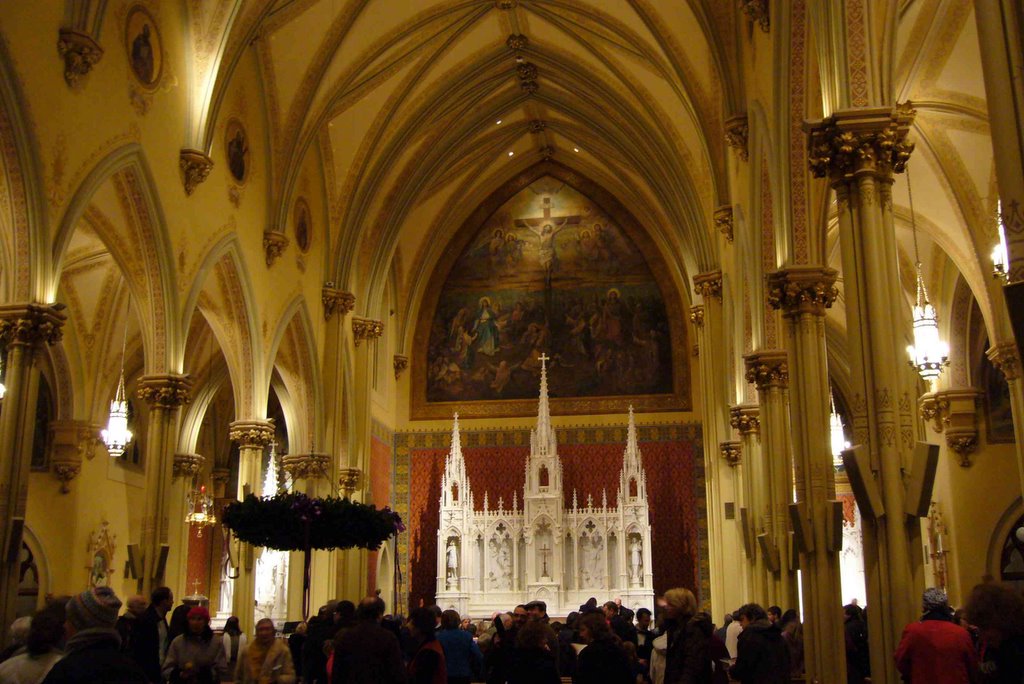
The church is huge and impressive; its cathedral ceilings reminded me of some European churches I have visited. The interior is bright, no doubt helped by the many lights installed in the ceiling and the light color paint. Mosaics of the apostles adorn the high arches supporting the ceiling. It must seat well over 1000 people; a few hundred people attended the concert, and generally lent a festive atmosphere to the evening.

By and large this was a well performed concert, if one makes allowances for this being a community chorus. The church’s acoustics worked quite well for the orchestra and for the chorus. We were seated towards the back, but still could hear very well. The sopranos had to reach a high B-flat, a challenge for most people. They by-and-large managed the high notes quite well, although at times the sound was strained. The many 16th note runs were done quite well, although they were a little on the slow side. The orchestra had a nice sound to it, and once it settled down, played with precision.

There were some major shortcomings, though. The chorus’s individual sections were quite competent, but the soprano voices dominated the other three parts, and the tenors and basses were particularly weak. Many amateur choruses don’t have enough male voices to balance the female ones, and the NCC appears to suffer from this problem. The conductor did his job rather mechanically, often evoking the image of a marching band leader. With an amateur chorus, the conductor could help out a lot by providing timely lead-ins. This was particularly evident in “For unto Us a Child is Born.” The tenors and basses could have used more help. My daughter told me he appeared to be better with the orchestra, although I didn’t notice it. He provided precise cues for the endings of phrases, though.

The first two solos were done by the tenor. My impression was while his voice was good and projected well, it lacked maturity and didn’t do justice to the air “Every Valley”. I then read the program notes and found out he must be only around 20 years old! Too bad for tonight’s performance these were the only two tenor pieces. The other soloists’ performances all had something to be desired: how their voices projected over the orchestra, volume, clarity, phrasing, and (especially in the case of the soprano) diction. Perhaps one should also point out these are all young people who will undoubtedly improve with more experience.

As a critic one has to conclude this concert had much to be desired. On the other hand, the more appropriate attitude is to enjoy a great choral piece by Handel during the Christmas season. And as such I enjoyed the concert very much. One could tell the chorus members performed with well-deserved pride at what they accomplished.

Sunday, December 04, 2005

New York Philharmonic – Ivan Fischer, guest conductor; Leonidas Kavakos, Violin. 12/3/2005.

Avery Fischer Hall at Lincoln Center; Second Tier, Seat DD16.

Program

Romanian Folk Dances, BB 76 (1915; orch 1917) by Bartok (1881-1945).
L’Arbre des songes Violin Concerto (1979-85) by Henri Dutilleux (b. 1916).
Symphony No. 2 in E minor, Op. 27 (1906-08) by Rachmaninoff (1873-1943).

We decided to attend this concert at the last minute since we had no plans for the rest of the evening after seeing the opera Carmen. I was not familiar with any of the pieces on the program this evening, so I was reading up on the program notes feverishly when we got into our seats. Perhaps the New York Philharmonic should consider putting up some season-appropriate music for this time of the year, but in any case, I was glad to have attended this concert. The concert hall was fuller than usual, no doubt with attendance boosted by the many tourists that are in the area during the Christmas season.

I didn’t know much about the conductor or the soloist. Fischer was born in Budapest in 1951, plays several instruments, studied in Vienna, and made his US debut with the LA Philharmonic in 1983. His current “regular” job appears to be the principal guest conductor of the National Symphony Orchestra in Washington, D.C. He certainly impressed with the ability to conduct the Rachmaninoff symphony (which was 56 minutes long) without music. Kavakos was born in Athens and is in his late 30s. He plays the 1692 “Falmouth” Stradivarius. The violin has a nice sound but does not project as well as some of the later Strads; this would prove to be a problem with a large orchestra and the demands of the piece.

It took more time to read the program notes on Bartok’s piece than to listen to it. The piece lasted all of 7 minutes and contains 7 different folk dances. I never know what to expect with Bartok, but I didn’t expect a “traditional” symphony orchestra with the absence of a percussion section. Perhaps it’s because the dances were orchestrated from his original work for the piano. The Stick Dance (Allegro moderato) defined the folksiness of the suite (without percussion), and is followed by the Sash Dance (Allegro) which was even shorter in duration. In One Spot (Andante) spotlighted the flute which played notes of a limited range, and the Horn Dance (Moderato) had a violin (not horn!) solo by Sheryl Staples that was done quite well. Staples had quite a few solo lines this evening and they were all done superbly. The Romanian Polka (Allegro) was fast paced. The simple, pleasant suite concluded with a couple of satisfying Fast Dances (L’istesso tempo, Allegro vivace).

The program quotes Dutilleux’s description of the violin concerto “as a piece that grows somewhat like a tree, for the constant multiplication and renewal of its branches is the lyrical essence of the tree. This symbolic image, as well as the notion of a seasonal cycle, inspired my choice of L’Arbre des songes as the title of the piece.” The four movements (Freely, Quick, Slow and Broad & Animated) are linked by three interludes.

This is one of the few concerto performances where the soloists need the music. And needed it he did: he seemed to be glued to it the whole time. The piece was quite chaotic, whether by design or from lack of practice, I don’t know. But I am sure the soloist was tuning his violin out loud during the third movement, and it wasn’t part of the plan. Nonetheless it sounded as if it belonged, so out of control was that part of the piece. The timpanist was surrounded by seven drums, although I’m not sure he used them all. During the fourth movement the violin was completely overwhelmed by the orchestra for several minutes before it regained its balance. At other times I felt the violinist was playing the piece like an etude.

The violin concerto is clearly written for the virtuoso, but is it good music? The program notes evoke Van Gogh’s Road with Cypress and Star. There may be glimpses of growth of branches in the piece, but most of the time it makes one think of wild weeds. Kovakos has won Sibelius and Paganini competitions, any piece by one of those composers would have been welcome.

I didn’t remember having heard any of Rachmaninoff’s Symphonies before. I have since discovered all three of his symphonies on my iPod, I guess that still doesn’t mean I have heard it before. This symphony is quite long at close to one hour and contributes to its not being heard often in live concerts. Rachmaninoff was so wounded by the unkind reviews of his first symphony (1897) that he needed the help of daily hypnosis sessions by a physician before he would start writing again. The second symphony was completed about 10 years later, and was received enthusiastically at its Moscow debut conducted by the composer himself.

The symphony contains quite a few solo phrases by various instruments and they were all done very well. The only movement I was vaguely familiar with was the third (Adagio), although I am not sure it’s from a CD I own or it was used in a movie. In general, the symphony contains nice melodies, highlights the different orchestral instruments appropriately, and has a nice structure to it. I don’t know my musicology well enough to know if any new composition ground was broken, it sounded traditional enough, especially for the time it was written.

Fischer conducted in an animated manner, and pointed to the different orchestral sections with conviction. He seems to be able to bring out the right sounds from the orchestra, although every now and then the performance was a bit chaotic.

All things considered, it was a pleasant concert. I would still prefer “simpler” holiday fare for this time of the year though.

See also the New York Times review of an earlier performance of the concert. The reviewer obviously appreciated the Dutilleux piece much more than I did.

New York Metropolitan Opera – Bizet’s Carmen 12/3/2005.

Metropolitan Opera at Lincoln Center – Dress Circle, Seat G105.

Conductor – Philippe Jordan; Carmen – Nancy Fabiola Herrera, Don Jose – Marcello Giordani, Escamillo – Erwin Schrott, Micaela – Ana Maria Martinez.

Story: Don Jose abandons his lover Micaela, mother, and military post to join Carmen as a bandit and smuggler. When after a while Carmen decides to go with the matador Escamillo, Don Jose stalks her and murders her outside of the bull-fighting arena.

Carmen and La Traviata (by Verdi) are two operas I would suggest to a first time opera goer. They both contain nice tunes, and the stories are easy to understand. Unfortunately both are tragedies; also, Carmen is quite long at about 3 ½ hours.

Most people think of Carmen when they think of Bizet. Indeed this is his most famous work. Bizet died at age 36, 3 months after the opening of the Opera, and never lived to see its success. Some arias were adapted from Spanish melodies, and many were Bizet’s own. In Bizet’s original work there was quite a bit of spoken dialog linking the arias together. He intended to but died before he could substitute these with recitatives. Today’s performance was the modified version, although no credit was given to Guiraud, Bizet’s friend who added the sung recitatives.

This was the third time we saw Carmen in recent years, and I still found it enjoyable. The sets were certainly interesting, and several horses, donkeys and dogs were used. The orchestra section was full for today's performance.

Micaela was introduced early in Act I. Martinez has a voice that seemed perfect for the role; the voice projected very well and had the innocence of a simple kind-hearted young woman. This character had only a small role in the original novella (by Prosper Merimee) but was a nice contrast to the “I’ll do what I please” Carmen and Don Jose. Carmen first appeared on stage after being arrested for fighting. She soon launched into the famous Haberena describing her philosophy towards love. Herrera had an excellent voice but I thought she took the arias a little too slowly. For a soprano (she also sings Violetta in La Traviata this season at Covent Garden) she has an unusually strong voice in the low registers. One of the last pieces in Act I (Seguidilla and Duet) has a catchy tune without a key (nominally in B minor). The genius of Bizet is amazing.

Act II contains the famous matador song sung by Schrott whose performance was on the weak side. Don Jose’s unaccompanied entrance song into Lillas Pastia’s Inn was also disappointing, and slightly off-key at that: this is a particularly difficult aria to do as it begins off-stage.

Acts III and IV were performed with a short 5 minute pause. Act III began with a pleasant andantino Entr’acte, but soon after that it was clear the opera was on its way to a tragic end. Micaela’s pleading only added to the feeling of impending doom. Act IV began with a festive scene at the city square outside of the bull-fighting arena and ended with Don Jose stabbing Carmen to death after she threw the ring at him.

This afternoon's performance left something to be desired, but was still a very enjoyable experience. As with many operas, the audience has to fill in many blanks to make the story come to life. Somehow there wasn’t enough time in the 2 plus hours (not counting the intermissions) to develop the story on its own.

Sunday, October 23, 2005

New York Philharmonic – Gianandrea Noseda, guest conductor; Simon Trpceski, piano. 10/22/2005.

Avery Fisher Hall at Lincoln Center, Second Tier, Seat AA109.

Program

Dance Suite BB 86a (1923) by Bartok (1881-1945).
Sinfonia da Requiem, Op. 20 (1940) by Britten (1913-76).
Piano Concerto No. 3 in D minor, Op. 30 (1909) by Rachmaninoff (1873-1943).

Today’s music was all from the 20th Century. I generally enjoy Rachmaninoff, mostly for the virtuosity it requires of the player. Bartok and Britten are usually not my cup of tea. I ended up enjoying the Bartok and Britten pieces, and was somewhat disappointed by how the Rachmanioff Concerto was played.

Noseda looks youngish in the various photos of him I have seen. I was seated too far back to get a good look. In any case, he started conducting professionally in the early 90s, and has conducted quite a few major orchestras. He is quite tall and towers over the orchestra. He was also conducting every beat with energy, and for the most part the orchestra responded correspondingly.

The program notes contain a good description of the Bartok piece. Bartok created the folksy themes in this Suite. The bassoon and the lower strings began the first movement (Moderato), they were soon joined by the brass and other woodwind instruments. Then the first violins began the next section. Per the notes, this movement is Arabic in character. The cellos began the second movement (Allegro molto) and the trombone glissandos added an energetic air to the movement, which is Hungarian in character. The third movement (Allegro vivace) is multi-national (Hungarian, Romanian, and Arab influences). It contained piano and percussion passages, followed by flutes and piccolos. A slight pause then brought us to the “Molto tranquillo” 4th movement, with the horns playing a major role. The violins playing slowly in the higher registers brought the movement to an end. The 5th movement (Comodo) began primitively with very limited tonal range, it then sped up, halted abruptly, and finally came to an end. The last movement (Finale: Allegro) began pleasantly and recalled parts of earlier movements, but sounded a bit fragmented. I thought the conductor’s attempt to elicit a strong timpani entrance didn’t quite succeed. In any case, after appearances by the solo viola and second violin, the piece came to a close after strong statements by the brass. It was an energetic ending that properly concluded this rather enjoyable piece.

The Britten piece has a rather interesting history. It was commissioned by Japan to celebrate the 2600th anniversary of the founding of the Mikado dynasty. How we ended up with essentially a requiem is beyond my grasp. But it stands to reason why this piece didn’t meet with great enthusiasm in Japan. Britten ended up dedicating the piece to the memory of his deceased parents. He commented on the piece in 1941; the first movement (Lacrymosa) is a slow marching lament with three main motives; the second (Dies irae) is a form of Dance of Death with various interesting motives; the last movement (Requiem aeternam) begins quietly, grows in the middle, and ends quietly on a sustained clarinet note. For the most part I could correlate the performance with the description. There are some interesting aspect to the piece. The saxophone plays an important role in it, and the harps strummed at a steady, controlled manner not often heard in other pieces. Sheryl Staples, the Principal Associate Concertmaster, didn’t project the solo part too well, though.

A combination of conductor, orchestra and music that allow me to sit through 40 or so minutes of 20th century music must be congratulated. And I enjoyed the first half.

Rachmaninoff’s third piano concerto is a virtuoso piano piece. After all, he wrote it for himself for his American debut: it is so technically challenging that Josef Hofmann, to whom the work was dedicated, was never able to perform it. But it is also an excellent concerto with a lot of give-and-take between the solo pianist and the orchestra. While the criticism that there is too much repetition is somewhat true, but these are nice melodic tunes that I don’t mind listening to over and over again.

I do not know much about tonight’s soloist. He is about 25 or 26, and seems to have burst onto the scene a couple of years ago.

The performance was technically sound, and the balance between the soloist and the orchestra was good. However, it was the small things that were sometimes neglected. The piece seemed to have been mechanically pounded out, the melodies sounded flat for the most part. Trpceski also had this somewhat unsettling habit of looking at the audience during the orchestral interludes. You just felt the conductor, the orchestra, and the soloist were not all on the same interpretative page.

A Rachmaninoff performance should be an event much anticipated, full of excitement, and exhilarating to watch. For the most part, tonight’s performance didn’t measure up. Given the enthusiastic standing ovation, many others evidently felt otherwise. (The guy next to me kept shouting bravo, but I thought he was asleep through much of the performance.) Trpceski played a simple encore piece, I wasn’t sure whether he was just humoring the audience, or proving to them he could string a singing melody together.

New York Metropolitan Opera – Mozart’s Cosi Fan Tutte. 10/21/2005.

Metropolitan Opera at Lincoln Center – Dress Circle, Set G112.

Conductor – James Levine; Ferrando – Matthew Polenzani, Guglielmo – Mariusz Kwiecien, Don Alfonso – Thomas Allen, Fiordiligi – Barbara Frittoli, Dorabella – Magdalena Kozena, Depina – Nuccia Focile.

Story: Don Alfonso, friend of Ferrando and Guglielmo, makes a bet with the soon-to-be married young men that their fiancées won’t stay faithful. The two men pretend to go to war and come back disguised as foreigners, each trying to woo the fiancé of the other. With help from Don Alfonso and Despina the maid, they both succeed. In the end they end up getting married anyway.

Many people know of Mozart’s Cosi Fan Tutte, but very few have actually seen it. A main reason has to be the length of the opera. With the one intermission, this performance lasted over 3 ½ hours. Imagine the demand the opera must have on the conductor, the singers, and the orchestra.

Tonight’s performance was conducted by James Levine, a world-renowned conductor who somehow finds time to lead multiple orchestras. He is also the conductor in the remake of Disney’s Fantasia. This was the first time I saw him. Given the distance from the stage, I didn’t have a very good view, but he was just like what you would expect. The orchestra and the performance were conducted with precision.

The sets were generally simple, especially by the usual elaborate Met standards. However, the boats in the background that took the soldiers away were done nicely. They appeared to morph from inside a painting to real objects, one even sailed away. I suspect that was done with a screen and lighting effects; interesting to watch nonetheless.

The tunes in this opera are barely on the other side of “singable”. The arias in some of Mozart’s other operas (Don Giovanni and the Marriage of Figaro, for instance) come easily. The singing was excellent, the acting was realistic. Don Alfonso, however, came across as weak on occasion. Despina the maid often times stole the show. She drew a hearty laugh when she demonstrated the hard life of a servant by pulling the house onto the set. She disguised as a doctor and a notary in her effort to trick the ladies. All were done with the right touch of hilarity.

I also thought the opera had arias that were a little too long, and could do away with a few of the mad scenes. That would help cut down on the duration also.

The opera works very well as a comedy, but gets into murky territory when it tries to go beyond that. It had to be a very weak commitment for people to marry someone else after a one day absence of their fiancées. And for the fiancées to take them back immediately speaks of a more generous or nonchalant spirit than anyone’s I know. I can’t speak for women, but I would be very offended if I were one by how women were portrayed. “Cosi Fan Tutte”, after all, means “All women act like that”. Given the great music and the generally excellent performance by the artists, it was a real regret that I came away disappointed at the story and the writers’ (composer and librettist) dark view of human nature. We are better than that.

Wednesday, October 19, 2005

The Brentano Quartet – Mark Steinberg, violin; Serena Canin, violin; Misha Amory, viola; Nina Maria Lee, cello. 10/18/2005.

Richardson Auditorium in Alexander Hall, Princeton University. Row 3, Center Left.

Program

String Quartet in B-flat Major, Op. 64, no. 3 by Franz Joseph Haydn (1732-1809).
String Quartet No. 15 in E-flat Minor, Op. 144 by Dmitri Shostakovich (1906-1975).
String Quartet in G Minor, Op. 10 by Claude Debussy (1862-1918).

We were made aware of this concert by a couple we’ve known since my college days. We have only seen them a few times in the intervening 25 or so years, but I did run into Vivian on my trip to Hong Kong last month. Dave and Vivian, my wife Anne and I had dinner at Alchemist and Barrister before the concert.

I am not a great fan of string quartets; I don’t really understand why I feel that way, probably most of the time quartets sound like a solo violin with three accompanists. The last one I saw was the Tokyo Quartet in Sydney a few years back, and I remember that as a rather pleasant concert.

Tonight’s program was quite interesting, with pieces dating from each of the last three centuries. The program notes were also very illuminating, although the annotators (especially Steinberg) seemed to favor complex words over simple ones. Why say “twilight” if you can say “crepuscular”? The notes were especially useful in the case of Shostakovich. I might still have enjoyed the piece, but I probably would have felt terribly lost.

The quartet members all appear to be quite young (in their 30s?). One realizes quickly that they must play together a lot (indeed, the quartet was formed in 1992) and they enjoy making music together. I find it quite strange that they didn’t have to tune their instruments at the beginning, nor in between movements despite the heavy pounding on the strings during some movements. I was facing the cellist, so I couldn’t but help noticing that she played with a severe frown on her face, and I only caught her smiling a couple of times, at her partners. They could also sit a little further apart, the current arrangement has the first violin and viola blocking in the second violin and the cello. Every now and then there were some intonation problems and sloppiness, though.

The Haydn piece highlighted many of the strengths of the quartet. The sound was good, the coordination was good, and the interpretation was good. However, it reinforced my feeling that the first violin is the primary instrument, and the second violin often gets short shrift. I particularly enjoyed the viola though. The Minuet & Trio was a little long: must one do all the repeats? In any case, the piece set the program on a sound foundation (pun intended).

This was my first encounter with the Shostakovich piece, and I like it very much. The quartet was unusual (at least for me) in that it only had slow movements (six of them, Adagio and Adagio molto) and they were played through without interruption. It was also relatively long at about 35 minutes, although it didn’t feel long at all. All the movements were in E flat which inhibited the natural resonance of the string instruments. Many of the movements were played without much vibrato, creating a simple yet disturbing sound. The construction of the movements was also very interesting (helped along by the description in the program notes). The overall effect was sadness, chaos, sense of loss, and hopelessness. Two of the movements were titled “Elegy” and “Funeral March”. The program notes compare the heavy accented screams in the “Serenade” to the broken body parts in Picasso’s Guernica; they simply reminded me of Munch’s famous painting “Scream”. This quartet was written after the death of Stalin, so the political influence, which was often reflected in Shostakovich’s music, should have diminished considerably. Perhaps, to Shostakovich’s dismay, Russia after Stalin remained gray and dismal? It was also written a year before Shostakovich’s death and might well have been his personal requiem. If you are looking for uplifting music, avoid this one. The lady sitting next to us certainly made her displeasure known. If you are looking to extend your musical horizons, this is highly recommended.

If I were designing the program, I would have placed Debussy’s Quartet (he wrote only one) in the middle, both for chronological reasons and to balance the length of the two halves of the concert. This was also a good piece, although it didn’t speak as directly to the listener as Shostakovich’s. The first movement was spirited, and was well played. The notes say it contains the generative material for the entire quartet: I frankly couldn’t trace most of the similarities. The second movement (Scherzo) had each instrument in turn playing with the bow (arco) and the rest plugging away (pizzicato). It was texturally rich. The third movement was slow and played often with mutes. It was supposed to remind the listener of Franck, but I failed to grasp the similarity. The last movement had an interesting fugue-like passage. Amazingly the discordant passage sounded quite harmonious, perhaps Shostakovich was still influencing my perception. The first violin double stops were played with a virtuosic flare. As in the Shostakovich piece, here the different instruments seemed to be playing equally important roles.

It was an evening well spent. A very nice fall evening, meeting up with old friends, pleasant conversations, enjoyable meal, comfortable auditorium, and great music. What’s there not to like? All that, and the concert was free.

Monday, October 17, 2005

New York Philharmonic – Marin Alsop, guest conductor; Midori, violin. 10/15/2005.

Avery Fisher Hall at Lincoln Center, First Tier Box, Seat 24F2.

Program

The Confessions of Isobel Gowdie (1990) by James MacMillan (b. 1959)
Violin Concerto No. 1 in D, Op. 19 (1917) by Profokiev (1891-1953)
Symphony No. 1 in C minor, Op. 68 (1862-77) by Brahms (1833-97)

Marin Alsop is a relatively young conductor (born in 1956) known for a few things: she is the first woman to lead a major US orchestra (Baltimore starting in 2007), she got a vote of “no confidence” from members of that orchestra, she just won the MacArthur “genius” award, she studied the violin at Julliard, and she is a protégé of Leonard Bernstein. Since she had been in the news quite a bit lately, I was quite eager to see how she would do. The other main draw for me was the performance by Midori: this would be my first time seeing her in a live performance.

Alsop turned to the audience to talk about MacMillan’s piece. She had the orchestra play snippets that denoted the weeping of Gowdie, a young girl who in 1662 was forced to confess to being a witch, executed by strangulation and then burned; the church bells; and how the themes were hidden by the composer. I am not sure the audience appreciated it all that much.

The piece began as advertised, with the strings making a rather disturbing sound which denoted the struggle and tension very well. We then had trumpets playing sustained notes to begin a new passage, with the snare drums and timpani joining in. A segment where the violins played out of synch with each other must have denoted the confusion and violence of the event. The xylophone was used extensively, with a strange effect.

MacMillan didn’t seem to use a lot of tonal range, instead he relied on dynamic range, especially with brass and percussion, to get his idea across. To me, unfortunately, the effect was segmented and flat.

We then heard church-like music that was overtaken by chaos and the original glissando weep in the cellos. A loud scream from the percussion (especially the gong) punctuated the end of the piece.

The piece did not leave a lasting impact on me. The topic (how people are willing to persecute those they don’t understand) can be treated in many ways, and I just failed to see the story MacMillan was trying to tell, or the effect he was trying to accomplish. An interesting passage here or there does not a masterpiece make.

I appreciate the conducting style of Alsop. She threw herself into the music and gestures to get what she wants out of the orchestra. I am not sure the orchestra responded as well as she had hoped though.

Midori is well known to anyone who listens to violin performances. She performed with the New York Philharmonic when she was 11, and that was 20 odd years ago. I was very interested to hear what a Guarnerius violin would sound like: they are generally considered softer and not project as brilliantly as a Stradvarius would.

Prokofiev’s Violin Concerto No. 1 is relatively short at a little over 20 minutes. It began (Andantino – Andante assai) with the violin doing a soft duet with the orchestra; and the solo violin projected very well. The music tensed up soon afterward. Flutes and string pizzicatos started the next passsage; and here I wished the violin projected a little better. Towards the end of the movement, the violin was accompanying the woodwind and harp in a trance-like manner.

The short second movement (Scherzo: Vivacissimo) was technically demanding, which Midori tackled with ease. At times she seemed to try to reach to the music by stretching her body. The passage played on the G string along seemed to be a little rushed for my taste. The muted string accompaniment added a nice effect.

A dance passage began the third movement (Moderato – Allegro moderato – Moderato – Piu tranquillo). High trills in the solo violin ware backed by the orchestra, ending the piece with a dreamlike effect similar to that of the first movement.

I enjoyed the performance very much. I saw Sarah Chang about ten days ago, and couldn’t but help comparing the two performers. Midori was much more mature and much more controlled in her performance; and Midori doesn’t have the same movements (of the body and of the bow) that were so distracting in Chang’s case.

Being a perfectionist, and worried about comparisons with Beethoven, Brahm’s first symphony took all of 14 years or so to complete (well, he worked on it on and off). The program notes wrote glowingly of the symphony, saying it both paid tribute to Beethoven while taking back the “strict instrumental symphony form”. I think it was an overstatement on both counts. The way I reckon it: the symphony wasn’t Beethoven enough, nor was it Mahler enough. I think the later Brahms symphonies have much more character to them.

This was a relatively long symphony at about 45 minutes, and the first movement (Un poco sostenuto – Allegro) was very heavy on strings. The second movement (Andante sostenuto) contained a beautiful clarinet piece, and the solo violin (Glenn Dicterow) played beautifully. The coughs in the audience disturbed much of the third movement (Un poco allegretto e grazioso): again, think cough drops in Carnegie Hall. The theme and the hymn-like passages of the fourth movement (Adagio – Piu andante – Allegro non troppo, ma con brio) reminded of Beethoven’s Choral Symphony strongly. At some point you wished Brahms had put in a choral part – it would have completed the music, rather than detracted from it.

While the concert wasn’t overwhelming, it was nonetheless good to get to see Alsop conducting and Midori playing. See also the New York Times review.