Avery Fisher Hall at Lincoln Center, Second Tier, Seat AA109.
Program
Dance Suite BB 86a (1923) by Bartok (1881-1945).
Sinfonia da Requiem, Op. 20 (1940) by Britten (1913-76).
Piano Concerto No. 3 in D minor, Op. 30 (1909) by Rachmaninoff (1873-1943).
Today’s music was all from the 20th Century. I generally enjoy Rachmaninoff, mostly for the virtuosity it requires of the player. Bartok and Britten are usually not my cup of tea. I ended up enjoying the Bartok and Britten pieces, and was somewhat disappointed by how the Rachmanioff Concerto was played.
Noseda looks youngish in the various photos of him I have seen. I was seated too far back to get a good look. In any case, he started conducting professionally in the early 90s, and has conducted quite a few major orchestras. He is quite tall and towers over the orchestra. He was also conducting every beat with energy, and for the most part the orchestra responded correspondingly.
The program notes contain a good description of the Bartok piece. Bartok created the folksy themes in this Suite. The bassoon and the lower strings began the first movement (Moderato), they were soon joined by the brass and other woodwind instruments. Then the first violins began the next section. Per the notes, this movement is Arabic in character. The cellos began the second movement (Allegro molto) and the trombone glissandos added an energetic air to the movement, which is Hungarian in character. The third movement (Allegro vivace) is multi-national (Hungarian, Romanian, and Arab influences). It contained piano and percussion passages, followed by flutes and piccolos. A slight pause then brought us to the “Molto tranquillo” 4th movement, with the horns playing a major role. The violins playing slowly in the higher registers brought the movement to an end. The 5th movement (Comodo) began primitively with very limited tonal range, it then sped up, halted abruptly, and finally came to an end. The last movement (Finale: Allegro) began pleasantly and recalled parts of earlier movements, but sounded a bit fragmented. I thought the conductor’s attempt to elicit a strong timpani entrance didn’t quite succeed. In any case, after appearances by the solo viola and second violin, the piece came to a close after strong statements by the brass. It was an energetic ending that properly concluded this rather enjoyable piece.
The Britten piece has a rather interesting history. It was commissioned by Japan to celebrate the 2600th anniversary of the founding of the Mikado dynasty. How we ended up with essentially a requiem is beyond my grasp. But it stands to reason why this piece didn’t meet with great enthusiasm in Japan. Britten ended up dedicating the piece to the memory of his deceased parents. He commented on the piece in 1941; the first movement (Lacrymosa) is a slow marching lament with three main motives; the second (Dies irae) is a form of Dance of Death with various interesting motives; the last movement (Requiem aeternam) begins quietly, grows in the middle, and ends quietly on a sustained clarinet note. For the most part I could correlate the performance with the description. There are some interesting aspect to the piece. The saxophone plays an important role in it, and the harps strummed at a steady, controlled manner not often heard in other pieces. Sheryl Staples, the Principal Associate Concertmaster, didn’t project the solo part too well, though.
A combination of conductor, orchestra and music that allow me to sit through 40 or so minutes of 20th century music must be congratulated. And I enjoyed the first half.
Rachmaninoff’s third piano concerto is a virtuoso piano piece. After all, he wrote it for himself for his American debut: it is so technically challenging that Josef Hofmann, to whom the work was dedicated, was never able to perform it. But it is also an excellent concerto with a lot of give-and-take between the solo pianist and the orchestra. While the criticism that there is too much repetition is somewhat true, but these are nice melodic tunes that I don’t mind listening to over and over again.
I do not know much about tonight’s soloist. He is about 25 or 26, and seems to have burst onto the scene a couple of years ago.
The performance was technically sound, and the balance between the soloist and the orchestra was good. However, it was the small things that were sometimes neglected. The piece seemed to have been mechanically pounded out, the melodies sounded flat for the most part. Trpceski also had this somewhat unsettling habit of looking at the audience during the orchestral interludes. You just felt the conductor, the orchestra, and the soloist were not all on the same interpretative page.
A Rachmaninoff performance should be an event much anticipated, full of excitement, and exhilarating to watch. For the most part, tonight’s performance didn’t measure up. Given the enthusiastic standing ovation, many others evidently felt otherwise. (The guy next to me kept shouting bravo, but I thought he was asleep through much of the performance.) Trpceski played a simple encore piece, I wasn’t sure whether he was just humoring the audience, or proving to them he could string a singing melody together.
Sunday, October 23, 2005


New York Metropolitan Opera – Mozart’s Cosi Fan Tutte. 10/21/2005.
Metropolitan Opera at
The sets were generally simple, especially by the usual elaborate Met standards. However, the boats in the background that took the soldiers away were done nicely. They appeared to morph from inside a painting to real objects, one even sailed away. I suspect that was done with a screen and lighting effects; interesting to watch nonetheless.
The tunes in this opera are barely on the other side of “singable”. The arias in some of Mozart’s other operas (Don Giovanni and the Marriage of Figaro, for instance) come easily. The singing was excellent, the acting was realistic. Don Alfonso, however, came across as weak on occasion. Despina the maid often times stole the show. She drew a hearty laugh when she demonstrated the hard life of a servant by pulling the house onto the set. She disguised as a doctor and a notary in her effort to trick the ladies. All were done with the right touch of hilarity.
I also thought the opera had arias that were a little too long, and could do away with a few of the mad scenes. That would help cut down on the duration also.
The opera works very well as a comedy, but gets into murky territory when it tries to go beyond that. It had to be a very weak commitment for people to marry someone else after a one day absence of their fiancées. And for the fiancées to take them back immediately speaks of a more generous or nonchalant spirit than anyone’s I know. I can’t speak for women, but I would be very offended if I were one by how women were portrayed. “Cosi Fan Tutte”, after all, means “All women act like that”. Given the great music and the generally excellent performance by the artists, it was a real regret that I came away disappointed at the story and the writers’ (composer and librettist) dark view of human nature. We are better than that.
Wednesday, October 19, 2005
The Brentano Quartet – Mark Steinberg, violin; Serena Canin, violin; Misha Amory, viola; Nina Maria Lee, cello. 10/18/2005.
Program
String Quartet in B-flat Major, Op. 64, no. 3 by Franz Joseph Haydn (1732-1809).
String Quartet No. 15 in E-flat Minor, Op. 144 by Dmitri Shostakovich (1906-1975).
String Quartet in G Minor, Op. 10 by Claude Debussy (1862-1918).
I am not a great fan of string quartets; I don’t really understand why I feel that way, probably most of the time quartets sound like a solo violin with three accompanists. The last one I saw was the Tokyo Quartet in
Tonight’s program was quite interesting, with pieces dating from each of the last three centuries. The program notes were also very illuminating, although the annotators (especially Steinberg) seemed to favor complex words over simple ones. Why say “twilight” if you can say “crepuscular”? The notes were especially useful in the case of Shostakovich. I might still have enjoyed the piece, but I probably would have felt terribly lost.
The quartet members all appear to be quite young (in their 30s?). One realizes quickly that they must play together a lot (indeed, the quartet was formed in 1992) and they enjoy making music together. I find it quite strange that they didn’t have to tune their instruments at the beginning, nor in between movements despite the heavy pounding on the strings during some movements. I was facing the cellist, so I couldn’t but help noticing that she played with a severe frown on her face, and I only caught her smiling a couple of times, at her partners. They could also sit a little further apart, the current arrangement has the first violin and viola blocking in the second violin and the cello. Every now and then there were some intonation problems and sloppiness, though.
The Haydn piece highlighted many of the strengths of the quartet. The sound was good, the coordination was good, and the interpretation was good. However, it reinforced my feeling that the first violin is the primary instrument, and the second violin often gets short shrift. I particularly enjoyed the viola though. The Minuet & Trio was a little long: must one do all the repeats? In any case, the piece set the program on a sound foundation (pun intended).
This was my first encounter with the Shostakovich piece, and I like it very much. The quartet was unusual (at least for me) in that it only had slow movements (six of them, Adagio and Adagio molto) and they were played through without interruption. It was also relatively long at about 35 minutes, although it didn’t feel long at all. All the movements were in E flat which inhibited the natural resonance of the string instruments. Many of the movements were played without much vibrato, creating a simple yet disturbing sound. The construction of the movements was also very interesting (helped along by the description in the program notes). The overall effect was sadness, chaos, sense of loss, and hopelessness. Two of the movements were titled “Elegy” and “Funeral March”. The program notes compare the heavy accented screams in the “Serenade” to the broken body parts in Picasso’s
If I were designing the program, I would have placed Debussy’s Quartet (he wrote only one) in the middle, both for chronological reasons and to balance the length of the two halves of the concert. This was also a good piece, although it didn’t speak as directly to the listener as Shostakovich’s. The first movement was spirited, and was well played. The notes say it contains the generative material for the entire quartet: I frankly couldn’t trace most of the similarities. The second movement (Scherzo) had each instrument in turn playing with the bow (arco) and the rest plugging away (pizzicato). It was texturally rich. The third movement was slow and played often with mutes. It was supposed to remind the listener of Franck, but I failed to grasp the similarity. The last movement had an interesting fugue-like passage. Amazingly the discordant passage sounded quite harmonious, perhaps Shostakovich was still influencing my perception. The first violin double stops were played with a virtuosic flare. As in the Shostakovich piece, here the different instruments seemed to be playing equally important roles.
It was an evening well spent. A very nice fall evening, meeting up with old friends, pleasant conversations, enjoyable meal, comfortable auditorium, and great music. What’s there not to like? All that, and the concert was free.
Monday, October 17, 2005
New York Philharmonic – Marin Alsop, guest conductor; Midori, violin. 10/15/2005.
Avery Fisher Hall at
Program
The Confessions of Isobel Gowdie (1990) by James MacMillan (b. 1959)
Violin Concerto No. 1 in D, Op. 19 (1917) by Profokiev (1891-1953)
Symphony No. 1 in C minor, Op. 68 (1862-77) by Brahms (1833-97)
Marin Alsop is a relatively young conductor (born in 1956) known for a few things: she is the first woman to lead a major US orchestra (Baltimore starting in 2007), she got a vote of “no confidence” from members of that orchestra, she just won the MacArthur “genius” award, she studied the violin at Julliard, and she is a protégé of Leonard Bernstein. Since she had been in the news quite a bit lately, I was quite eager to see how she would do. The other main draw for me was the performance by Midori: this would be my first time seeing her in a live performance.
Alsop turned to the audience to talk about MacMillan’s piece. She had the orchestra play snippets that denoted the weeping of Gowdie, a young girl who in 1662 was forced to confess to being a witch, executed by strangulation and then burned; the church bells; and how the themes were hidden by the composer. I am not sure the audience appreciated it all that much.
The piece began as advertised, with the strings making a rather disturbing sound which denoted the struggle and tension very well. We then had trumpets playing sustained notes to begin a new passage, with the snare drums and timpani joining in. A segment where the violins played out of synch with each other must have denoted the confusion and violence of the event. The xylophone was used extensively, with a strange effect.
MacMillan didn’t seem to use a lot of tonal range, instead he relied on dynamic range, especially with brass and percussion, to get his idea across. To me, unfortunately, the effect was segmented and flat.
We then heard church-like music that was overtaken by chaos and the original glissando weep in the cellos. A loud scream from the percussion (especially the gong) punctuated the end of the piece.
The piece did not leave a lasting impact on me. The topic (how people are willing to persecute those they don’t understand) can be treated in many ways, and I just failed to see the story MacMillan was trying to tell, or the effect he was trying to accomplish. An interesting passage here or there does not a masterpiece make.
I appreciate the conducting style of Alsop. She threw herself into the music and gestures to get what she wants out of the orchestra. I am not sure the orchestra responded as well as she had hoped though.
Midori is well known to anyone who listens to violin performances. She performed with the New York Philharmonic when she was 11, and that was 20 odd years ago. I was very interested to hear what a Guarnerius violin would sound like: they are generally considered softer and not project as brilliantly as a Stradvarius would.
Prokofiev’s Violin Concerto No. 1 is relatively short at a little over 20 minutes. It began (Andantino – Andante assai) with the violin doing a soft duet with the orchestra; and the solo violin projected very well. The music tensed up soon afterward. Flutes and string pizzicatos started the next passsage; and here I wished the violin projected a little better. Towards the end of the movement, the violin was accompanying the woodwind and harp in a trance-like manner.
The short second movement (Scherzo: Vivacissimo) was technically demanding, which Midori tackled with ease. At times she seemed to try to reach to the music by stretching her body. The passage played on the G string along seemed to be a little rushed for my taste. The muted string accompaniment added a nice effect.
A dance passage began the third movement (Moderato – Allegro moderato – Moderato – Piu tranquillo). High trills in the solo violin ware backed by the orchestra, ending the piece with a dreamlike effect similar to that of the first movement.
I enjoyed the performance very much. I saw Sarah Chang about ten days ago, and couldn’t but help comparing the two performers. Midori was much more mature and much more controlled in her performance; and Midori doesn’t have the same movements (of the body and of the bow) that were so distracting in Chang’s case.
Being a perfectionist, and worried about comparisons with Beethoven, Brahm’s first symphony took all of 14 years or so to complete (well, he worked on it on and off). The program notes wrote glowingly of the symphony, saying it both paid tribute to Beethoven while taking back the “strict instrumental symphony form”. I think it was an overstatement on both counts. The way I reckon it: the symphony wasn’t Beethoven enough, nor was it Mahler enough. I think the later Brahms symphonies have much more character to them.
This was a relatively long symphony at about 45 minutes, and the first movement (Un poco sostenuto – Allegro) was very heavy on strings. The second movement (Andante sostenuto) contained a beautiful clarinet piece, and the solo violin (Glenn Dicterow) played beautifully. The coughs in the audience disturbed much of the third movement (Un poco allegretto e grazioso): again, think cough drops in Carnegie Hall. The theme and the hymn-like passages of the fourth movement (Adagio – Piu andante – Allegro non troppo, ma con brio) reminded of Beethoven’s Choral Symphony strongly. At some point you wished Brahms had put in a choral part – it would have completed the music, rather than detracted from it.
While the concert wasn’t overwhelming, it was nonetheless good to get to see Alsop conducting and Midori playing. See also the New York Times review.
Sunday, October 16, 2005
New York City Opera – Puccini’s Tosca. 10/15/2005.
New York State Theater at
Conductor: John DeMain; Mario Cavaradossi – Jorge Antonio Pita, Floria Tosca – Carla Thelaen Hanson, Baron Scarpia – Todd Thomas.
Story: To get information on an escaped political prisoner, Scarpia imprisons Cavardossi and threatens to have him killed unless Tosca yields to his sexual desires. After getting Scarpia to promise a fake execution and safe passage, Tosca kills Scarpia. The execution turns out to be genuine and Tosca leaps to her death as Scarpia’s murder was discovered.
I had watched parts of Tosca on TV a few years back, and my wife had seen the entire TV show. Also, I have listened to the entire CD recording before. Nonetheless, this performance turned out to be a great experience.
The curtain opened after a short introduction. It was a simple yet dramatic set showing the inside of a church. A huge cross above, gates on both sides, candles in the front. The tenor soon launched into the famous aria “Recondita armonia” where Cavaradossi reflected on the beauty of Tosca compared with Marchese Angelotti, the woman in his painting of Mary Magdalene. I was disappointed with the tenor’s weak voice, but it was a lovely tune nonetheless. Most of Act 1 was relatively slow, the escape and hiding of Cesare Angelotti (the escaped prisoner) and Tosca's jealousy added some but insufficient tense and light moments. The audience did chuckle at the requests Tosca made to have Mary Magdalene’s eyes painted dark, though. The Act ended with a chilling scene where Scarpia’s evilness was expertly contrasted with the piety of the worshippers. The color of the set turned red, foreboding the impending treachery we were about to witness.
The setting for Act 2 is Scarpia’s living quarters, next to it was the dungeon where Cavaradossi was imprisoned. As if the audience had not developed enough hatred of Scarpia already, here we witnessed how depraved a character he really was. When he described in detail to Tosca how Cavaradossi was tortured, you could sense how revolted the audience felt. It was a heart-wrenching moment as Tosca dropped to her knees and sang “Vissa d’art, vissi d’amore”. Puccini had a great technique with the vocalist accompanying the orchestra playing the melody, and it was used to great effect here. While there was some satisfaction that Tosca killed Scarpia at the end of the Act, there was not much feeling of relief as we knew how the story would turn out. That Tosca tried to sanctify the body of Scarpia just added to the unease.
The setting for Act 3 was simple but macabre. On the right was a stack of sandbags that showed some blood stains, and the Act began with soldiers mopping up from the last execution. Here Cavaradossi sang the famous aria “E luceven le stelle,” reflecting on the world he was to leave behind. The words to this aria were written by Puccini after much argument with the librettists. When Tosca joined him and sang of the future they would have, it simply added to the despair felt by the audience. Mercifully, the opera ended rather quickly when the “mock execution like that of Palmieri” and Tosca jumping off the balcony happened in quick succession.
The audience gave the performers a well deserved round of applause, and I was personally relieved to see everyone that was killed return for the curtain call.
The story would be called over-dramatic, but this was a very enjoyable opera that was well-directed and well-performed. I was a bit disappointed at Cavaradossi – afterall, the CD I listened to has the part sung by Domingo.
An opera well worth the three hours. See also the New York Times review.
Friday, October 07, 2005
New York Philharmonic – Charles Dutoit, Guest Conductor; Sarah Chang, violin. 10/6/2005.
Avery Fisher Hall at Lincoln Center, First Tier Center, Seat DD116.
Program
Valses nobles et sentimentales (1911, orch. 1912) by Ravel (1875-1937)
Violin Concerto in A minor, Op. 53 (1879; rev. 1880-82) by Dvorak (1841-1904)
Selections from Romeo and Juliet (1935-1936) by Prokofiev (1891-1953)
October is going to be a heavy concert month for us. Tonight’s concert was the third this month, and next Saturday we will be attending Tosca at NYC Opera and seeing Midori with the NY Philharmonic (Dutoit guest conducting). We have 2 more concerts the following week (Cosi fan Tutti at the Met and another New York Philharmonic concert).
This set of Ravel’s Waltzes were first written for the piano to be played in a studio or a salon, but was later orchestrated by Ravel over the course of 15 days. I have not heard the music before, and was surprised that the full orchestra was out for the performance.
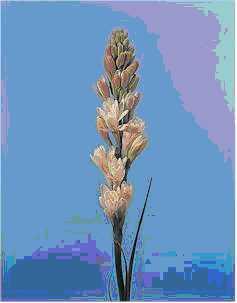
The eight waltzes were played without any noticeable breaks, and they followed the scenario of a love story where different flowers were presented. The first waltz described the tuberose (for sensual pleasure, pictured), and this is represented by heavy, accented beats – not much imagination needed here. The smooth, dreamlike waltz that follows describes the buttercup (coquetry, which means flirtation). The flowers that were subsequently presented were marguerite (love shunned), sunflower (empty riches), acacia (Platonic love), poppy (forgetfulness), and red rose (love fulfilled). The piece concludes with an epilogue.
I wasn’t able to correlate the different waltzes with the flowers after a while, that there sometimes wasn’t a noticeable break didn’t help. Ravel used different techniques and instruments to describe the changing scenes. We have “out-of-breath” flutes, muted strings (a lot of it), melodious segments, and agitated play. If you are not familiar with the music, you can get quite confused trying to assign a particular theme to a program. It may be interesting to hear the pieces played by the piano also.
I have seen Dutoit a few times before, once with the Montreal Symphony, and once with the Philadelphia Orchestra. He looks much more emotive than Maazel, and generates a different sound from the New York Philharmonic. Surprisingly, the orchestra sounded more restrained under Dutoit.
Sarah Chang is a Korean American violinist. She has been around for a long time (I must have a CD of hers that’s close to 10 years old), but must be only around 25. This is the first time I see her in a live performance.
The Dvorak violin concerto started with strong statements by the violin and the orchestra, which defined how the first movement (Allegro ma non troppo) was going to play out. Chang has this habit of swaying (a bit much for me) and swinging her bow in a huge arc. She must do this all the time, so my fear that she may trip or break her bow was probably unwarranted. While this was a little distracting, the music was still very enjoyable.
New York Philharmonic has a tradition of the concertmaster ceding his chair when a solo artist is on stage. I don’t know exactly who is extending the courtesy to whom, but if I were the concertmaster, I would definitely want to take part in these exciting performances. I don’t recall this being done in other orchestras.
The program notes describes an argument between Dvorak and his publisher on whether there should be a pause between the first and second movements. Dvorak stood his ground and we continue on with Adagio ma non troppo. Chang seemed to have to struggle to get her violin heard over the (surprisingly) large orchestra. The human ear is amazing, it can pick out one instrument out of a group of 80 or so, over 20 of them are of the same kind (violins).
The third movement (Finale: Allegro giocoso, ma non troppo) contains themes from two traditional Czech dances. By this time I was a little disappointed at how the piece was being rushed through. To me Dvorak probably tried to avoid this by marking all three movements “ma non troppo.” While there might have been attempts to slow down every now and then, the overall effect was hurried and a little muddled.
There was no encore, even though the audience reception was quite enthusiastic. Make no mistake, the piece was brilliantly played, except I was hoping for more than just a virtuoso performance.
There must be a lot of music based on Romeo and Juliet, so I wasn’t sure if I was familiar with Prokofiev’s take on it. Turns out except for a couple of the selections, the music was new to me. Altogether eight selections from the ballet were performed tonight.
Prokofiev tended to have well defined themes for the individual characters, and it was easy to discern the themes for Juliet, the Montagues, and the Capulets. The piece began with the brass and percussion sections generating immediate tension, and Juliet was introduced by the flute. I again had trouble tracking the different selections, but the music was pleasant, especially the cello solo. I managed to resynchronize the music when the percussions began the “Romeo & Juliet” selection, a rather familiar “movement.” Unfortunately I again lost track. The rather long movement (“Death of Tybalt?”) provided a sense of urgency first appearing in the strings and brass, and later shared by the entire orchestra. The timpani and string pizzicato lead to a series of broad statement punctuated by timpani and drums. I was ready to applaud, luckily the raised arms of Dutoit told me that wasn’t the end yet. The piece finished with the full sound of the orchestra which did convey a sense of hopelessness. I couldn’t imagine there was any debate whether Prokofiev should substitute a happy ending in the ballet, no one would have accepted it. In any case, the high-pitched piccolo and strings concluded a satisfying piece of orchestra work.
Overall, a worthwhile concert.
Program
Valses nobles et sentimentales (1911, orch. 1912) by Ravel (1875-1937)
Violin Concerto in A minor, Op. 53 (1879; rev. 1880-82) by Dvorak (1841-1904)
Selections from Romeo and Juliet (1935-1936) by Prokofiev (1891-1953)
October is going to be a heavy concert month for us. Tonight’s concert was the third this month, and next Saturday we will be attending Tosca at NYC Opera and seeing Midori with the NY Philharmonic (Dutoit guest conducting). We have 2 more concerts the following week (Cosi fan Tutti at the Met and another New York Philharmonic concert).
This set of Ravel’s Waltzes were first written for the piano to be played in a studio or a salon, but was later orchestrated by Ravel over the course of 15 days. I have not heard the music before, and was surprised that the full orchestra was out for the performance.
The eight waltzes were played without any noticeable breaks, and they followed the scenario of a love story where different flowers were presented. The first waltz described the tuberose (for sensual pleasure, pictured), and this is represented by heavy, accented beats – not much imagination needed here. The smooth, dreamlike waltz that follows describes the buttercup (coquetry, which means flirtation). The flowers that were subsequently presented were marguerite (love shunned), sunflower (empty riches), acacia (Platonic love), poppy (forgetfulness), and red rose (love fulfilled). The piece concludes with an epilogue.

I wasn’t able to correlate the different waltzes with the flowers after a while, that there sometimes wasn’t a noticeable break didn’t help. Ravel used different techniques and instruments to describe the changing scenes. We have “out-of-breath” flutes, muted strings (a lot of it), melodious segments, and agitated play. If you are not familiar with the music, you can get quite confused trying to assign a particular theme to a program. It may be interesting to hear the pieces played by the piano also.
I have seen Dutoit a few times before, once with the Montreal Symphony, and once with the Philadelphia Orchestra. He looks much more emotive than Maazel, and generates a different sound from the New York Philharmonic. Surprisingly, the orchestra sounded more restrained under Dutoit.
Sarah Chang is a Korean American violinist. She has been around for a long time (I must have a CD of hers that’s close to 10 years old), but must be only around 25. This is the first time I see her in a live performance.
The Dvorak violin concerto started with strong statements by the violin and the orchestra, which defined how the first movement (Allegro ma non troppo) was going to play out. Chang has this habit of swaying (a bit much for me) and swinging her bow in a huge arc. She must do this all the time, so my fear that she may trip or break her bow was probably unwarranted. While this was a little distracting, the music was still very enjoyable.
New York Philharmonic has a tradition of the concertmaster ceding his chair when a solo artist is on stage. I don’t know exactly who is extending the courtesy to whom, but if I were the concertmaster, I would definitely want to take part in these exciting performances. I don’t recall this being done in other orchestras.
The program notes describes an argument between Dvorak and his publisher on whether there should be a pause between the first and second movements. Dvorak stood his ground and we continue on with Adagio ma non troppo. Chang seemed to have to struggle to get her violin heard over the (surprisingly) large orchestra. The human ear is amazing, it can pick out one instrument out of a group of 80 or so, over 20 of them are of the same kind (violins).
The third movement (Finale: Allegro giocoso, ma non troppo) contains themes from two traditional Czech dances. By this time I was a little disappointed at how the piece was being rushed through. To me Dvorak probably tried to avoid this by marking all three movements “ma non troppo.” While there might have been attempts to slow down every now and then, the overall effect was hurried and a little muddled.
There was no encore, even though the audience reception was quite enthusiastic. Make no mistake, the piece was brilliantly played, except I was hoping for more than just a virtuoso performance.
There must be a lot of music based on Romeo and Juliet, so I wasn’t sure if I was familiar with Prokofiev’s take on it. Turns out except for a couple of the selections, the music was new to me. Altogether eight selections from the ballet were performed tonight.
Prokofiev tended to have well defined themes for the individual characters, and it was easy to discern the themes for Juliet, the Montagues, and the Capulets. The piece began with the brass and percussion sections generating immediate tension, and Juliet was introduced by the flute. I again had trouble tracking the different selections, but the music was pleasant, especially the cello solo. I managed to resynchronize the music when the percussions began the “Romeo & Juliet” selection, a rather familiar “movement.” Unfortunately I again lost track. The rather long movement (“Death of Tybalt?”) provided a sense of urgency first appearing in the strings and brass, and later shared by the entire orchestra. The timpani and string pizzicato lead to a series of broad statement punctuated by timpani and drums. I was ready to applaud, luckily the raised arms of Dutoit told me that wasn’t the end yet. The piece finished with the full sound of the orchestra which did convey a sense of hopelessness. I couldn’t imagine there was any debate whether Prokofiev should substitute a happy ending in the ballet, no one would have accepted it. In any case, the high-pitched piccolo and strings concluded a satisfying piece of orchestra work.
Overall, a worthwhile concert.
Sunday, October 02, 2005
New York Philharmonic – Lorin Maazel, Conductor; Jonathan Bliss, piano. 10/1/2005.
Avery Fisher Hall at Lincoln Center, Second Tier Center, Seat CC8.
Program
Holiday Overture (1944, rev. 1961) by Elliott Carter (b. 1908)
Piano Concerto in A major, K. 488 (ca 1784-86) by Mozart (1756-91)
Death and Transfiguration, Op. 24 (1888-89) by R. Strasuss (1864-1949)
Dance of the Seven Veils, from Salome (1905) by R. Strauss
We couldn’t go to a planned concert so we exchanged our tickets for this one. This was going to be the second concert for the day – we had just seen NYC Opera’s production of Rossini’s Il Viaggio a Reims. I had not heard of either Elliott Carter or Jonathan Biss. Elliott Carter is close to 97 years old and lives in the area. He has been composing for many decades, and had even taught at my alma mater (Cornell, although it was before my time), but I had never encountered his music before. I am sure it speaks more to my lack of exposure to American composer music than his music’s popularity. Jonathan Biss is a young pianist (25 years old) who debuted with the New York Philharmonic 5 years ago. The program notes say he is from a line of professional musicians, but do not say much about Biss’s own accomplishments.
Sometimes I don’t understand how a program is put together. I don’t see any relationship among the three composers, or the pieces that were performed today. Mozart looks especailly out of place, stuck as it is between works composed about 200 years later.
Carter’s Holiday Overture is an enjoyable piece. The first impression was that it was quite loud, unexpectedly tonal, and rather folksy sounding. About half way into the 10 minute piece, the music changed with muted violins playing softly. A series of volume and tempo changes changed the tone of the music. Towards the end, string tremolos lead to rather strong statements from the full orchestra which sounded at times a little chaotic.
The orchestra played extraordinarily well. They made excellent sound with great precision, and one sensed the entire orchestra was into the music. The program notes describe this as a complicated piece for the time it was written, I couldn’t tell. The statement also assumes composers have a herd mentality, which I am sure the composers themselves will contest.
The Mozart piano concerto was written while Mozart was enjoying great success as a concerto pianist. It is unthinkable that Mozart could fall out of favor, but evidently he did from time to time.
Compared to Chopin (see last week’s blog), the orchestra plays a significant role in Mozart’s concertos, even though Mozart also used his concertos to showcase the piano. This is a rather complicated composition and was done quite well. At times I had problems with the relative loudness of the piano (generally too soft for my taste). I like my Mozart crisp, and there seemed to be too much pedaling. The cadenza and the third movement were nicely done though. Biss seems to have some exaggerated body movements that don’t go quite well with the piece. For the casual listener, it is very difficult to come away from a Mozart concerto greatly impressed.
I have encountered a lot of Strauss lately. We heard his Symphonia domestica in May, and saw the opera Capriccio three weeks ago. “Death and Transfiguration”, like the Symphonia, is a symphonic poem. It is a single movement with four distinct sections: the sick man and his dreams (Largo); the man’s struggle with death (Allegro molto agitato); the man seeing his life pass before him and giving himself over to death (Meno moss, ma sempre alla breve); and the man’s redemption and transfiguration (Moderato).
I enjoy music that follows a program so I can, for example, correlate the taps on the timpani with death. It is easier than to try to follow how Strauss started the composition in C minor and ended it in C major, per the program notes. It was also interesting to catch the “artistic theme” which was repeated many times in different parts of the orchestra. The later hymn-like repetition of the theme reassures that the subject indeed finds redemption. There is a section where the strings seemed to “fire at will” that I don’t quite comprehend.
They put out the full orchestra for the Dance. I doubt in the opera the orchestra would be that big as it will drown out most singers. After its debut in New York (in 1905), Salome wasn’t played for 27 years because of the furor it caused, and one would think the dance had a lot to do with it. A hundred years later, the music sounded quite innocuous: one would need a large dose of imagination to be shocked by it. The frenzied theme at the end and the brass brought the music to an interesting conclusion. I mentioned in a previous blog that I had seen some parts of the opera on TV. I vaguely recall John’s head on a plate, and that Salome was killed at the end. Salome was played by one of these sopranos that, according to the program notes, “clarified why they became singers rather than dancers.”
An okay concert, but not as good as some others I have been to.
See also the New York Times review of the concert.
Program
Holiday Overture (1944, rev. 1961) by Elliott Carter (b. 1908)
Piano Concerto in A major, K. 488 (ca 1784-86) by Mozart (1756-91)
Death and Transfiguration, Op. 24 (1888-89) by R. Strasuss (1864-1949)
Dance of the Seven Veils, from Salome (1905) by R. Strauss
We couldn’t go to a planned concert so we exchanged our tickets for this one. This was going to be the second concert for the day – we had just seen NYC Opera’s production of Rossini’s Il Viaggio a Reims. I had not heard of either Elliott Carter or Jonathan Biss. Elliott Carter is close to 97 years old and lives in the area. He has been composing for many decades, and had even taught at my alma mater (Cornell, although it was before my time), but I had never encountered his music before. I am sure it speaks more to my lack of exposure to American composer music than his music’s popularity. Jonathan Biss is a young pianist (25 years old) who debuted with the New York Philharmonic 5 years ago. The program notes say he is from a line of professional musicians, but do not say much about Biss’s own accomplishments.
Sometimes I don’t understand how a program is put together. I don’t see any relationship among the three composers, or the pieces that were performed today. Mozart looks especailly out of place, stuck as it is between works composed about 200 years later.
Carter’s Holiday Overture is an enjoyable piece. The first impression was that it was quite loud, unexpectedly tonal, and rather folksy sounding. About half way into the 10 minute piece, the music changed with muted violins playing softly. A series of volume and tempo changes changed the tone of the music. Towards the end, string tremolos lead to rather strong statements from the full orchestra which sounded at times a little chaotic.
The orchestra played extraordinarily well. They made excellent sound with great precision, and one sensed the entire orchestra was into the music. The program notes describe this as a complicated piece for the time it was written, I couldn’t tell. The statement also assumes composers have a herd mentality, which I am sure the composers themselves will contest.
The Mozart piano concerto was written while Mozart was enjoying great success as a concerto pianist. It is unthinkable that Mozart could fall out of favor, but evidently he did from time to time.
Compared to Chopin (see last week’s blog), the orchestra plays a significant role in Mozart’s concertos, even though Mozart also used his concertos to showcase the piano. This is a rather complicated composition and was done quite well. At times I had problems with the relative loudness of the piano (generally too soft for my taste). I like my Mozart crisp, and there seemed to be too much pedaling. The cadenza and the third movement were nicely done though. Biss seems to have some exaggerated body movements that don’t go quite well with the piece. For the casual listener, it is very difficult to come away from a Mozart concerto greatly impressed.
I have encountered a lot of Strauss lately. We heard his Symphonia domestica in May, and saw the opera Capriccio three weeks ago. “Death and Transfiguration”, like the Symphonia, is a symphonic poem. It is a single movement with four distinct sections: the sick man and his dreams (Largo); the man’s struggle with death (Allegro molto agitato); the man seeing his life pass before him and giving himself over to death (Meno moss, ma sempre alla breve); and the man’s redemption and transfiguration (Moderato).
I enjoy music that follows a program so I can, for example, correlate the taps on the timpani with death. It is easier than to try to follow how Strauss started the composition in C minor and ended it in C major, per the program notes. It was also interesting to catch the “artistic theme” which was repeated many times in different parts of the orchestra. The later hymn-like repetition of the theme reassures that the subject indeed finds redemption. There is a section where the strings seemed to “fire at will” that I don’t quite comprehend.
They put out the full orchestra for the Dance. I doubt in the opera the orchestra would be that big as it will drown out most singers. After its debut in New York (in 1905), Salome wasn’t played for 27 years because of the furor it caused, and one would think the dance had a lot to do with it. A hundred years later, the music sounded quite innocuous: one would need a large dose of imagination to be shocked by it. The frenzied theme at the end and the brass brought the music to an interesting conclusion. I mentioned in a previous blog that I had seen some parts of the opera on TV. I vaguely recall John’s head on a plate, and that Salome was killed at the end. Salome was played by one of these sopranos that, according to the program notes, “clarified why they became singers rather than dancers.”
An okay concert, but not as good as some others I have been to.
See also the New York Times review of the concert.
New York City Opera – Rossini’s Il Viaggio a Reims 10/1/2005.
New York State Theater at Lincoln Center – First Ring, Seat D18.
Conductor: George Manahan. Cast: Many.
This opera has practically no story. It was written by Rossini as part of the celebration of Charles X’s coronation, and to showcase the superiority of bel canto style to the “French howling” style employed at the Paris Opera. An international assemblage of guests were stuck at the Golden Lily Hotel on their way to Rheims, which provided an occasion for the many many (the program lists 18 names) singers to showcase their talents.
Viewed as such, it was a very enjoyable opera. The curtain was actually a helpful map of Europe showing the different nationalities involved. Most of the time the set was dominated by one color (white and orange come to mind), which produced a surprising nice effect. The individual arias demonstrated different vocal techniques. Some were a little on the lengthy side though.
There was a very well done and comical fight scene where toy canons and soldiers were advanced to calm and quiet music. The final bursts of canon fire killed everyone, but they were awakened gently by the harp. Unfortunately world peace proved temporary as the principals engaged in fighting once again.
Many arias projected especially well – the one sung by the Englishman comes to mind – and again I wonder if it has to do with the sound system employed by the theater.
Rossini seemed particularly fond of making fun of the French, both in the portrayal of the Countess and in the national anthems sequence. Some things never change.
Satires, especially of the political kind, tend not to keep well. Except for the serious history student, political issues lose their meaning after, say, a hundred years. I suspect not even the French would be moved by a long tribute to King Charles X? This contrasts with operas based on human emotions, which seem to resonate forever.
“The Journey to Rheims” suffers both from being an out-of-date political satire and an opera without a story. Go see it for the music, though.
Conductor: George Manahan. Cast: Many.
This opera has practically no story. It was written by Rossini as part of the celebration of Charles X’s coronation, and to showcase the superiority of bel canto style to the “French howling” style employed at the Paris Opera. An international assemblage of guests were stuck at the Golden Lily Hotel on their way to Rheims, which provided an occasion for the many many (the program lists 18 names) singers to showcase their talents.
Viewed as such, it was a very enjoyable opera. The curtain was actually a helpful map of Europe showing the different nationalities involved. Most of the time the set was dominated by one color (white and orange come to mind), which produced a surprising nice effect. The individual arias demonstrated different vocal techniques. Some were a little on the lengthy side though.
There was a very well done and comical fight scene where toy canons and soldiers were advanced to calm and quiet music. The final bursts of canon fire killed everyone, but they were awakened gently by the harp. Unfortunately world peace proved temporary as the principals engaged in fighting once again.
Many arias projected especially well – the one sung by the Englishman comes to mind – and again I wonder if it has to do with the sound system employed by the theater.
Rossini seemed particularly fond of making fun of the French, both in the portrayal of the Countess and in the national anthems sequence. Some things never change.
Satires, especially of the political kind, tend not to keep well. Except for the serious history student, political issues lose their meaning after, say, a hundred years. I suspect not even the French would be moved by a long tribute to King Charles X? This contrasts with operas based on human emotions, which seem to resonate forever.
“The Journey to Rheims” suffers both from being an out-of-date political satire and an opera without a story. Go see it for the music, though.
Monday, September 26, 2005
New York Philharmonic – Lorin Maazel, Conductor; Lang Lang, Piano. 9/24/2005.
Avery Fisher Hall at Lincoln Center, Second Tier Center, Seat AA110.
Program
Piano Concerto in E minor, Op. 11 (1829-30) by Chopin (1810-49).
Symphony No. 1 in D major (1888; rev. 1893-1906) by Mahler (1860-1911).
We planned our vacation so we could be back for this concert, in large part due to the performance by Lang Lang. My expectations for Lang Lang’s performance was met, but, unfortunately, not exceeded.
The Chopin concerto began with a long orchestral introduction. The program notes referred to the 138 measures deleted in many of the performances as the “cruelest cut”. The introduction was pleasant enough, but the subjects were going to be repeated several times in the movement anyway, so I wouldn’t have minded as much.
When Lang Lang launched into the piece, one could feel the expectation fill the concert hall. And this was a well attended concert. Chopin’s concertos often sound like nocturnes and polonaises juxtaposed together, this movement was no exception. Musicologists can do their endless analyses of the music, but to me (and I suspect to most listeners) Chopin concertos are virtuoso pieces with orchestral accompaniment. Every now and then there is more of a dialog – like the duet with the bassoons – but there is no doubt that the piano is the showcased instrument here. Which is perfectly okay … People think of Paganini’s concertos the same way.
During the first part of the second movement, I had trouble staying awake. After all, I flew back the previous day from Hong Kong, and was quite jet-lagged. And it was a slow movement.
The third movement was in classical rondo form. I wonder what kind of a career Lang Lang would have. He is now in his early 20s, and can play for another 50 or more years. Would he continue to improve? Would he experiment with different kinds of music? The possibilities are endless. To piano students, Lang Lang must be an inspiration. However, to struggling piano players, it must be very discouraging to have someone burst on to the scene apparently so effortlessly. (Not to take away the hard work Lang Lang has done ever since he was a kid.) In any case, the coda of the third movement was brilliantly done.
Make no mistake about it, Lang Lang is impressive, and makes difficult pieces look simple. And this was a great performance. However, I saw him playing Tchaikovsky’s concerto in October, 2004, and I remember that as a more exciting performance.
Mahler’s first symphony is quite different from his later ones. He already started using huge orchestras (especially the brass sections), and his symphonies are all quite long. This one lasted over 50 minutes. I am not that familiar with Mahler, but it would be an interesting exercise to see how his composition techniques changed as he got older.
To my ears this symphony is quite tonal, and contains many “hummable” melodies. In this symphony, Mahler was also more repetitions of his themes in different parts of the orchestra. There are some very classical passages in the first movement that would remind one of Beethoven (Pastoral Symphony) or Schubert (Unfinished Symphony.) The melodies have a hint of Dvorak also.
The program notes said Mahler originally annotated an earlier version of this symphony and later discarded the “program” as the piece got revised. I don’t see how the revisions or even the withdrawal of the notes would change the original images the composer had in mind. In any case, I couldn’t help associating the stormy passage in the first movement with spring.
The second movement began with a march like passage with well-accented beats. The theme was repeated multiple times in different parts of the orchestra – dare I say perhaps more than necessary? A quiet passage lulls the listener into thinking this was to be a short movement, but the orchestra then launches into the original theme before speeding to the conclusion.
The third movement began with the “Frere Jacques” theme in the double bass, repeated in turn by the bassoons, cellos, and then the clarinets. The polka-like and gypsy passages make the movement sound comical at times. The pizzicatos in the double basses combine with the timpani to bring the movement to a pleasant end.
The loud cymbal started the fourth movement with a jolt. Here I thought the orchestra was a little out of control and played too violently. Perhaps it was an unexpected storm (although this movement is to be an “advance towards spiritual victory”). A series of decrescendos brought the music to a slower, quieter passage. The tremolos in the violins presaged a buildup followed by several crescendos and decrescendos. Here we see the full range of Mahler techniques at work. An apparent end became the beginning of yet another passage. At the end, all the French horns (my wife counted eight, the program says seven) stood up, and everyone joined in the chaotic end.
I like Mahler’s symphonies. Most of them, however, are acquired tastes in that I had to listen to them several times before I started to appreciate them. I believe this is the first time I listened to the entire first symphony, and I like it. I can also appreciate how difficult it is to interpret his music well. Despite the sometimes over-the-top passages, Maazel has a well-deserved reputation as a Mahler specialist.
Despite some of my misgivings, this was a very enjoyable evening. I am glad I came back in time for it.
See also the New York Times review of the concert. It had surprisingly little to say about the Mahler symphony.
Program
Piano Concerto in E minor, Op. 11 (1829-30) by Chopin (1810-49).
Symphony No. 1 in D major (1888; rev. 1893-1906) by Mahler (1860-1911).
We planned our vacation so we could be back for this concert, in large part due to the performance by Lang Lang. My expectations for Lang Lang’s performance was met, but, unfortunately, not exceeded.
The Chopin concerto began with a long orchestral introduction. The program notes referred to the 138 measures deleted in many of the performances as the “cruelest cut”. The introduction was pleasant enough, but the subjects were going to be repeated several times in the movement anyway, so I wouldn’t have minded as much.
When Lang Lang launched into the piece, one could feel the expectation fill the concert hall. And this was a well attended concert. Chopin’s concertos often sound like nocturnes and polonaises juxtaposed together, this movement was no exception. Musicologists can do their endless analyses of the music, but to me (and I suspect to most listeners) Chopin concertos are virtuoso pieces with orchestral accompaniment. Every now and then there is more of a dialog – like the duet with the bassoons – but there is no doubt that the piano is the showcased instrument here. Which is perfectly okay … People think of Paganini’s concertos the same way.
During the first part of the second movement, I had trouble staying awake. After all, I flew back the previous day from Hong Kong, and was quite jet-lagged. And it was a slow movement.
The third movement was in classical rondo form. I wonder what kind of a career Lang Lang would have. He is now in his early 20s, and can play for another 50 or more years. Would he continue to improve? Would he experiment with different kinds of music? The possibilities are endless. To piano students, Lang Lang must be an inspiration. However, to struggling piano players, it must be very discouraging to have someone burst on to the scene apparently so effortlessly. (Not to take away the hard work Lang Lang has done ever since he was a kid.) In any case, the coda of the third movement was brilliantly done.
Make no mistake about it, Lang Lang is impressive, and makes difficult pieces look simple. And this was a great performance. However, I saw him playing Tchaikovsky’s concerto in October, 2004, and I remember that as a more exciting performance.
Mahler’s first symphony is quite different from his later ones. He already started using huge orchestras (especially the brass sections), and his symphonies are all quite long. This one lasted over 50 minutes. I am not that familiar with Mahler, but it would be an interesting exercise to see how his composition techniques changed as he got older.
To my ears this symphony is quite tonal, and contains many “hummable” melodies. In this symphony, Mahler was also more repetitions of his themes in different parts of the orchestra. There are some very classical passages in the first movement that would remind one of Beethoven (Pastoral Symphony) or Schubert (Unfinished Symphony.) The melodies have a hint of Dvorak also.
The program notes said Mahler originally annotated an earlier version of this symphony and later discarded the “program” as the piece got revised. I don’t see how the revisions or even the withdrawal of the notes would change the original images the composer had in mind. In any case, I couldn’t help associating the stormy passage in the first movement with spring.
The second movement began with a march like passage with well-accented beats. The theme was repeated multiple times in different parts of the orchestra – dare I say perhaps more than necessary? A quiet passage lulls the listener into thinking this was to be a short movement, but the orchestra then launches into the original theme before speeding to the conclusion.
The third movement began with the “Frere Jacques” theme in the double bass, repeated in turn by the bassoons, cellos, and then the clarinets. The polka-like and gypsy passages make the movement sound comical at times. The pizzicatos in the double basses combine with the timpani to bring the movement to a pleasant end.
The loud cymbal started the fourth movement with a jolt. Here I thought the orchestra was a little out of control and played too violently. Perhaps it was an unexpected storm (although this movement is to be an “advance towards spiritual victory”). A series of decrescendos brought the music to a slower, quieter passage. The tremolos in the violins presaged a buildup followed by several crescendos and decrescendos. Here we see the full range of Mahler techniques at work. An apparent end became the beginning of yet another passage. At the end, all the French horns (my wife counted eight, the program says seven) stood up, and everyone joined in the chaotic end.
I like Mahler’s symphonies. Most of them, however, are acquired tastes in that I had to listen to them several times before I started to appreciate them. I believe this is the first time I listened to the entire first symphony, and I like it. I can also appreciate how difficult it is to interpret his music well. Despite the sometimes over-the-top passages, Maazel has a well-deserved reputation as a Mahler specialist.
Despite some of my misgivings, this was a very enjoyable evening. I am glad I came back in time for it.
See also the New York Times review of the concert. It had surprisingly little to say about the Mahler symphony.
Saturday, September 10, 2005
New York City Opera – Strauss’s Capriccio 9/10/2005
New York State Theater at Lincoln Center – First Tier, Seat B23.
Conductor: George Manahan; Flamand – Ryan MacPherson, Olivier – Mel Ulrich, Countess – Pamela Armstrong.
Story: This opera explores if words or music is the greater art form. The Countess was in love with Flamand the composer and Olivier the poet. She couldn’t decide and therefore asked the two men to write an opera and she would pick the finale of the one she chose.
This was the first concert we were attending for the 2005/2006 season. My expectations were high after reading up on the opera at the NYC Opera website. Capriccio was Strauss’s last (15th) opera and considered by him to be his best. I came away quite disappointed for two reasons. The opera, a comedy, didn’t live up to the billing. (Warning: if you don’t want the ending spoiled, skip the next sentence.) Also, the question of which is the higher art form wasn’t answered.
This was the first Strauss opera I saw. The only other exposure I have had of his operas was what the last part of Salome I caught on TV, which I found quite fascinating. NYC Opera sets appear to be more elaborate compared to those of a few years ago when I first started going. The set for this opera even had a moving stage in Act 2. There were also many scenes where the wait staff kept rearranging chairs for apparently no good reason, but was quite amusing.
Part I began with an overture that sounded like a string ensemble. It was a nice piece, but a bit on the long side. I was also pleased with the acoustics of the theater – did NYC Opera work to improve it during the off season? Clairon, the object of affection of the Count, had a rather wobbly vocal entrance, although she improved during the show.
There was a play within the opera which I found a bit too affected. The laughter of the audience was at time more due to embarrassment than amusement. At this point I thought the opera was quite disjoint and lacked a clear direction.
In addition to weighing the relative merits of music and words, the opera throws in other forms of art including acting, singing and dance. There was a ballet interlude that is quite pleasant to watch (it even borders on being funny at times). But the question of “why?” kept popping up in my mind. Similarly, the aria sung by the bel canto Italian singers was pleasant enough but didn’t add much to the opera.
Part I ended with the Countess deciding on an important thing: serving chocolate at the party. This reminds me of Scarlett’s famous line in Gone with the Wind: “I can’t think about that right now … I’ll think about that tomorrow.” I am sure the sale of candy was quite brisk during the intermission!
Part II was more enjoyable than Part I. It had a mad scene where everyone was on stage. I counted the waitstaff, the principals, the ballet dances, the director, a couple of Roman soldiers, Roman royalty (well, they could be Greek), and the Italian singers. It was choreographed nicely enough, but wasn’t very funny.
About an hour into Part II, there was an orchestral interlude at the conclusion of which the stage got a bit surreal. The color turned mostly gold, with the Countess asking herself, and the mirror, which man/art form she should pick. At one point I was sure the images of Flamand and Olivier appeared for a while. How did they do that?
The opera concluded with the Countess deciding on what to eat for supper. By this time I had already given up on a definite opinion from the composer, but was still surprised at the non-climax which few, if any, in the audience found funny.
I don’t speak French, Italian, and had only one year of German in college. One would think the language the opera was sung in won’t bother me a bit. I have heard the recording of The Flying Dutchman, and it was okay. I have heard Bizet’s and Thomas’s operas in French, and they sounded marvelous. For some reason I found this opera (in German) a little awkward.
The premise of the opera is interesting enough, but the composer and the librettist wouldn’t answer the questions they posed, and couldn’t make a true comedy out of the subject matter either. There were many elements that could have been woven together into an interesting whole, but I don’t think they succeeded. Capriccio doesn’t appear to be a popular opera (one proof: not that many relevant Google references). There are many operas I would want to see again to get a deeper appreciation, not this one.
See also the New York Times review of this opera. It also explains why there were all these references to Gluck which escaped me.
Conductor: George Manahan; Flamand – Ryan MacPherson, Olivier – Mel Ulrich, Countess – Pamela Armstrong.
Story: This opera explores if words or music is the greater art form. The Countess was in love with Flamand the composer and Olivier the poet. She couldn’t decide and therefore asked the two men to write an opera and she would pick the finale of the one she chose.
This was the first concert we were attending for the 2005/2006 season. My expectations were high after reading up on the opera at the NYC Opera website. Capriccio was Strauss’s last (15th) opera and considered by him to be his best. I came away quite disappointed for two reasons. The opera, a comedy, didn’t live up to the billing. (Warning: if you don’t want the ending spoiled, skip the next sentence.) Also, the question of which is the higher art form wasn’t answered.
This was the first Strauss opera I saw. The only other exposure I have had of his operas was what the last part of Salome I caught on TV, which I found quite fascinating. NYC Opera sets appear to be more elaborate compared to those of a few years ago when I first started going. The set for this opera even had a moving stage in Act 2. There were also many scenes where the wait staff kept rearranging chairs for apparently no good reason, but was quite amusing.
Part I began with an overture that sounded like a string ensemble. It was a nice piece, but a bit on the long side. I was also pleased with the acoustics of the theater – did NYC Opera work to improve it during the off season? Clairon, the object of affection of the Count, had a rather wobbly vocal entrance, although she improved during the show.
There was a play within the opera which I found a bit too affected. The laughter of the audience was at time more due to embarrassment than amusement. At this point I thought the opera was quite disjoint and lacked a clear direction.
In addition to weighing the relative merits of music and words, the opera throws in other forms of art including acting, singing and dance. There was a ballet interlude that is quite pleasant to watch (it even borders on being funny at times). But the question of “why?” kept popping up in my mind. Similarly, the aria sung by the bel canto Italian singers was pleasant enough but didn’t add much to the opera.
Part I ended with the Countess deciding on an important thing: serving chocolate at the party. This reminds me of Scarlett’s famous line in Gone with the Wind: “I can’t think about that right now … I’ll think about that tomorrow.” I am sure the sale of candy was quite brisk during the intermission!
Part II was more enjoyable than Part I. It had a mad scene where everyone was on stage. I counted the waitstaff, the principals, the ballet dances, the director, a couple of Roman soldiers, Roman royalty (well, they could be Greek), and the Italian singers. It was choreographed nicely enough, but wasn’t very funny.
About an hour into Part II, there was an orchestral interlude at the conclusion of which the stage got a bit surreal. The color turned mostly gold, with the Countess asking herself, and the mirror, which man/art form she should pick. At one point I was sure the images of Flamand and Olivier appeared for a while. How did they do that?
The opera concluded with the Countess deciding on what to eat for supper. By this time I had already given up on a definite opinion from the composer, but was still surprised at the non-climax which few, if any, in the audience found funny.
I don’t speak French, Italian, and had only one year of German in college. One would think the language the opera was sung in won’t bother me a bit. I have heard the recording of The Flying Dutchman, and it was okay. I have heard Bizet’s and Thomas’s operas in French, and they sounded marvelous. For some reason I found this opera (in German) a little awkward.
The premise of the opera is interesting enough, but the composer and the librettist wouldn’t answer the questions they posed, and couldn’t make a true comedy out of the subject matter either. There were many elements that could have been woven together into an interesting whole, but I don’t think they succeeded. Capriccio doesn’t appear to be a popular opera (one proof: not that many relevant Google references). There are many operas I would want to see again to get a deeper appreciation, not this one.
See also the New York Times review of this opera. It also explains why there were all these references to Gluck which escaped me.
Sunday, June 26, 2005
New York Philharmonic – Lorin Maazel, Conductor. 6/25/2005.
Avery Fisher Hall at Lincoln Center. First Tier Center, Seat AA21.
Mahler (1860-1911). Symphony No. 6 in A minor (1903-05, rev. 1906)
I am not too familiar with Mahler’s music outside of a couple of his symphonies. When I was playing at the Cornell Symphony we played his Fifth Symphony, probably the most well known one of the ten or so he published. The program notes described this symphony, commonly called “tragic,” as “a cosmos that holds out no hope for mankind.” So I was getting ready for a depressing evening.
Perhaps one other reason the symphony is not familiar to many people is its length. The program notes mentioned a length of about 83 minutes; including the pauses in between movements, tonight’s performance was 85 minutes. It was a massive production requiring a lot of stamina from the orchestra and, especially, the conductor. On the other hand, it must be satisfying to be able to put out a huge production. Maazel usually conducts without music, not for this complicated case, though
The orchestra launched energetically into the first movement (Allegro energico, ma non troppo), with the snare drums making an early entrance. After a quiet interlude, we heard for the first time the Alma’s theme described in Playbill. This theme would be repeated many times. The many fragments created an image of struggles without success. About 10 minutes into the movement, a sweet passage surfaced but the music soon turned dark again. Alma’s theme reappeared before the coda concluded the 25-minute movement.
There was a short pause after the first movement so late-comers could get seated. A melancholic, melodic theme in the violins began the second movement (Andante). Then came the woodwinds with the second theme against a pedal point by the strings. The movement could have concluded at this point. As the movement continued, I couldn’t help but think Mahler was trying to squeeze in every thought he had about the movement. Perhaps it had not reached the level of despair he felt. I can imagine why one would go crazy trying to express in music one’s inner feelings. (Not that Mahler did.) In any case, this was a relatively short 17 minute movement.
The timpani began the third movement (Scherzo, weighty), followed by ear-piercing piccolos. True to its description, the movement contained many passages that were at least comical, bordering on happy. However, about 5 minutes into this movement, the timpani announced another section that brought the music back down to earth. After developing the theme in different parts of the orchestra, a new theme emerged to conclude the 13-minute movement. I didn’t think “weighty” is quite how I’d describe this movement, although it is quite weighty for a Scherzo.
The dreamlike strums of the harps began the last movement (Finale. Allegro moderato – Allegro energico). A loud percussion section brought the audience back to earth. A tuba and harp passage was followed by one bordering on standard harmony, the effect was impending doom. The harps evoked images of the pi-pa (a Chinese instrument) and seemed to describe wandering in the wilderness. Another interlude of light and pleasant message was plunged into despair with strings and percussion. It was fun to watch the percussion musicians move from one station to the other. The bell-ringer had to go back stage to play certain passages. I also noticed at this point that the full orchestra took up the entire stage, and that the black screens usually at the back of the stage were not used for tonight’s concert. About 15 minutes into this movement, the first of the 2 famous hammer blows came down with a loud thud. The mood changed to one of precision and clarity. Soon enough the second hammer blow came down. At this point the music got to be quite chaotic – that a violinist dropped her bow was only barely noticed. A series of bells followed by a small part of the orchestra made one think the end was near, until more chaos came along, helped by two sets of cymbals played together. Eventually the movement (which was 27 minutes long) and the symphony drew to a conclusion with a quiet passage punctuated by several loud chords.
The audience gave the performance a well-deserved standing ovation. This was the last regular concert of the season. Maazel made several curtain calls and thanked the orchestra. I was quite impressed at his energy level throughout the physically demanding symphony. After all, he couldn’t conduct last week’s concerts because of illness.
My appreciation of Mahler’s music usually improves with continued exposure. I suspect it would be the same with this symphony. It was a hugely interesting piece to watch and listen to. Unfortunately, the symphony is long, and not often played. If you enjoy symphonies, this one is well worth the time.
The New York Times review, which I read after writing mine, contains an interesting storyline for the symphony that is quite interesting. It is also a good review, I must say.
Mahler (1860-1911). Symphony No. 6 in A minor (1903-05, rev. 1906)
I am not too familiar with Mahler’s music outside of a couple of his symphonies. When I was playing at the Cornell Symphony we played his Fifth Symphony, probably the most well known one of the ten or so he published. The program notes described this symphony, commonly called “tragic,” as “a cosmos that holds out no hope for mankind.” So I was getting ready for a depressing evening.
Perhaps one other reason the symphony is not familiar to many people is its length. The program notes mentioned a length of about 83 minutes; including the pauses in between movements, tonight’s performance was 85 minutes. It was a massive production requiring a lot of stamina from the orchestra and, especially, the conductor. On the other hand, it must be satisfying to be able to put out a huge production. Maazel usually conducts without music, not for this complicated case, though
The orchestra launched energetically into the first movement (Allegro energico, ma non troppo), with the snare drums making an early entrance. After a quiet interlude, we heard for the first time the Alma’s theme described in Playbill. This theme would be repeated many times. The many fragments created an image of struggles without success. About 10 minutes into the movement, a sweet passage surfaced but the music soon turned dark again. Alma’s theme reappeared before the coda concluded the 25-minute movement.
There was a short pause after the first movement so late-comers could get seated. A melancholic, melodic theme in the violins began the second movement (Andante). Then came the woodwinds with the second theme against a pedal point by the strings. The movement could have concluded at this point. As the movement continued, I couldn’t help but think Mahler was trying to squeeze in every thought he had about the movement. Perhaps it had not reached the level of despair he felt. I can imagine why one would go crazy trying to express in music one’s inner feelings. (Not that Mahler did.) In any case, this was a relatively short 17 minute movement.
The timpani began the third movement (Scherzo, weighty), followed by ear-piercing piccolos. True to its description, the movement contained many passages that were at least comical, bordering on happy. However, about 5 minutes into this movement, the timpani announced another section that brought the music back down to earth. After developing the theme in different parts of the orchestra, a new theme emerged to conclude the 13-minute movement. I didn’t think “weighty” is quite how I’d describe this movement, although it is quite weighty for a Scherzo.
The dreamlike strums of the harps began the last movement (Finale. Allegro moderato – Allegro energico). A loud percussion section brought the audience back to earth. A tuba and harp passage was followed by one bordering on standard harmony, the effect was impending doom. The harps evoked images of the pi-pa (a Chinese instrument) and seemed to describe wandering in the wilderness. Another interlude of light and pleasant message was plunged into despair with strings and percussion. It was fun to watch the percussion musicians move from one station to the other. The bell-ringer had to go back stage to play certain passages. I also noticed at this point that the full orchestra took up the entire stage, and that the black screens usually at the back of the stage were not used for tonight’s concert. About 15 minutes into this movement, the first of the 2 famous hammer blows came down with a loud thud. The mood changed to one of precision and clarity. Soon enough the second hammer blow came down. At this point the music got to be quite chaotic – that a violinist dropped her bow was only barely noticed. A series of bells followed by a small part of the orchestra made one think the end was near, until more chaos came along, helped by two sets of cymbals played together. Eventually the movement (which was 27 minutes long) and the symphony drew to a conclusion with a quiet passage punctuated by several loud chords.
The audience gave the performance a well-deserved standing ovation. This was the last regular concert of the season. Maazel made several curtain calls and thanked the orchestra. I was quite impressed at his energy level throughout the physically demanding symphony. After all, he couldn’t conduct last week’s concerts because of illness.
My appreciation of Mahler’s music usually improves with continued exposure. I suspect it would be the same with this symphony. It was a hugely interesting piece to watch and listen to. Unfortunately, the symphony is long, and not often played. If you enjoy symphonies, this one is well worth the time.
The New York Times review, which I read after writing mine, contains an interesting storyline for the symphony that is quite interesting. It is also a good review, I must say.
Sunday, June 19, 2005
New York Philharmonic. David Robertson – guest conductor; Gil Shaham – violin; Thomas Stacy – English horn. 6/18/2005.
Avery Fisher Hall at Lincoln Center. Second Tier Center. Seat BB113.
David Robertson was guest conductor for this evening’s concert as Lorin Maazel was sick. The program was also changed.
Dukas (1865-1935). The Sorcerer’s Apprentice: Scherzo after a ballad of Goethe (1897).
Sibelius (1865-1957). Violin Concerto in D minor, op. 47 (1902-04, rev. 1905).
Sibelius. The Swan of Tuonela, op. 22, No. 2 (from the Lemminkainen Suite, 1895, rev. 1879, 1900).
Stravinsky (1882-1971). The Firebird Suite for Orchestra (1919).
The Dukas piece was put in the program with the guest conductor Robertson, who is the director-designate of the St. Louis Symphony Orchestra. We heard this piece played by the New York Philharmonic under Lorin Maazel in February, 2005, and I am frankly quite surprised that they couldn’t find another piece. It may have something to do with pieces with themes for this evening’s concert, but still …
I had never heard of Robertson before, he appeared to be quite youthful and energetic when he stepped onto the podium, so I was quite hopeful. The Sorcerer’s Apprentice is a piece made famous by Mickey Mouse in Disney’s Fantasia, and is an interesting piece telling of the story of an apprentice getting in trouble by casting a spell which he didn’t know how to break.
The performance was quite uninspiring, with a loudness that for the most part ranged from loud to louder, except for the few parts that were obligatorily soft. I think the performance was a missed opportunity to showcase how the orchestra could work with a guest conductor, and was surprised to recall I enjoyed the February performance quite a bit more.
Gil Shaham is a world-renowned violinist who is in his 30s. He was received enthusiastically by the audience. I have never heard the Sibelius violin concerto played on stage, and was quite amazed at how difficult the piece was. Shaham started the first movement (Allegro moderato) with a captivating opening statement, but encountered some unexpected technical problems with keeping the bow on the strings. Perhaps it was opening jitters as he went to tackle with ease some passages that were much more demanding. His violin (a Stradivarious) had good volume, although the sound was not as brilliant as some other Straivarii I’ve heard. But the violin projected well against the orchestra. There was a flying staccato section that I wished had come through more, though.
Shaham moved around quite a bit on stage. Sometimes he was very close to the conductor, other times he moved so far back that he nearly lined up with the strings. I am sure many in the audience were wondering if he was going to hit someone or something.
It is widely known that Sibelius wanted to be a solo violinist but either started too late or didn’t have the required natural talent, and that this violin concerto indicated how he wished to play, but couldn’t. Given how dark Sibelius’s music tends to be anyway, it was easy to read in the first movement the frustration and struggle he must have felt as he came to grips with his limited potential as a performer.
Shaham seemed to have to struggle to produce the volume needed at the beginning of the second movement (Adagio di molto), a surprise given the violin he was playing. Nonetheless, the movement contained some interesting passages, one of which was an ascending violin with a descending orchestra. The cello part was very pleasant.
The third movement (Allegro ma non troppo) was probably the most difficult, and was done very well. There was a section with just the violin repeating the theme with the timpani in the background that I found extremely captivating. If one were to read meaning into these things, one could conclude Sibelius finally came to accept his limitations and was at peace with it.
The audience gave Shaham a well-deserved applause, and he played an encore piece which I believe to be a Bach partita for the solo violin.
The second half of the concert began with another Sibelius piece based on a Finnish epic complied from ancient pagan myths. This tone poem tells of the story of the Swan of Tuonela (land of death, hell) floating majestically on the waters surrounding this Tuonela. The English horn represents the Swan’s death song.
This was a forgettable performance of a forgettable piece. The program notes recognizes this by saying the mood is more of resignation; I would go further and say the piece didn’t reflect at all the story it was supposed to tell. The English horn was barely noticeable most of the time, and sounded more like endless droning than the song of the dying Swan. There were several cello passages that were quite pleasant, though.
The Firebird Suite began with the double bass section, first joined by the cellos, and then the trombones. It quickly captured your attention. The mysterious nature of the first movement (Introduction: The Firebird and its Dance; Variation of the Firebird) was enhanced by the muted strings. The second movement (The Khorovod of the Princessess) was melodic and smooth. It contained some nice solo passages for the strings and the flute. Anyone dozing off must have been waken up when the bass drum and the tuba started the third movement (Infernal Dance of King Kashchei). Which is just as well as this familiar movement was quite pleasant to listen to. The music continues without pause to the fourth movement (Berceuse: Lullaby) which was quite reflective and tender. The bassoon passage was particularly haunting and sweet. The fifth movement (Finale) began with a tune first played by the French horn and subsequently repeated by other sections of the orchestra. The precise, organ-like passage confirmed that we are listening to a wedding processional for the prince and his chosen princess. This popular movement concluded a rather delightful performance of the piece. It also makes you want to go see the ballet.
See the New York Times review on an earlier performance of the program. The article also contains some interesting facts.
David Robertson was guest conductor for this evening’s concert as Lorin Maazel was sick. The program was also changed.
Dukas (1865-1935). The Sorcerer’s Apprentice: Scherzo after a ballad of Goethe (1897).
Sibelius (1865-1957). Violin Concerto in D minor, op. 47 (1902-04, rev. 1905).
Sibelius. The Swan of Tuonela, op. 22, No. 2 (from the Lemminkainen Suite, 1895, rev. 1879, 1900).
Stravinsky (1882-1971). The Firebird Suite for Orchestra (1919).
The Dukas piece was put in the program with the guest conductor Robertson, who is the director-designate of the St. Louis Symphony Orchestra. We heard this piece played by the New York Philharmonic under Lorin Maazel in February, 2005, and I am frankly quite surprised that they couldn’t find another piece. It may have something to do with pieces with themes for this evening’s concert, but still …
I had never heard of Robertson before, he appeared to be quite youthful and energetic when he stepped onto the podium, so I was quite hopeful. The Sorcerer’s Apprentice is a piece made famous by Mickey Mouse in Disney’s Fantasia, and is an interesting piece telling of the story of an apprentice getting in trouble by casting a spell which he didn’t know how to break.
The performance was quite uninspiring, with a loudness that for the most part ranged from loud to louder, except for the few parts that were obligatorily soft. I think the performance was a missed opportunity to showcase how the orchestra could work with a guest conductor, and was surprised to recall I enjoyed the February performance quite a bit more.
Gil Shaham is a world-renowned violinist who is in his 30s. He was received enthusiastically by the audience. I have never heard the Sibelius violin concerto played on stage, and was quite amazed at how difficult the piece was. Shaham started the first movement (Allegro moderato) with a captivating opening statement, but encountered some unexpected technical problems with keeping the bow on the strings. Perhaps it was opening jitters as he went to tackle with ease some passages that were much more demanding. His violin (a Stradivarious) had good volume, although the sound was not as brilliant as some other Straivarii I’ve heard. But the violin projected well against the orchestra. There was a flying staccato section that I wished had come through more, though.
Shaham moved around quite a bit on stage. Sometimes he was very close to the conductor, other times he moved so far back that he nearly lined up with the strings. I am sure many in the audience were wondering if he was going to hit someone or something.
It is widely known that Sibelius wanted to be a solo violinist but either started too late or didn’t have the required natural talent, and that this violin concerto indicated how he wished to play, but couldn’t. Given how dark Sibelius’s music tends to be anyway, it was easy to read in the first movement the frustration and struggle he must have felt as he came to grips with his limited potential as a performer.
Shaham seemed to have to struggle to produce the volume needed at the beginning of the second movement (Adagio di molto), a surprise given the violin he was playing. Nonetheless, the movement contained some interesting passages, one of which was an ascending violin with a descending orchestra. The cello part was very pleasant.
The third movement (Allegro ma non troppo) was probably the most difficult, and was done very well. There was a section with just the violin repeating the theme with the timpani in the background that I found extremely captivating. If one were to read meaning into these things, one could conclude Sibelius finally came to accept his limitations and was at peace with it.
The audience gave Shaham a well-deserved applause, and he played an encore piece which I believe to be a Bach partita for the solo violin.
The second half of the concert began with another Sibelius piece based on a Finnish epic complied from ancient pagan myths. This tone poem tells of the story of the Swan of Tuonela (land of death, hell) floating majestically on the waters surrounding this Tuonela. The English horn represents the Swan’s death song.
This was a forgettable performance of a forgettable piece. The program notes recognizes this by saying the mood is more of resignation; I would go further and say the piece didn’t reflect at all the story it was supposed to tell. The English horn was barely noticeable most of the time, and sounded more like endless droning than the song of the dying Swan. There were several cello passages that were quite pleasant, though.
The Firebird Suite began with the double bass section, first joined by the cellos, and then the trombones. It quickly captured your attention. The mysterious nature of the first movement (Introduction: The Firebird and its Dance; Variation of the Firebird) was enhanced by the muted strings. The second movement (The Khorovod of the Princessess) was melodic and smooth. It contained some nice solo passages for the strings and the flute. Anyone dozing off must have been waken up when the bass drum and the tuba started the third movement (Infernal Dance of King Kashchei). Which is just as well as this familiar movement was quite pleasant to listen to. The music continues without pause to the fourth movement (Berceuse: Lullaby) which was quite reflective and tender. The bassoon passage was particularly haunting and sweet. The fifth movement (Finale) began with a tune first played by the French horn and subsequently repeated by other sections of the orchestra. The precise, organ-like passage confirmed that we are listening to a wedding processional for the prince and his chosen princess. This popular movement concluded a rather delightful performance of the piece. It also makes you want to go see the ballet.
See the New York Times review on an earlier performance of the program. The article also contains some interesting facts.
Friday, May 06, 2005
New York Philharmonic. Leonard Slatkin – guest conductor; Lynn Harrell - cello. 5/5/2005.
Avery Fisher Hall at Lincoln Center. Second Tier Center. Seat AA114.
Program
The Throne of the Third Heaven of the Nations Millennium General Assembly (2002-04;
New York premiere) by Jefferson Friedman (b. 1974).
Schelomo (Solomon): A Hebrew Rhapsody for Violoncello Solo and Orchestra (1916) by
Ernest Bloch (1880-1959). Soloist: Lynn Harrell.
Symphonia domestica, op. 53 (1902-03) by Richard Strauss (1864-1949).
We had seats for the Saturday 5/7/2005 evening performance of this program. We live in New Jersey, so Saturdays usually work out better for us. However, we would like to drive to New Haven to visit our daughter who will have finished the last of her examinations at University (her graduation is in a couple of weeks), so I exchanged those tickets for tonight’s performance instead. As we expected, the concert was not well attended at all, I estimate it to be about 70% full. Even a city as big as New York can’t always muster up a good audience for its Philharmonic orchestra.
I had not seen Slatkin in person before, and had not heard any of the pieces either, so tonight was going to be a new experience for me.
Before the concert began, Slatkin turned to the audience and explained that the concert would be quite special. The pieces represented extremely personal statements by the composers. Strauss had already written a symphonic poem about himself (Ein Heldenleben) before he embarked on describing a day in his (family) life in tonight’s piece, Symphonia domestica. Slatkin promised that the audience would be fascinated by how the simple motifs (consisting of 3 notes) would bounce around in the piece. The piece “Solomon” is an example of Bloch’s work about faith, especially Judaism. The cello, representing Solomon, had a special meaning for Bloch. The maestro joked the opening piece had such a long title that he couldn’t remember it. The work was an expression for both the composer and the artist whose work inspired the piece. The set of elaborate sculptures was created by James Hampton, a janitor, from found objects such as tin cans. Slatkin talked about the difficulty of translating physical objects into aural ones, but the finished work reflected the sculptor’s deep faith. The composer was in the audience, and the performance of his work was dedicated to his father who had passed away six days earlier.
Friedman’s piece turned out to be quite interesting and pleasant to hear. It opened with the brass section accompanied by some background “noise.” A majestic theme was then heard over the cacophony of the percussion section. The music continued this way for four or five minutes before a lone viola led the orchestra into the next segment. The dissonance created by the violins and the cellos were joined gradually by the rest of the string section, with the timpani beats foreboding impending doom. Again other parts of the orchestra joined in with the strings providing a pedal point of sorts. It seems Friedman limited the tonal range and used instead dynamic range to develop the piece. Eventually we came to another climax, and then the orchestra was quiet again. When the new short melody was overtaken again by a similar construction, the technique felt a little tired and overused. According to the program notes, Friedman describes “the first half of the piece [as depicting] Hampton’s receipt of vision and the construction of The Throne.” About 15 minutes into the piece, a structured segment appeared, and it sounded like a collection of fragments from some familiar hymns with classical tonal harmony. One wonders if the glimmering sound was the reflection of the light off the objects in the sculpture. Towards the end we heard sounds that could be described as church bells. Friedman intends the second part to depict Hampton’s salvation. To produce the desired effects, the composer places trumpets and trombones in a ring around the outer edge of the orchestra, and placed two string quartets to the left and right of the orchestra to frame the string sections.
Overall, this was an enjoyable piece. The composer used combination of instruments to generate some interesting sounds. The audience showed its appreciation when Friedman was invited onto the stage by Slatkin.
Lynn Harrell’s entry onto the stage was energetic: he lifted the cello above his head as he walked to the podium. (The cello actually isn’t that heavy, but it’s a sizable piece of instrument.) The cello began the piece with string pizzicato as the backdrop. In contrast to the first piece, the full tonal range of the cello was utilized right at the outset. The cello’s tone was beautiful, and Harrell seemed to be able to make even the low registers sing pleasantly and clearly. Every now and then, however, I thought his intonation was a bit off. Even though a rather full orchestra was playing, the good balance between it and the soloist made for a good conversation between the two.
This piece was inspired by Ecclesiastes, where 11 of the 12 chapters describe the woes of mankind and that all is vanity. Bloch’s music seemed to go through different ways of raising one’s hope, only to plunge back into despair. The music was agitated in many parts. One can easily imagine Solomon screaming or tearing out his hair. Every now and then a euphoric sounding segment would appear, only to deteriorate into hopelessness. The piece ended on a sad note, to which Bloch said “This work … concludes in a complete negation. But the subject demanded it!” That was unfortunate. If one continues on with the 12th chapter of the book, one would realize meaning can be found in God, and that He should be remembered. Indeed the last two verses of Ecclesiastes reads, “Now all has been heard; here is the conclusion of the matter: Fear God and keep his commandments, for this is the whole duty of man. For God will bring every deed into judgment, including every hidden thing, whether it is good or evil.”
Strauss’s Symphonia domestica concluded the evening’s program after the intermission. By that time so many had left the concert hall that you could see a lot of empty seats in the preferred orchestra section. Which was too bad, as the piece was quite unique and had an interesting structure to it. It was about 44 minutes long, but is divided into seven sections each with depicts a particular aspect of the Strauss household.
The first section was five minutes in length and introduced Richard, Pauline his wife, and Franz their young son, with an assortment of relatives making appearances. It was delightful to hear, left an impression that the family led a harmonious and happy life, and that they complemented each other, but I must admit I couldn’t gleam from it the motifs that would describe the three characters.
The Scherzo had the motifs played in different sections of the orchestra and presented some interesting structures. It was surprisingly “heavy duty” for a supposedly light-hearted section, ending on a noisy segment. The slow lullaby section contained a pleasant melodic passage by the flutes and clarinets, with bassoons in the background. I was falling asleep together with Baby Franz, and therefore missed the seven bells marking the event.
The Adagio that followed described the grown ups’ private time. It had a relatively intense section which the program notes describes as “[making] the possibility of another Strauss child foreseeable.” It was mainly played by the strings, but didn’t sound erotic to me at all. The dream-like state that followed recalled some of the passion and contained a nice passage by the two harps and muted strings. I heard the clock striking seven very distinctly this time.
The orchestra launched into the Finale without so much as a pause – definitely not how I wake up in the mornings. The motifs made short, repeated appearances in this double fugue, and the listener was reassured that everyone was enjoying the day. Towards the end, Pauline’s motif kept asserting itself (nagging wife?) until the piece concluded with Strauss’s motif making a definitive statement.
Overall, this was a pleasant experience. The thing about modern music is that it requires more work on the audience’s part. I suspect my appreciation of the event would have been greatly enhanced if I had studied the music in advance. Also, vitality of a live performance depends a lot on the feedback from the audience; it was disappointing that not more people attended this particular concert.
See also the short review in the New York Times.
Program
The Throne of the Third Heaven of the Nations Millennium General Assembly (2002-04;
New York premiere) by Jefferson Friedman (b. 1974).
Schelomo (Solomon): A Hebrew Rhapsody for Violoncello Solo and Orchestra (1916) by
Ernest Bloch (1880-1959). Soloist: Lynn Harrell.
Symphonia domestica, op. 53 (1902-03) by Richard Strauss (1864-1949).
We had seats for the Saturday 5/7/2005 evening performance of this program. We live in New Jersey, so Saturdays usually work out better for us. However, we would like to drive to New Haven to visit our daughter who will have finished the last of her examinations at University (her graduation is in a couple of weeks), so I exchanged those tickets for tonight’s performance instead. As we expected, the concert was not well attended at all, I estimate it to be about 70% full. Even a city as big as New York can’t always muster up a good audience for its Philharmonic orchestra.
I had not seen Slatkin in person before, and had not heard any of the pieces either, so tonight was going to be a new experience for me.
Before the concert began, Slatkin turned to the audience and explained that the concert would be quite special. The pieces represented extremely personal statements by the composers. Strauss had already written a symphonic poem about himself (Ein Heldenleben) before he embarked on describing a day in his (family) life in tonight’s piece, Symphonia domestica. Slatkin promised that the audience would be fascinated by how the simple motifs (consisting of 3 notes) would bounce around in the piece. The piece “Solomon” is an example of Bloch’s work about faith, especially Judaism. The cello, representing Solomon, had a special meaning for Bloch. The maestro joked the opening piece had such a long title that he couldn’t remember it. The work was an expression for both the composer and the artist whose work inspired the piece. The set of elaborate sculptures was created by James Hampton, a janitor, from found objects such as tin cans. Slatkin talked about the difficulty of translating physical objects into aural ones, but the finished work reflected the sculptor’s deep faith. The composer was in the audience, and the performance of his work was dedicated to his father who had passed away six days earlier.
Friedman’s piece turned out to be quite interesting and pleasant to hear. It opened with the brass section accompanied by some background “noise.” A majestic theme was then heard over the cacophony of the percussion section. The music continued this way for four or five minutes before a lone viola led the orchestra into the next segment. The dissonance created by the violins and the cellos were joined gradually by the rest of the string section, with the timpani beats foreboding impending doom. Again other parts of the orchestra joined in with the strings providing a pedal point of sorts. It seems Friedman limited the tonal range and used instead dynamic range to develop the piece. Eventually we came to another climax, and then the orchestra was quiet again. When the new short melody was overtaken again by a similar construction, the technique felt a little tired and overused. According to the program notes, Friedman describes “the first half of the piece [as depicting] Hampton’s receipt of vision and the construction of The Throne.” About 15 minutes into the piece, a structured segment appeared, and it sounded like a collection of fragments from some familiar hymns with classical tonal harmony. One wonders if the glimmering sound was the reflection of the light off the objects in the sculpture. Towards the end we heard sounds that could be described as church bells. Friedman intends the second part to depict Hampton’s salvation. To produce the desired effects, the composer places trumpets and trombones in a ring around the outer edge of the orchestra, and placed two string quartets to the left and right of the orchestra to frame the string sections.
Overall, this was an enjoyable piece. The composer used combination of instruments to generate some interesting sounds. The audience showed its appreciation when Friedman was invited onto the stage by Slatkin.
Lynn Harrell’s entry onto the stage was energetic: he lifted the cello above his head as he walked to the podium. (The cello actually isn’t that heavy, but it’s a sizable piece of instrument.) The cello began the piece with string pizzicato as the backdrop. In contrast to the first piece, the full tonal range of the cello was utilized right at the outset. The cello’s tone was beautiful, and Harrell seemed to be able to make even the low registers sing pleasantly and clearly. Every now and then, however, I thought his intonation was a bit off. Even though a rather full orchestra was playing, the good balance between it and the soloist made for a good conversation between the two.
This piece was inspired by Ecclesiastes, where 11 of the 12 chapters describe the woes of mankind and that all is vanity. Bloch’s music seemed to go through different ways of raising one’s hope, only to plunge back into despair. The music was agitated in many parts. One can easily imagine Solomon screaming or tearing out his hair. Every now and then a euphoric sounding segment would appear, only to deteriorate into hopelessness. The piece ended on a sad note, to which Bloch said “This work … concludes in a complete negation. But the subject demanded it!” That was unfortunate. If one continues on with the 12th chapter of the book, one would realize meaning can be found in God, and that He should be remembered. Indeed the last two verses of Ecclesiastes reads, “Now all has been heard; here is the conclusion of the matter: Fear God and keep his commandments, for this is the whole duty of man. For God will bring every deed into judgment, including every hidden thing, whether it is good or evil.”
Strauss’s Symphonia domestica concluded the evening’s program after the intermission. By that time so many had left the concert hall that you could see a lot of empty seats in the preferred orchestra section. Which was too bad, as the piece was quite unique and had an interesting structure to it. It was about 44 minutes long, but is divided into seven sections each with depicts a particular aspect of the Strauss household.
The first section was five minutes in length and introduced Richard, Pauline his wife, and Franz their young son, with an assortment of relatives making appearances. It was delightful to hear, left an impression that the family led a harmonious and happy life, and that they complemented each other, but I must admit I couldn’t gleam from it the motifs that would describe the three characters.
The Scherzo had the motifs played in different sections of the orchestra and presented some interesting structures. It was surprisingly “heavy duty” for a supposedly light-hearted section, ending on a noisy segment. The slow lullaby section contained a pleasant melodic passage by the flutes and clarinets, with bassoons in the background. I was falling asleep together with Baby Franz, and therefore missed the seven bells marking the event.
The Adagio that followed described the grown ups’ private time. It had a relatively intense section which the program notes describes as “[making] the possibility of another Strauss child foreseeable.” It was mainly played by the strings, but didn’t sound erotic to me at all. The dream-like state that followed recalled some of the passion and contained a nice passage by the two harps and muted strings. I heard the clock striking seven very distinctly this time.
The orchestra launched into the Finale without so much as a pause – definitely not how I wake up in the mornings. The motifs made short, repeated appearances in this double fugue, and the listener was reassured that everyone was enjoying the day. Towards the end, Pauline’s motif kept asserting itself (nagging wife?) until the piece concluded with Strauss’s motif making a definitive statement.
Overall, this was a pleasant experience. The thing about modern music is that it requires more work on the audience’s part. I suspect my appreciation of the event would have been greatly enhanced if I had studied the music in advance. Also, vitality of a live performance depends a lot on the feedback from the audience; it was disappointing that not more people attended this particular concert.
See also the short review in the New York Times.
Sunday, May 01, 2005
New York Philharmonic. Rostropovich – guest conductor; Martha Argerich – piano; Philip Smith – trumpet. 4/30/2005
Avery Fisher Hall at Lincoln Center. First Tier Center. Seat AA21.
Tonight’s concert was nearly an all-Russian affair. Two pieces by Dmitry Shostakovich and two by Sergei Prokofiev. The conductor was Mstislav Rostropovich. Argentina-born Martha Argerich was the solo pianist.
I don’t understand Shostakovich. I suspect many in the audience, in their moments of weakness, would admit to the same. But this is New York City, and we are all masters of the universe, at least masters of Russian modern music.
My first contact with Shostakovich was when I was a teenager in Hong Kong. One of his concertos was performed by a competitor in the Hong Kong School Music Festival. I went as a student reporter for a local newspaper and dutifully jotted down the judge’s comments on the performance, although I was totally confounded by the piece. During the intervening 30-odd years, I have come into contact with this composer’s works quite a few times. I recall enjoying listening to his violin concerto and his symphony (don’t remember which ones), and if you search my house, you may find a CD of his music.
The program started with his op. 96 Festive Overture composed in 1954. The beginning trumpet voluntary seemed a little wobbly, but the performance improved to become exciting and enjoyable. Rostropovich, in his late 70s, is still very energetic. His effervescence was contagious and he got himself a very appreciative crowd who applauded with great enthusiasm. This short piece is quite different from my impression of what Shostakovich sounds like, in that it still has a heavy dose of romantic structure in it.
The program notes contains some interesting facts about this piece: it was pulled together in about a week, and the orchestra had a dress rehearsal two days later. It amazes me how the genius and the professional can work at such blazing speed.
Shostakovich’s Concerto No. 1 in C minor for Piano, Trumpet, and Strings (op. 35) is mostly for the piano and the string orchestra, with the trumpet making an appearance here and there. This was composed in 1933, a full 20 years before the Festive Overture, yet it has a much more modern structure to it. The composer lived during a very tumultuous period in Russian history with the political winds blowing in different directions from one year to the other. He won the accolades of the government many times, and he was condemned many times for compositions considered either not patriotic enough or not appropriately effusive of the revolution. It was a sign of the times that at a youthful 27 he refused to comment on the inner meaning of the work (quoting from the program notes.) I couldn’t tell whether it was revolutionary, patriotic, or hinted at anti-communism – I am sure many of my fellow concert-goers couldn’t either.
While I am not able to analyze the work, it is overall a melodious piece, with good balance between the soloist, the trumpet, and the orchestra. I attended a concert at Carnegie Hall a couple of weeks ago where Argerich performed Beethoven’s Piano Concerto No. 4 with Charles Dutoit conducting the Philadelphia Orchestra. There Argerich dominated the orchestra which detracted from an otherwise excellent performance. She didn’t have that problem tonight. The back-and-forth among the strings, the trumpet and the piano was most enjoyable. The segments where the trumpet played a mournful tune (when’s the last time you heard a mournful tune from a trumpet?) and the strings played with the wooden part of the bow (del sogno?) were most interesting. The fourth movement sounded just like what I thought Shostakovich should sound like. At the end Argerich launched into a fiery cadenza which she tackled with ease.
Prokofiev’s Piano Concerto No. 1 in D-flat major (op. 10) was composed in 1911, when the composer was only 20 years old. This work is quite well known and begins with an energetic statement by the piano that will recur a couple of times during the piece. The glissandos and chromatic scales make the first movement a delight for both the performer and the audience. The tight and mechanical section in the middle provides a nice change of pace, and the theme reappears at the end of the first movement. The second movement begins in a dream-like manner by the woodwinds, and is eventually developed broadly by the full orchestra. The third movement is light and fast, with another demanding cadenza that Argerich does so well. Towards the end the piano and the orchestra engage in an animated conversation and the work ends after the original theme makes its third appearance. It is a testament to Prokofiev’s prodigy that he could compose such a masterful, mature piece while still a student at the Conservatory of St. Petersburg.
Perhaps I can pause here and reflect a little on Argerich’s performance. She is a technical virtuoso who seems to get through the most difficult pieces without any appearance of struggling. In a couple of her prior performances I saw (the Carnegie Hall one mentioned above was the latest before this one), she was also a great interpreter of the music. This performance, however, seemed a little flat. Not because she couldn’t handle the pieces, but she didn’t seem to resonate as much with these pieces as she did with, say, Beethoven’s Piano Concerto. While I admire her technical skills, I was slightly disappointed at the overall effect. I may have been in the minority, given how ready the audience was to jump and give her a standing ovation.
The last work for the evening was Prokofiev’s Symphony No. 7 in C-sharp minor (op. 131), the last of his symphonies. I noticed that Rostropovich was conducting without a baton, perhaps in keeping with the gentle beginning of the symphony which soon developed into a small climax. The symphony was written with young listeners in mind, and the program notes point to a “child-like” theme which was easy enough to catch. Its first appearance was a disappointment, though it became more interesting as it got developed. The second movement also began gently, and its development section had a mysterious air to it. During the melodic interlude I noticed that Rostropovich picked up his baton again, and with it he brought the second movement to its climatic conclusion. While the maestro was catching his breath, I noticed all this coughing around me. Lincoln Center should emulate Carnegie Hall and provide its patrons with cough drops. During the third and relatively short third movement, Rostropovich did away with his baton again. There were nice segments played by various parts of the orchestra, and the march-like structure was pleasant to the ear. The tone of the work changed rather quickly as we got to the fourth movement, although lighter segments seemed to try to make their appearances every now and then. The atmosphere got quite ominous when the timpani reasserted itself in a different key, and the earlier child-like theme was now played in various minor keys, and the mournful xylophone brought a wave of sadness at the end – or what I thought was the end. For some reason Prokofiev didn’t want to end the symphony that way; as a coda we got a light and bright segment to conclude the work. I am not sure I understand why.
One can’t help but notice that the percussion section was having a lot of fun with this piece. You see the timpani player constantly tuning his drums for the next segment, and other percussionists walking from one instrument to the other, carrying the music. I think the modern composers created percussion as a profession. Most of the music from the baroque and classical periods call for only a timpani! It’s also fun for the audience, I must say.
My wife and I first saw Rostropovich playing the cello at Bailey Hall of Cornell University, Ithaca, New York, probably in the late 1970s, while I was a graduate student. I don’t remember much of that event, except that he was very expressive, and that he had recently emigrated from Russia. If you read the Playbill biographical notes, you can’t but admire how he was a contemporary of Shostakovich and Prokofiev, and how he took great risks in speaking out for freedom of his compatriots. At 78, it must take a lot of stamina to stand there and conduct for 90 minutes or so.
See the New York Times review of the same program performed on Wednesday 4/27/2005.
Tonight’s concert was nearly an all-Russian affair. Two pieces by Dmitry Shostakovich and two by Sergei Prokofiev. The conductor was Mstislav Rostropovich. Argentina-born Martha Argerich was the solo pianist.
I don’t understand Shostakovich. I suspect many in the audience, in their moments of weakness, would admit to the same. But this is New York City, and we are all masters of the universe, at least masters of Russian modern music.
My first contact with Shostakovich was when I was a teenager in Hong Kong. One of his concertos was performed by a competitor in the Hong Kong School Music Festival. I went as a student reporter for a local newspaper and dutifully jotted down the judge’s comments on the performance, although I was totally confounded by the piece. During the intervening 30-odd years, I have come into contact with this composer’s works quite a few times. I recall enjoying listening to his violin concerto and his symphony (don’t remember which ones), and if you search my house, you may find a CD of his music.
The program started with his op. 96 Festive Overture composed in 1954. The beginning trumpet voluntary seemed a little wobbly, but the performance improved to become exciting and enjoyable. Rostropovich, in his late 70s, is still very energetic. His effervescence was contagious and he got himself a very appreciative crowd who applauded with great enthusiasm. This short piece is quite different from my impression of what Shostakovich sounds like, in that it still has a heavy dose of romantic structure in it.
The program notes contains some interesting facts about this piece: it was pulled together in about a week, and the orchestra had a dress rehearsal two days later. It amazes me how the genius and the professional can work at such blazing speed.
Shostakovich’s Concerto No. 1 in C minor for Piano, Trumpet, and Strings (op. 35) is mostly for the piano and the string orchestra, with the trumpet making an appearance here and there. This was composed in 1933, a full 20 years before the Festive Overture, yet it has a much more modern structure to it. The composer lived during a very tumultuous period in Russian history with the political winds blowing in different directions from one year to the other. He won the accolades of the government many times, and he was condemned many times for compositions considered either not patriotic enough or not appropriately effusive of the revolution. It was a sign of the times that at a youthful 27 he refused to comment on the inner meaning of the work (quoting from the program notes.) I couldn’t tell whether it was revolutionary, patriotic, or hinted at anti-communism – I am sure many of my fellow concert-goers couldn’t either.
While I am not able to analyze the work, it is overall a melodious piece, with good balance between the soloist, the trumpet, and the orchestra. I attended a concert at Carnegie Hall a couple of weeks ago where Argerich performed Beethoven’s Piano Concerto No. 4 with Charles Dutoit conducting the Philadelphia Orchestra. There Argerich dominated the orchestra which detracted from an otherwise excellent performance. She didn’t have that problem tonight. The back-and-forth among the strings, the trumpet and the piano was most enjoyable. The segments where the trumpet played a mournful tune (when’s the last time you heard a mournful tune from a trumpet?) and the strings played with the wooden part of the bow (del sogno?) were most interesting. The fourth movement sounded just like what I thought Shostakovich should sound like. At the end Argerich launched into a fiery cadenza which she tackled with ease.
Prokofiev’s Piano Concerto No. 1 in D-flat major (op. 10) was composed in 1911, when the composer was only 20 years old. This work is quite well known and begins with an energetic statement by the piano that will recur a couple of times during the piece. The glissandos and chromatic scales make the first movement a delight for both the performer and the audience. The tight and mechanical section in the middle provides a nice change of pace, and the theme reappears at the end of the first movement. The second movement begins in a dream-like manner by the woodwinds, and is eventually developed broadly by the full orchestra. The third movement is light and fast, with another demanding cadenza that Argerich does so well. Towards the end the piano and the orchestra engage in an animated conversation and the work ends after the original theme makes its third appearance. It is a testament to Prokofiev’s prodigy that he could compose such a masterful, mature piece while still a student at the Conservatory of St. Petersburg.
Perhaps I can pause here and reflect a little on Argerich’s performance. She is a technical virtuoso who seems to get through the most difficult pieces without any appearance of struggling. In a couple of her prior performances I saw (the Carnegie Hall one mentioned above was the latest before this one), she was also a great interpreter of the music. This performance, however, seemed a little flat. Not because she couldn’t handle the pieces, but she didn’t seem to resonate as much with these pieces as she did with, say, Beethoven’s Piano Concerto. While I admire her technical skills, I was slightly disappointed at the overall effect. I may have been in the minority, given how ready the audience was to jump and give her a standing ovation.
The last work for the evening was Prokofiev’s Symphony No. 7 in C-sharp minor (op. 131), the last of his symphonies. I noticed that Rostropovich was conducting without a baton, perhaps in keeping with the gentle beginning of the symphony which soon developed into a small climax. The symphony was written with young listeners in mind, and the program notes point to a “child-like” theme which was easy enough to catch. Its first appearance was a disappointment, though it became more interesting as it got developed. The second movement also began gently, and its development section had a mysterious air to it. During the melodic interlude I noticed that Rostropovich picked up his baton again, and with it he brought the second movement to its climatic conclusion. While the maestro was catching his breath, I noticed all this coughing around me. Lincoln Center should emulate Carnegie Hall and provide its patrons with cough drops. During the third and relatively short third movement, Rostropovich did away with his baton again. There were nice segments played by various parts of the orchestra, and the march-like structure was pleasant to the ear. The tone of the work changed rather quickly as we got to the fourth movement, although lighter segments seemed to try to make their appearances every now and then. The atmosphere got quite ominous when the timpani reasserted itself in a different key, and the earlier child-like theme was now played in various minor keys, and the mournful xylophone brought a wave of sadness at the end – or what I thought was the end. For some reason Prokofiev didn’t want to end the symphony that way; as a coda we got a light and bright segment to conclude the work. I am not sure I understand why.
One can’t help but notice that the percussion section was having a lot of fun with this piece. You see the timpani player constantly tuning his drums for the next segment, and other percussionists walking from one instrument to the other, carrying the music. I think the modern composers created percussion as a profession. Most of the music from the baroque and classical periods call for only a timpani! It’s also fun for the audience, I must say.
My wife and I first saw Rostropovich playing the cello at Bailey Hall of Cornell University, Ithaca, New York, probably in the late 1970s, while I was a graduate student. I don’t remember much of that event, except that he was very expressive, and that he had recently emigrated from Russia. If you read the Playbill biographical notes, you can’t but admire how he was a contemporary of Shostakovich and Prokofiev, and how he took great risks in speaking out for freedom of his compatriots. At 78, it must take a lot of stamina to stand there and conduct for 90 minutes or so.
See the New York Times review of the same program performed on Wednesday 4/27/2005.
Sunday, April 24, 2005
New York City Opera - Puccini's La Fanciulla del West 4/23/2005
New York State Theater at Lincoln Center. First Tier, Seat B20.
Conductor: George Manahan; Rance – Stephen Kechulius, Minnie – Stephanie Friede, Johnson/Rameriz – Renzo Zulian.
Story: Minnie, the owner of a tavern at a California gold mining town, falls in love with the outlaw Rameriz who visits disguised as Johnson. Minnie ends up saving the life of Johnson twice, first by winning a poker game with Sheriff Rance, then by convincing the townspeople that he should be freed.
I still consider myself a novice opera person. I started going regularly when I lived in Los Angeles in 2001/2002, attending several performances by the LA Opera at the Dorothy Chandler Pavilion. My observations are that one’s sense of reality has to be suspended, and much of the story happens outside of the opera itself. Nonetheless, operas have a way to catch one’s imagination and resonate with one’s emotions.
It’s difficult to write my first review. I’m not sure what I should comment on, the music, the story, how the opera performance went, or other issues. Perhaps I should start by saying I thoroughly enjoyed this opera, even though my expectations going in were not very high.
When the curtain opened, the audience applauded. NYC Opera, for some reason (budgetary?), usually has rather Spartan settings: a trunk here or a bed there would serve as the scenery. For the Girl, though, there is this relatively elaborate setup of a gold mining town. However, when the members and the chorus began to sing, I felt disappointed at the acoustics. The sound quality and volume were both inconsistent. Fortunately, as the story went on, things began to settle down. The first familiar aria, sung by Jack Wallace, a blind minstrel played by Brian Mulligan, was very well done. This “detachable aria” (as the program notes describe it) paints the humanity of these rough and tough miners: they can be homesick and sentimental. However, the initial appearance of Minnie was not promising – I had a hard time picking her out in the otherwise all-men crowd. It certainly didn’t live up to the description in the program notes (“scene-stopping.”) I am still confused about Minnie’s job: was she an entertainer, hostess, bar-owner, or bible teacher? My bet is “tavern owner,” it really doesn’t matter.
Act 2 didn’t begin auspiciously either. The sound quality at the beginning was annoyingly inconsistent, again. I don’t know if that was due to the performers, the stage, or the sound system. [As an aside, I read this concert hall has a “sound-enhancement system” involving 100 or so microphones planted throughout. I will record my findings when I get around to finding what they are.] It speaks to the power of this opera that after a short while I forgot all about this problem, being totally absorbed in the performance. When Johnson was found by Rance, Minnie challenged Rance to a winner-take-all poker game. It was a captivating scene, even though I knew how it would turn out – having read the synopsis – with the cellos/double-basses playing two notes in repetition. When Minnie cheated at the third game, the audience all chuckled with delight. At this point, we were all wondering who Nina M (can’t spell her last name) is; she being the woman everyone is accused of lusting after. Turns out Nina never appears on stage.
The audience all breathed a sigh of relief when Minnie won her poker game. The curtain could have come down there and then, and everyone would go home happy.
Act 3 in a sense was a replay of the capture and release of Johnson, and for a while I wasn’t sure it added a lot to the opera. (Not that NYC Opera would have dared cut it out.) My reservations were completed negated towards the end where Minnie movingly appealed individually to each one in the posse (Sonora, Joe, Harry, Trin, Happy & Bello – I wrote these down in the darkened theater). They were simple statements recalling the kindness of each person (e.g., who brought her flowers) and asking them to forgive Johnson. In real life Johnson probably would still be lynched, but this is to have a happy ending, so Johnson was spared and he and Minnie disappeared happily into the sunset (no kidding) to the delight of all. (Or it is the sunrise as Playbill says.)
It puzzles me why “The Girl of the Golden West” isn’t performed more regularly than it is. I have seen three other Puccini operas (Turandot, La Boheme & Madama Butterfly), and this one certainly deserves the same level of popularity as the other three. I recommend strongly that you make an effort to go if they are performed in your area.
See also the New York Times Review on this opera.
Conductor: George Manahan; Rance – Stephen Kechulius, Minnie – Stephanie Friede, Johnson/Rameriz – Renzo Zulian.
Story: Minnie, the owner of a tavern at a California gold mining town, falls in love with the outlaw Rameriz who visits disguised as Johnson. Minnie ends up saving the life of Johnson twice, first by winning a poker game with Sheriff Rance, then by convincing the townspeople that he should be freed.
I still consider myself a novice opera person. I started going regularly when I lived in Los Angeles in 2001/2002, attending several performances by the LA Opera at the Dorothy Chandler Pavilion. My observations are that one’s sense of reality has to be suspended, and much of the story happens outside of the opera itself. Nonetheless, operas have a way to catch one’s imagination and resonate with one’s emotions.
It’s difficult to write my first review. I’m not sure what I should comment on, the music, the story, how the opera performance went, or other issues. Perhaps I should start by saying I thoroughly enjoyed this opera, even though my expectations going in were not very high.
When the curtain opened, the audience applauded. NYC Opera, for some reason (budgetary?), usually has rather Spartan settings: a trunk here or a bed there would serve as the scenery. For the Girl, though, there is this relatively elaborate setup of a gold mining town. However, when the members and the chorus began to sing, I felt disappointed at the acoustics. The sound quality and volume were both inconsistent. Fortunately, as the story went on, things began to settle down. The first familiar aria, sung by Jack Wallace, a blind minstrel played by Brian Mulligan, was very well done. This “detachable aria” (as the program notes describe it) paints the humanity of these rough and tough miners: they can be homesick and sentimental. However, the initial appearance of Minnie was not promising – I had a hard time picking her out in the otherwise all-men crowd. It certainly didn’t live up to the description in the program notes (“scene-stopping.”) I am still confused about Minnie’s job: was she an entertainer, hostess, bar-owner, or bible teacher? My bet is “tavern owner,” it really doesn’t matter.
Act 2 didn’t begin auspiciously either. The sound quality at the beginning was annoyingly inconsistent, again. I don’t know if that was due to the performers, the stage, or the sound system. [As an aside, I read this concert hall has a “sound-enhancement system” involving 100 or so microphones planted throughout. I will record my findings when I get around to finding what they are.] It speaks to the power of this opera that after a short while I forgot all about this problem, being totally absorbed in the performance. When Johnson was found by Rance, Minnie challenged Rance to a winner-take-all poker game. It was a captivating scene, even though I knew how it would turn out – having read the synopsis – with the cellos/double-basses playing two notes in repetition. When Minnie cheated at the third game, the audience all chuckled with delight. At this point, we were all wondering who Nina M (can’t spell her last name) is; she being the woman everyone is accused of lusting after. Turns out Nina never appears on stage.
The audience all breathed a sigh of relief when Minnie won her poker game. The curtain could have come down there and then, and everyone would go home happy.
Act 3 in a sense was a replay of the capture and release of Johnson, and for a while I wasn’t sure it added a lot to the opera. (Not that NYC Opera would have dared cut it out.) My reservations were completed negated towards the end where Minnie movingly appealed individually to each one in the posse (Sonora, Joe, Harry, Trin, Happy & Bello – I wrote these down in the darkened theater). They were simple statements recalling the kindness of each person (e.g., who brought her flowers) and asking them to forgive Johnson. In real life Johnson probably would still be lynched, but this is to have a happy ending, so Johnson was spared and he and Minnie disappeared happily into the sunset (no kidding) to the delight of all. (Or it is the sunrise as Playbill says.)
It puzzles me why “The Girl of the Golden West” isn’t performed more regularly than it is. I have seen three other Puccini operas (Turandot, La Boheme & Madama Butterfly), and this one certainly deserves the same level of popularity as the other three. I recommend strongly that you make an effort to go if they are performed in your area.
See also the New York Times Review on this opera.
Subscribe to:
Posts (Atom)